This coming Sunday is the 13th Sunday in Ordinary Time. There was a woman afflicted with hemorrhages for twelve years. 26 She had suffered greatly at the hands of many doctors and had spent all that she had. Yet she was not helped but only grew worse.
It is most often assumed that the women suffered from some continued menstrual blood flow, however, that is just that, an assumption. The text is general and cites no source or cause for the hemorrhaging. That being said, whatever the source, such a woman was called a zabah, and came under the restrictions of Lev. 15:25–33. So important was the regulation of life for such a person that the Mishna tractate Zabim is devoted to this topic. The flow of blood would have left her ritually unclean and resulted in exclusion from society at large.
The One in Need of Healing. We are told that she had consulted a number of physicians, had endured a wide variety of treatments, and had spent all of her money in a desperate attempt to better her condition. Lane [190] reports One remedy consisted of drinking a goblet of wine containing a powder compounded from rubber, alum and garden crocuses. Another treatment consisted of a dose of Persian onions cooked in wine administered with the summons, “Arise out of your flow of blood!” Other physicians prescribed sudden shock, or the carrying of the ash of an ostrich’s egg in a certain cloth.
All this was in vain; in fact, her condition grew worse. Her existence was wretched because she was in a constant state of uncleanness and would be generally shunned by people since contact with her rendered others unclean. None of these remedies had benefited the woman. Having heard reports of the healing power of Jesus, she determined her course of action. Despite her ritual uncleanness she entered the crowd behind him and reached out to his garment. The desire to touch Jesus’ clothing likely reflects the popular belief that the dignity and power of a person are transferred to what he wears. This gesture depicts Jesus as a thaumaturge (a performer of miracles). Magical power flows from the charismatic healer to his clothing and anything that touches it. It is not possible to know the woman’s state of mind with respect to such quasi-magical thinking about popular beliefs of touch and her state of faith when it came to the person of Jesus.
We do know that after her healing She fell down before Jesus and told him the whole truth. (v.33) Undoubtedly part of that “whole truth” was her conviction of the popular belief in the power of touch, yet also may have included her knowledge that others had touched him and been made well (3:10; 6:56). We also know that, whatever her intentions, when she touched Jesus’ cloak she experienced the cessation of her hemorrhage, and knew that she had been healed. “ Immediately her flow of blood dried up. She felt in her body that she was healed of her affliction”
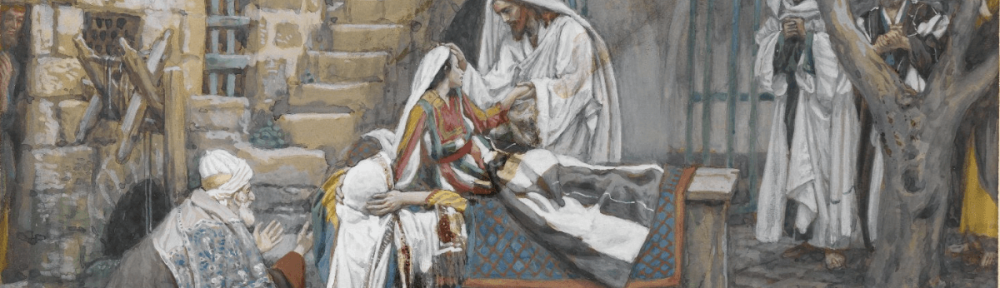
Image credit: The Daughter of Jairus (La fille de Zäire), 1886-1896 | James Tissot | Brooklyn Museum, | PD-US
Discover more from friarmusings
Subscribe to get the latest posts sent to your email.
 friarmusings