Over the previous four Sundays, the gospels have covered the “Bread of Life Discourse” from John 6. The Discourse itself reached its completion last Sunday (John 6:51-58). This Sunday we hear the reaction, not from the crowds, but from his disciples. O’Day [609] provides a keen description of how this small passage, in many ways, reflects the entire narrative structure of what came before it:
“John 6:60–71 follows the same pattern as 6:25–59: The disciples protest (6:60; cf. 6:41–42, 52), and Jesus responds. Verses 60–71 can be subdivided into two units: (1) vv. 60–65, which focus on doubt and rejection among Jesus’ disciples, and (2) vv. 66–71, which focus more narrowly on the faith response of the Twelve. The central theme of John 6:60–71 is the range of responses to Jesus among his followers: “grumbling” (v. 61), disbelief (v. 64), rejection (v. 66), confession of faith (vv. 68–69), and betrayal (vv. 64, 71). These verses form a poignant conclusion to chap. 6. In the face of Jesus’ most explicit and far-reaching offer of himself and the gift of life to those who believe, even many among his followers turn away.”
O’Day points out the central theme of vv.60-71 as she discusses the entire narrative structure. Perhaps it also good to consider the unifying theme of the entire discourse before we move to its conclusion.
Most commentators hold that the discourse, begun at the chapter’s beginning verse, comes to and end in v.58. But because of the length of “The Bread of Life Discourse,” the complex narrative, and the typical Johannine use of misunderstanding, the whole focus and intent of the discourse can be easily lost. Add to all that differing interpretations of the chapter along sacramental/non-sacramental views, denominational divides, and differences as to degree to which the synoptic gospels’ Eucharistic institution narratives form (or don’t form) the text in John – and the “big picture” can be subsumed in theological debates.
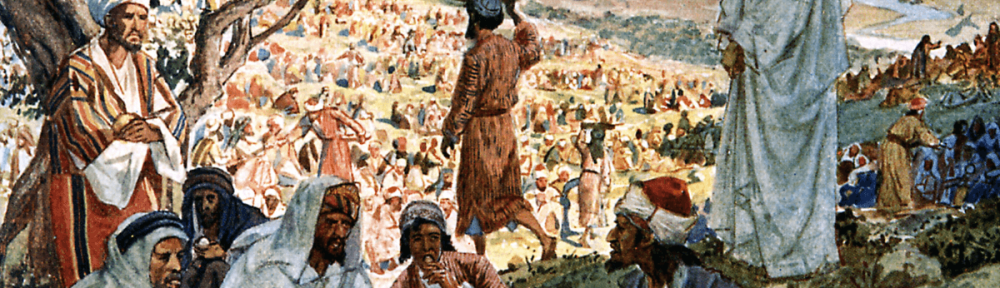
It is critical to remember that this chapter is part of the “Book of Signs” and the narrative begins with the sign of the miraculous feeding of more than 5,000 people. But as with each of the “signs” in John’s gospel, the point is not the sign, but the truth to whom the sign points. In order to fully understand “The Bread of Life Discourse” one begins with the sign (6:1-21) and listens to the discourse and dialogue (6:25-71) so that one can understand the truth signified by the sign. And, I would argue, one would do well to base the interpretive understanding as a continuous reading of a commentary upon the miracle.
The narrative has continuity throughout. The crowds who play such an important role (6:25-34) are the ones who were witnesses to the miracle of the feeding (sign); they are the ones who ate the bread and fish. They are the ones who murmur and grumble (v.41-42) and later quarrel (v.52). They are the ones who connect the reality of their experience to the reality of the events of Exodus 16 when another “bread” was given to them in their wilderness experience. They are the embodiment of “flesh and spirit.” O’Day [612] rightly points out that “Flesh and spirit belong together, and only when they are held together is life possible. On the one hand, without the Spirit, ‘the flesh is useless’ (6:63), and the miraculous feeding of the five thousand will end the same way the manna miracle ended—with the death of those who ate the bread (6:49, 59a). The miraculous feeding is only that—a miraculous feeding—without the life-giving words of Jesus (6:63, 68).”
It is Jesus’ words in the discourse that are also a gift to the crowds along with the bread. The words are the gateway for the ones who ate the bread to see and believe (6:40) and thus to have life and live forever (6:51, 58). At the same time, one must eat the bread in order to live (6:53, 58). These are part of the seamless union of flesh, spirit, humanity, and divinity that are part of the integrity of the whole of Chapter 6.
Image credit: The Feeding of the Five Thousand by William Hole (1846-1917) | Edinburgh University Library | PD-US
Discover more from friarmusings
Subscribe to get the latest posts sent to your email.
 friarmusings