This coming Sunday is the 21st Sunday in Ordinary Time. But there are some of you who do not believe.” Jesus knew from the beginning the ones who would not believe and the one who would betray him. And he said, “For this reason I have told you that no one can come to me unless it is granted him by my Father.” As a result of this, many (of) his disciples returned to their former way of life and no longer accompanied him. (John 6:64-66)
Some believe and some don’t. This is a theme woven throughout John 6 – the tension between divine initiative and human choice. Verse 65 echoes vv. 37,39, and 55 – we are drawn to Jesus via the initiating action of God. As mentioned in a previous commentary, these verses are also something that divides Christian theology. The basic question is the grace that draws one to Christ irresistible? If it is, then why do some disciples walk away (v.67). If such grace is indeed resistible, then has salvation become a human work relying too much on human free will? Some Christians resolve the question by their theology of “double predestination.” The followers of the Reformer John Calvin, in the generation following Calvin, decided that before people are born their judgment is already given – heaven or damnation – and is apart from any choices they could make in their lifetime: human will and action have no standing. Other Calvinists, principle among them Jacob Arminius, held that God provided “prevenient grace.” It is divine grace that precedes human decision. It exists prior to and without reference to anything humans may have done. As humans are corrupted by the effects of sin, prevenient grace allows persons to engage their God-given free will to choose the salvation offered by God in Jesus Christ or to reject that salvific offer [CCC §2670]. As the Catechism of the Catholic Church [CCC §1742] notes: “The grace of Christ is not in the slightest way a rival of our freedom when this freedom accords with the sense of the true and the good that God has put in the human heart. On the contrary, as Christian experience attests especially in prayer, the more docile we are to the promptings of grace, the more we grow in inner freedom and confidence during trials, such as those we face in the pressures and constraints of the outer world. By the working of grace the Holy Spirit educates us in spiritual freedom in order to make us free collaborators in his work in the Church and in the world.”
And so some disciples, in freedom and apart from the grace of God, walk away; some stay.
Some Believe – Jesus then said to the Twelve, “Do you also want to leave?” Simon Peter answered him, “Master, to whom shall we go? You have the words of eternal life. We have come to believe and are convinced that you are the Holy One of God.” (John 6:67-69)
The desertion (v.66) is the catalyst for Jesus’ question to the Twelve: “Do you also want to leave?” Again it is an encounter in which divine initiative and human choice again meet. The Twelve must choose whether to accept or reject the offer God has made to them in the person of Jesus.
Simon Peter, given the role of spokesman for the Twelve, chooses to accept what is offered in Jesus. His words in v. 68 acknowledge that he has heard and learned (cf. 6:45) from the bread of life discourse, because he knows that Jesus has “words of eternal life” (cf. 6:63; see also 6:40, 47, 51, 54, 58). This has the form of a confession of faith: “We have come to believe and are convinced.…” “Believe” (pisteuō) and “know” (ginōskō) function as synonyms here, as they do in many places in the Fourth Gospel (e.g., 10:38; 14:7; 16:30). The use of both verbs intensifies Peter’s confession. Both verbs are also in the perfect tense, indicating now and continuing.
Neal Flanagan [992] keenly observes: “The chapter concludes (vv. 66–71) with a presentation of two models. Peter is one. He takes the risk, opening himself to the Word whose revealing words give eternal life. “Master, to whom shall we go? You have the words of eternal life. We have come to believe and are convinced that you are the Holy One of God” (vv. 68–69). The other model is Judas. He will remain in the group, living a divided existence, but already moving into darkness and into the demonic power which that darkness symbolizes (13:26–30).”
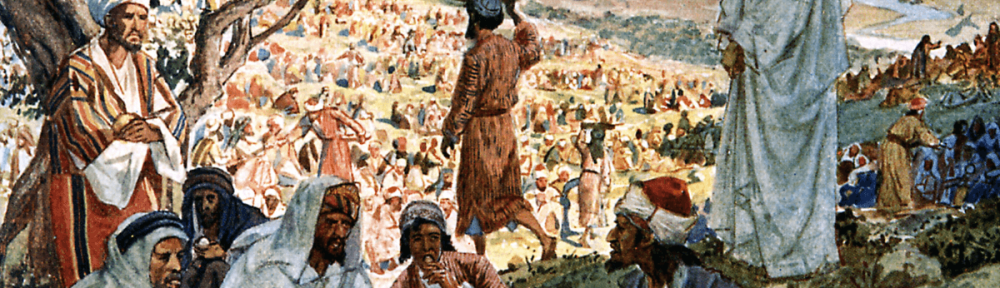
Image credit: The Feeding of the Five Thousand by William Hole (1846-1917) | Edinburgh University Library | PD-US
Discover more from friarmusings
Subscribe to get the latest posts sent to your email.
 friarmusings