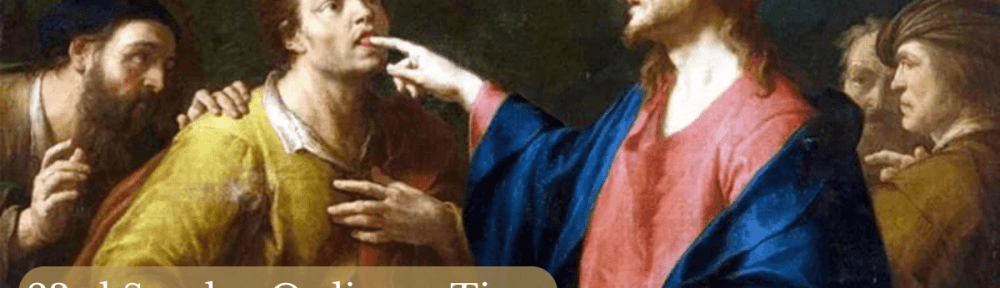
This coming Sunday we celebrate the 23rd Sunday of Ordinary Time in Lectionary Cycle B. After several weeks during which we took our Gospel readings from the Bread of Life Discourse in John, last week we returned to the Gospel of Mark. When we picked up again in the Gospel of Mark, we bypassed accounts of the death of John the Baptist, Jesus walking on the water, and the healing of the crowds in Gennesaret. Last week we picked up the story with Mark’s account of the conflict between Jesus and the Pharisees and Jerusalem scribes. Given the conflict at the end of the Bread of Life Discourse, that was probably a good segue.
The flow of the Markan gospel comes to the story of Jesus’ casting out of the demon from the Syrophoenician woman’s daughter – but that is not part of any Sunday gospel this year. Next is the cure of the deaf-mute which is our Sunday reading. This is followed by a second account of miraculous feeding of the crowds.
This is brought to your attention to make a note that sometimes there is a difference between what forms boundaries/transitions in the gospel narratives. There are the traditional and accepted chapters and numbering of verses that were introduced by a Parisian printer in the mid-16th century. There are also the later boundaries that seem to reveal themselves when the whole of the Gospel is seen with a literary viewpoint.
This section of the Gospel of Mark, described above, seems to be “bookended” by two stories of a miraculous feeding of the crowds (6:34-44 and 8:1-10). Was there an intent to use these bookends to frame all that happens in between? Do geographical references indicate boundary or transition points? Jesus and the Apostles move from Nazareth (6:1), to Bethsaida (6:45), to Gensarette (6:53), to Tyre (7:24) and then “left the district of Tyre and went by way of Sidon to the Sea of Galilee, into the district of the Decapolis.” (6:31). Perhaps they are nothing more than details of the story, but sometimes there is more to discern.
Image credit: Domenico Maggiotto (1713-1794), “Christ Healing a Deaf and Mute Man” (Public Domain)
Discover more from friarmusings
Subscribe to get the latest posts sent to your email.
 friarmusings