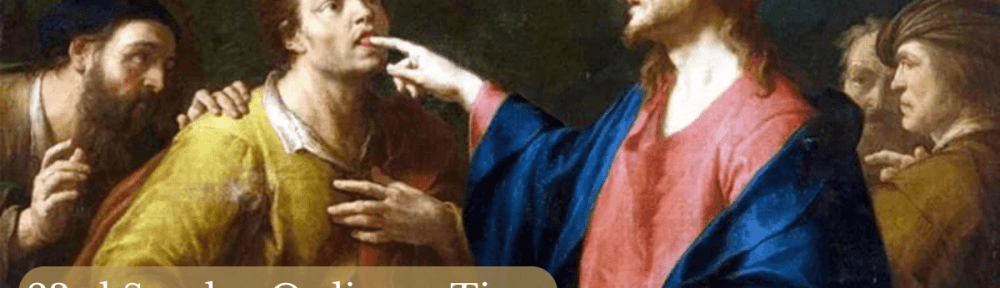
This coming Sunday we celebrate the 23rd Sunday of Ordinary Time. This section of Mark has three stories that are often treated separately, not always proclaimed as Sunday gospels, and as such the thread that connects these stories can be lost. The stories are the healing of the Syro-Phoenician woman’s child, the healing of the deaf/mute person and the restoration of sight to a blind person.
Van Linden [918] offers a succinct description of the thread and how these stories are meant to form discipleship:
The Syro-Phoenician woman who asked Jesus to heal her possessed daughter would seem to have had two counts against her from the start. Being a woman and a non-Jew, it is no wonder that she crouched at the feet of this male Jewish preacher, begging him for help (vv. 25–26)! The first-century readers of Mark’s Gospel would not be overly surprised at Jesus’ harsh-sounding refusal to give to Gentiles (the dogs) what rightfully belonged to the Jews (the children of the household). They would be surprised, though, that Jesus would allow a Gentile woman to persist in her pleading and even play off his own words to get what she wanted: “Lord, even the dogs under the table eat the children’s scraps!” (vv. 27–28). Her persistence forces Jesus to make an exception to the rule (i.e., take care of your own people first, then go to others, v. 27). He cures her possessed daughter by a word as a reward for her mother’s staying power and faith in him (v. 29).
Mark’s readers would hear in this passage several invitations to action: first, to imitate the persistence of the woman, even when things seem hopeless; second, to imitate Jesus’ “breaking the rules” on behalf of an “outsider”; and third, to examine their openness to those of other faiths, especially the Jews, the first “sons and daughters of the household.”
The story of the deaf-mute is like a gate swinging back and forth. It swings back to the story of the Syro-Phoenician woman, because the deaf-mute also comes from a non-Jewish part of Palestine (v. 31). It swings forward to the next chapter, to the story of the blind man (8:22–26), which closely parallels this cure. Both the deaf-mute and the blind man are brought to Jesus by others (v. 32; 8:22). Both times Jesus takes the men away from the crowd (v. 33; 8:23) and touches them, using spittle to heal them (vv. 33–35 and 8:23, 25).
These obvious parallels make it clear that Mark wants the two cures to be read side by side. In this way, Mark’s readers will hardly be able to miss that Jesus is the Messiah promised by Isaiah long before when he said: “Then will the eyes of the blind be opened, the ears of the deaf be cleared” (Isa 35:5–6; see Mark 7:37). However, with the final parallel element in the two stories (Jesus’ request for secrecy in 7:37 and 8:26), Mark asks his readers to remember another Isaian passage that Jesus has fulfilled by his life and life-giving death: “Who would believe what we have heard? … He was spurned and avoided by all, a man of suffering, accustomed to infirmity. … pierced for our offenses, crushed for our sins. Upon him was the chastisement that makes us whole, by his stripes we were healed” (Isa 53:1–5).
Jesus, for Mark, was the perfect fulfillment of all Isaiah’s prophecies.
Image credit: Domenico Maggiotto (1713-1794), “Christ Healing a Deaf and Mute Man” (Public Domain)
Discover more from friarmusings
Subscribe to get the latest posts sent to your email.
 friarmusings