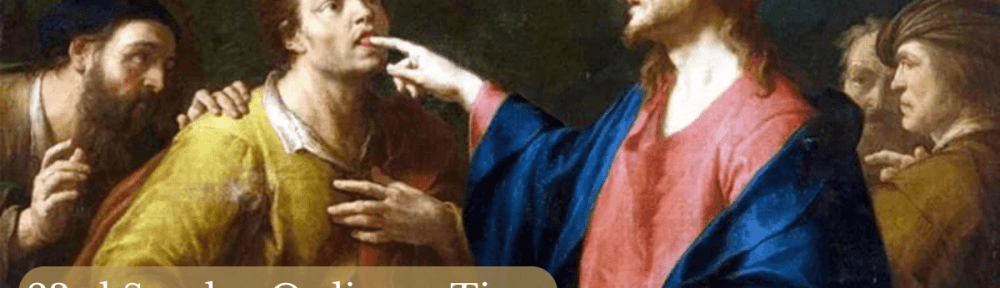
This coming Sunday we celebrate the 23rd Sunday of Ordinary Time. The language and the story support the conclusion that at one time the man was hearing-enabled and used a working vocabulary. Had he been deaf from the beginning there would not have been a post-healing note: “he spoke plainly.” Which perhaps makes his situation even more poignant, one which calls out to our compassion. We can each imagine having hearing and communication taken away from us, severing the social fabric of our lives. We all know some people that are gifted and have “ a way with words.” Pheme Perkins [613] shares some final thoughts on hearing and speech.
Hearing and speech have a symbolic role to play in Mark’s narrative. The Syrophoenician woman was so skilled in speech that Jesus healed her daughter. Jesus’ disciples, on the other hand, have shown increasing difficulty in understanding what Jesus is telling them. They clearly need some form of healing that will enable them to truly hear—that is, to understand.
Understanding, on the other hand, can be expressed to others only if we speak. Young children learn how the world around them works, whether that is the physical world or the world of human interactions, by repeating everything they hear. Schoolteachers once required that pupils recite their lessons. Now that such training has become rare, college and graduate students often fail to understand what they read, and trying to explain it without using the words of the source material creates havoc. It is fair to say that unless people can tell others what they know, they do not really know it. Believers need to recognize the need to speak about their experience of salvation. They speak to others in testimony and to God in thanksgiving and praise.
Image credit: Domenico Maggiotto (1713-1794), “Christ Healing a Deaf and Mute Man” (Public Domain)
Discover more from friarmusings
Subscribe to get the latest posts sent to your email.
 friarmusings