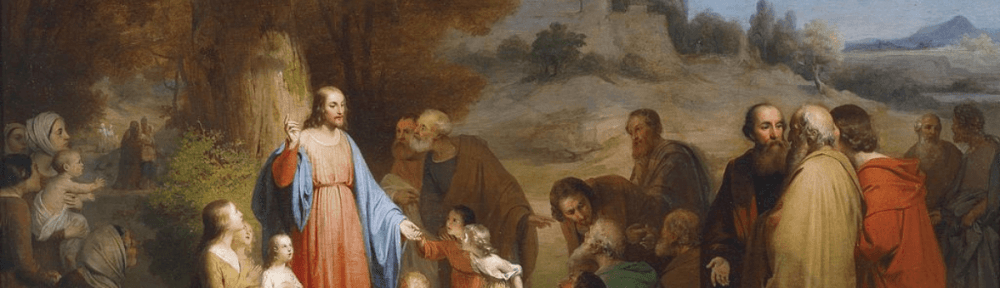
35 Then he sat down, called the Twelve, and said to them, “If anyone wishes to be first, he shall be the last of all and the servant of all.” 36 Taking a child he placed it in their midst, and putting his arms around it he said to them, 37 “Whoever receives one child such as this in my name, receives me; and whoever receives me, receives not me but the one who sent me.”
This coming Sunday is the 25th Sunday in Ordinary Time. The conversation in Capernaum is no longer addressed to “disciples” but to “the Twelve.”
In the gospel of Mark, the Twelve (hoi dōdeka) are a group of disciples chosen by Jesus to be his special companions (Mark 3:14; 4:10; 11:11; 14:17). They were particularly instructed by Jesus (Mark 9:35; 10:32) and were sent by him to proclaim the coming of the kingdom and to cast out demons (Mark 3:14, 16; 6:7). While we naturally add the phrase “Apostles” to the text, the emphasis is not on the 12 people in charge after the Resurrection, but rather the restoration of Israel as the people of God. The number was symbolic of the twelve tribes of Israel (cf. Matt 19:28; Luke 22:30; Rev 21:12–14) and pointed to the eschatological nature of Jesus’ mission. [AYBD 670] We can see this clearly in the Matthean account: 27 Then Peter said to him in reply, “We have given up everything and followed you. What will there be for us?” 28 Jesus said to them, “Amen, I say to you that you who have followed me, in the new age, when the Son of Man is seated on his throne of glory, will yourselves sit on twelve thrones, judging the twelve tribes of Israel.” (Matthew 19:27–28)
Those closest to Jesus do not understand and so they must be again taught. The phrase “Then he sat down” shows Jesus taking the formal position of the teacher. The content of his teaching is directed at the content of the discussion among the Twelve and their presumption that human convention will suit the working of the Kingdom. Jesus intends to overturn those presumptions with two short, vivid lessons:
- Greatness does not consist of who is first served, but rather in self-sacrificing service to all, and
- Greatness consists of seeing with the eyes of God – being able to see the dignity and worth in a child, someone convention held to be a non-person.
Image credit: “Lasset die Kindlein zu mir kommen” (Let the little children come to me) | Anonymous | 1841 | Dorotheum | PD-US Public Domain
Discover more from friarmusings
Subscribe to get the latest posts sent to your email.
 friarmusings