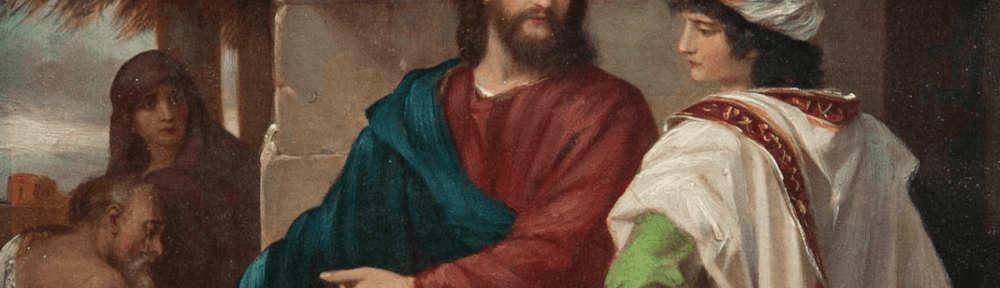
A man comes to Jesus seeking answers. The man knows that whatever his appearance on the outside, whatever his faithful and pious life, he’s missing something, something important, something that matters, something that’s a matter of life and death. The man instinctively knows this but is unable to put his finger on it. So he comes to Jesus and asks: “Good teacher, what must I do to inherit eternal life?”
Now, there’s a good question! What’s a good answer? I think Jesus’ answer to the question ‘what is the greatest commandment” would be an amazing response: to love God with all your heart, your mind, your life and to love your neighbor as yourself.
When I think of this scene from the gospel, I imagine the man asked the question and then there are moments of pause and extended silence with Jesus waiting, hopeful that the man might provide some answer, something he had been pondering. But the silence continues until Jesus decides to give a “hint” by introducing the Commandments, hopeful that the man who would be inspired to respond with the great prayer of the ’Shema, to love God with all your being. Instead the man simply responds to the listed commandments saying that he has done those things. Jesus, looking at him, loved him and said to him, “You are lacking in one thing. Go, sell what you have, and give to (the) poor and you will have treasure in heaven; then come, follow me.”
Not the answer the man was looking for. At that statement his face fell, and he went away sad, for he had many possessions
And, Ouch… I can imagine the man walking away and thinking, “what kind of answer was that?”
Of course maybe that, in some measure, is our response also. Over the many years of leading Bible studies, this passage always raises some form of the question, “OK…. so, is Jesus really saying? I mean, seriously, is Jesus telling us to give away everything and follow him. It has to be a hyperbole, right?” There is a beginning premise that Jesus can’t possibly be literal. “How hard it is for those who have wealth to enter the kingdom of God!” … It is easier for a camel to pass through the eye of a needle than for one who is rich to enter the kingdom of God.” What if wealth really is an obstacle to eternal life? What if God is truly calling us to give up everything we own? What if Mother Teresa and St. Francis had it right all along? Where does that leave the rest of us? It leaves us shuffling and looking for a loophole – like these:
- The historical loophole: the passage refers to the night gate in the east Jerusalem wall. It was really small and so only if you unloaded the camel down to a smaller load could it fit through the gate. You just had to downsize or right size. Ok, fine… there is no evidence the gate ever existed… but I like this bit of historical fiction.
- The linguistic loophole: did you know that the word for camel and rope are just one letter difference. Maybe the scribe messed up and the verse was supposed to be its’ easier for a rope to pass thru a needle’s eye. So… if you had a small rope and large needle… just saying.
- The water-it-down loophole: It is not really about wealth it is about priorities. After all, without rich Christians we don’t pay the staff and keep the lights on. We just need to remind folks about priorities. No me, mind you… the rich people… their priorities…and lastly there is….
- The no-need loophole. Just ignore the whole thing because I’m not rich.
You know what the problem is with all of this loophole hunting? It can make us miss the most important line in the whole passage: Jesus, looking at him, loved him. Wow! Let me put this in perspective. Does the Bible ever say Jesus loved Mary, his mother? We don’t doubt Jesus did, but the fact remains, Scripture does not record the words. But for this man, the words are clear and powerful: Jesus…loved him.
Love him and answer his question, holding up for the man the one thing missing, the one thing blocking the way to eternal life: his wealth. In effect Jesus is saying, “You know the great commandments: Love God, love your neighbor, love yourself – but your energy is centered on your wealth. Give it up so you can love. Return the love freely given. Let go of what holds you back from loving.”
How about us? What is the one thing we are lacking? What is the one thing that keeps you from loving God, from loving deeply and unabashedly? Is it wealth? Is it time? Is it the need to be in control? Is it a history of disappointment? Is it a story of a broken heart? What is the one thing we are lacking that keeps us from love and from love’s demands?
Today we too kneel before Jesus in the Mass and in the Eucharist. “Lord, what must we do to inherit eternal life?” Jesus responds, “OK, let’s review yesterday. I am sure you did many things. But I only have three questions for you. How did you love me? How did you love those whom I love? How did you love yourself?”
Maybe that will be our moment parallel to the man in the Gospel. The great silence, as we consider our possible answers. If we can answer those questions, then our yesterday is fine – we need not bother with the loophole searching – just work on today by continuing to love. If the question gives us pause – don’t bother with loophole searching – but rejoice because Jesus is looking at you, loving you. Today is a new day. Return the love. This is what we must do to inherit eternal life.
Loopholes or love – it’s your choice.
Image credit: Heinrich Hofmann | 1888 | Christ and the Rich Young Ruler | Brigham Young University Museum of Art | PD-US
Discover more from friarmusings
Subscribe to get the latest posts sent to your email.
 friarmusings
“How did you love me? How did you love those whom I love?” Tough questions, but may we have the appropriate answers. May all of us be able to share that love freely to all we encounter, especially those who desperately need it!