45 For the Son of Man did not come to be served but to serve and to give his life as a ransom for many.” As a follow on to Pheme Perkin’s discussion about ransom (lytron) and its meaning as the price paid to free a slave, Matt Skinner offers additional insight:
Jesus’ mention of a “ransom” indicates that his death will be more than just an inspiring example or a martyr’s tragic protest against an unjust system. The word in question (in Greek, lytron) indicates that his death does something; it secures a release. This verse often sparks lively debates, and it has a history of, in my opinion, being misunderstood by those who take the notion of a “ransom” to mean a specific type of payment. In those readings, Jesus’ death is transactional, a payment made to satisfy the penalties accrued by human sin or to repay something owed to God.
However, the explicit context in which this statement appears is about power and servitude, not the problem of sin or the need to secure forgiveness. Furthermore, the Old Testament (Septuagint) usage of lytron and its cognates, while sometimes referring to a redemption or purchased freedom, just as frequently refers to God’s acting to deliver people. A lytron is a liberation wrought by divine strength, not by payment (see examples of lytron cognates in Exodus 6:6; Deuteronomy 15:15; 2 Samuel 7:23; Psalm 69:18; Isaiah 43:14).
Jesus therefore declares (without stopping to clarify precisely how) that God, through Jesus’ death, will free people from oppression and captivity to another power, restoring them to membership in the community that corresponds to God’s reign.
Certainly, the word can carry and sustain both meanings: payment and release. The implication is like an unshackling of the bonds that make one subservient to one power. One is released to … .to what? In the case of slavery or indentured servitude, the person is released into the world and allure of freedom. A world where there are a new set of rules, standards and expectations of conduct, and responsibilities. A world the person has never navigated.
But what about those of us who are born into the Christian faith? We have been ransomed – from what? The bonds of sin? In the Christian view we’d respond, “Original Sin and the power of Sin.” Of course, the power of sin still seems awfully tempting. Which I think is part of what Skinner is pointing out: you have been released from one power, to embrace a saving and life-giving power. But have we?
It is the difference between redemption and salvation. The price has been paid, the shackles released, and the way shown to the saving and life-giving power, but there is nothing that says that is the road we have to walk.
As mentioned several days ago, our gospel passage includes the third prediction of the Passion – and notes that it is given “on the way (hodos).” Next week’s gospel is the account of the encounter with Blind Bartimaeus who is “by the roadside (hodos)” (v. 46), and who, once cured as a seeing man, will follow Jesus “on the way (hodos)” (v. 52). The use of this word as “bookends” suggests that the disciples between these words are just as blind as Bartimaeus and they are not “on the way” with Jesus, but only on the sidelines. The “Way” points to the ultimate end of Jesus’ earthly life – Golgotha and the cross. Paradoxically, while James and John ask for glory, it is on the cross that the fullness of God’s glory will be revealed.
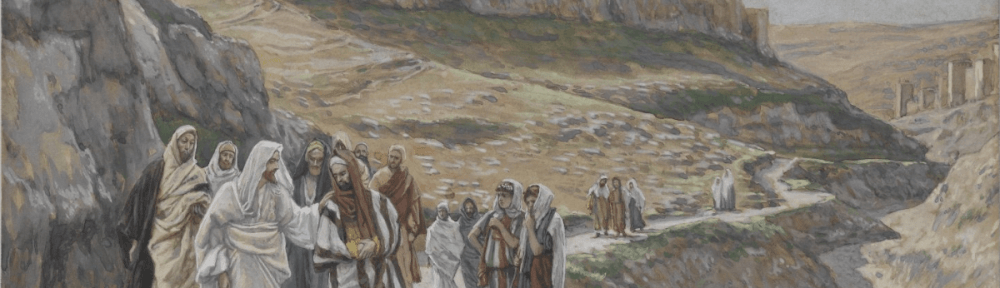
Image credit: Jesus Discoursing with his disciples | James Tissot | Brooklyn Museum | PD-US
Discover more from friarmusings
Subscribe to get the latest posts sent to your email.
 friarmusings