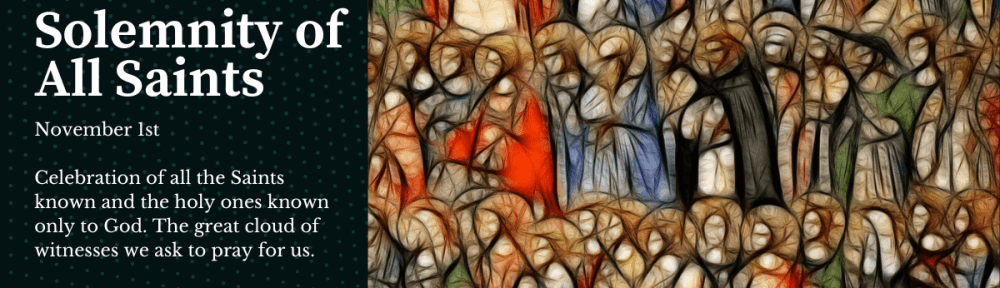
“After this I had a vision of a great multitude, which no one could count, from every nation, race, people, and tongue. They stood before the throne and before the Lamb, wearing white robes and holding palm branches in their hands.” (Rev 7:9).
In her short story “Revelation,” Flannery O’Connor tells of Mrs. Turpin, an upright if not self-righteous woman. The story opens in the waiting room of a doctor’s office, where the smug Mrs. Turpin is chatting amiably with a stranger to pass the time. The stranger’s homely, surly daughter Mary Grace sits nearby reading a book.
Mrs. Turpin feels a tremendous degree of self-satisfaction regarding her own position in the world. Her caste classifications boil down to race and ownership of land. Since she and her husband Claude are white, own a house and a little land to raise pigs on, she considers herself obviously superior to people who own only a house. She considers herself superior to any blacks, regardless of how much property they own. But she cannot figure out what to do with people who have a lot of money but are common, or with people who have “good blood” but have lost their money and have to rent. The paradox eludes her and she comfortably settles that there is nobody who is in any way superior to herself.
Inevitably Mrs. Turpin’s reflections break out into speech; she says feelingly, “If it’s one thing I am, it’s grateful. When I think who all I could have been besides myself and what all I got, I just feel like shouting, ‘Thank you, Jesus, for making everything the way it is!’ It could have been different!… Oh thank you, Jesus, thank you!”
At that moment Mary Grace apparently cannot stand this self-congratulatory blather any longer, and hurls her book at Mrs. Turpin, hitting her in the eye. Mary Grace then lurches across the waiting room, clamps her fingers around Mrs. Turpin’s neck and begins to choke her. Mary Grace is subdued by others, but falls into some kind of fit. Mrs. Turpin leans over her and “the girl’s eyes [stop] rolling.” At this point Mrs. Turpin asks her, “What have you got to say to me?”
This may seem like an extremely peculiar question to ask someone having a seizure, but Mrs. Turpin is simply unable to see that the girl is ill – she is able to see only that the girl has affronted her, and thus Mrs. Turpin seeks an apology. Or perhaps Mrs. Turpin believes Mary Grace has been slayed in the Spirit and is thus about to utter the Word of God for the blessed Mrs. Turpin. She is waiting for her “Revelation.” The revelation – if that is what it is – is, as all O’Connor’s revelations are, shocking. “Go back to hell where you came from, you old wart hog!” says Mary Grace.
That evening, as Mrs. Turpin watches the sunset at the edge of her hog pen, she has a vision of a “vast swinging bridge extending upward from the earth through a field of living fire. Upon it a vast horde of souls were rumbling toward heaven.” This is the “Revelation” for Mrs. Turpin.
Mrs. Turpin sees a whole parade of the most unexpected and motley people all clapping and leaping and shouting hallelujah. In her vision there was “a tribe of people whom she recognized at once as those who, like herself and Claude, had always had a little of everything and the God-given wit to use it right” – but they were bringing up the rear of the queue. They are saved, yes, but no more saved than anybody else.
Today’s feast, in like manner, celebrates the whole company of saints, including all those not recognized by name in the church calendar, all those who are part of the great multitude that now leaps for joy eternally in God’s presence, shouting hallelujah!
The author of the Book of Revelation describes a vision not too different from Mrs. Turpin’s: those of every nation, race, people and tongue are there, purified and robed in white, waving palm branches in gestures of thanks and victory, crying out exuberantly, acclaiming the salvation that comes from God. There are so many they cannot be counted. All have the protective divine seal emblazoned on their foreheads, marked as God’s own beloved possession.
At the end of the reading from Revelation this question is posed: Who are these wearing white robes and where did they come from? The second reading and the gospel answer in part: These are all the beloved children of God, whose family likeness to the Holy One is now revealed. They are the ones who have been poor in spirit, have mourned without comfort, have longed for their inheritance with meekness, have hungered and thirsted unsated for justice, have been merciful and clean of heart, have tried to build peace and have suffered for all these choices. Their striving to live this way in imitation of Jesus has not always been perfect. They have stumbled and erred but have asked forgiveness and have tried again. They are the ones whom others may never have thought of as saints but who have placed their trust and hope in God, knowing that only by God’s grace can they be washed clean and clothed in radiance. Many people, not only people like Mrs. Turpin, may be surprised to find themselves among this heavenly multitude.
Today’s feast assures us of a place within this great heavenly chorus when we accept the grace of being sealed as God’s own and then choose to live in accord with that grace. It also reminds us that none of us is an “only child.” We belong to an immense family, a great cloud of witnesses, who constantly surround us and are in communion with us, praying for us and with us, urging us onward toward our final reunion with God and with them.
Source
- Flannery O’Connor, “Revelation” in The Complete Stories of Flannery O’Connor (The Noonday Press, 1994)
Discover more from friarmusings
Subscribe to get the latest posts sent to your email.
 friarmusings