This coming Sunday is the 33rd Sunday in Ordinary Time. All week we have delved into the Olivet Discourse from the Gospel of Mark. It is a very apocalyptic reading, filled with symbols and signs, laced with uncertainty of “when and where,” but ever a message of hope.
Pheme Perkins [694] offers a final thought
“On the one hand, Mark underscores the certainty of Jesus’ word. Readers know that the death of Jesus on the cross does not end the story of salvation. On the other hand, Christians need not concern themselves with apocalyptic speculation. Disciples should remember that ‘doing the will of God’ (3:35) has no relationship to the timing of divine judgment. Neither should Christians concern themselves with the fate of those who persecute them or who reject the gospel. When Christians rush to judge others, they should remember this exhortation. The only question the master will ask is whether the servants have been faithful to their call as disciples.
“Living some two millennia after these words were spoken, many Christians today assume that the word about watchfulness has no significance for them. Yet we all know that human life is fleeting. A young man was murdered on the streets of a large city merely for asking some youths why they were verbally tormenting an elderly man. The young man’s fiancée discovers that her whole world has dissolved. Fortunately, the last words they had exchanged concerned love and their hopes for the future. A young woman went to pick up her infant from his nap and discovered that he had died of Sudden Infant Death Syndrome. Unfortunately, her last interaction with the baby had been one of anger and frustration over the child’s fussing and crying. Both women are in terrible pain. They have been stripped of what they love most in the whole world. But the young mother has to face the nagging regret that she did not show her baby the love she feels for him in the last hours she spent with him. On a personal level, such stories remind us that we should be watchful as Christians. The early religious orders practiced a time of examining one’s conscience, in which all members assessed how their behavior of the day just past reflected (or neglected) the conduct expected of members of their order. Being a faithful Christian does not just ‘happen’ like crabgrass or dandelions popping up in the lawn. It requires the care, attention, and cultivation of an expert gardener.”
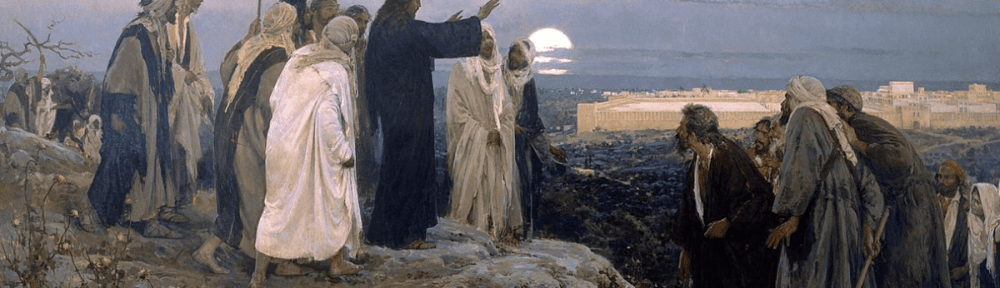
Image credit: Flevit super illam (He wept over it) | Enrique Simonet, 1892 | Museo del Prado, Madrid | PD-US
Discover more from friarmusings
Subscribe to get the latest posts sent to your email.
 friarmusings