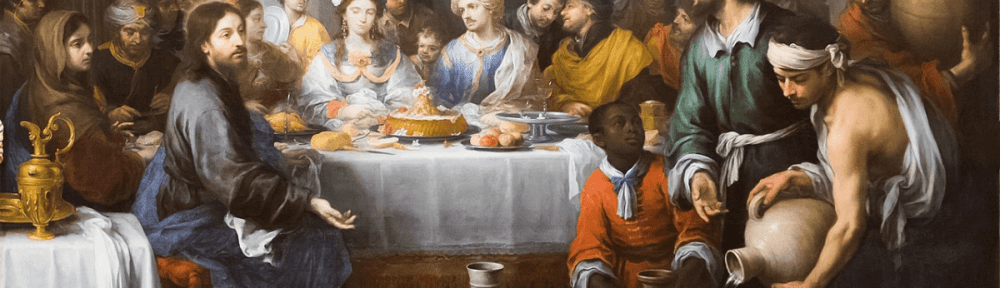
Even though we are in Year C of the liturgical cycle, the first gospel proclaimed in Year C-Ordinary Time is taken from the Gospel according to John – the wedding at Cana. In many ways it is considered a type of “proto” ministry before the very public beginning at the synagogue in Capernaum. In the ancient lectionaries of the church, John 2:1–11 was read on Epiphany, a practice carried over into the Eastern church. In the modern Common and Catholic lectionaries, this text is read at the beginning of the season following Epiphany. In Catholic circles this is labeled “Ordinary Time.” In the Common Lectionary the celebration appears as the “Second Sunday After Epiphany.”
The series of gospel selections from this Sunday into the Season of Lent are, in a way, like the Epiphany in that they reveal more and more about the person of Jesus of Nazareth, ever presenting more witness that this is the promised Messiah. The recounting of the transformation of water into wine is noteworthy at the head of the sequence of readings, because it tells the story of the unprecedented grace of Jesus, it reveals the glory of Jesus, and anticipates his ultimate moment of glorification, his death, resurrection, and ascension. So far, this addresses the liturgical placements of the reading.
With regards to the context in the Gospel of John, the account of the “Wedding at Cana” is placed immediately after the Prologue of the Gospel. The Prologue, “In the beginning…,” presents many of the major themes and motifs which reappear later in the gospel. The Prologue proclaims Jesus as the preexistent and incarnate Word of God through whom all things were created (1:3,10), who “made his dwelling among us,” (v.14), and who has revealed the Father to us. The rest of the first chapter forms the introduction to the gospel proper and consists of the Baptist’s testimony about Jesus (there is no baptism of Jesus in this gospel—John simply points him out as the Lamb of God), followed by stories of the call of the first disciples, in which various titles said of Jesus in the early church are presented.The Gospel according to John is a highly symbolic writing. A good monographic overview of the Gospel is available on the US Catholic Bishops website – and is well worth the time to review. However, let us also review one of the key elements of John’s gospel: signs.
The larger Johannine gospel narrative contains a series of “signs” (semeion) the gospel’s word for the miraculous deeds of Jesus. The writer is primarily interested in the significance of these deeds, and so interprets them for the reader by various reflections, narratives, and discourses. The first sign of seven is the transformation of water into wine at Cana (2:1–11); this represents the fulfillment of the Jewish ceremonial washings and symbolizes the entire creative and transforming work of Jesus. The second sign, the cure of the royal official’s son (4:46–54) simply by the word of Jesus at a distance, signifies the power of Jesus’ life-giving word. The third sign, the cure of the paralytic at the pool with five porticoes in chap. 5, continues the theme of water offering newness of life. In the preceding chapter, to the woman at the well in Samaria Jesus had offered living water springing up to eternal life, a symbol of the revelation that Jesus brings; here Jesus’ life-giving word replaces the water of the pool that failed to bring life. John 6 contains two signs, the multiplication of loaves and the walking on the waters of the Sea of Galilee. These signs are connected much as the manna and the crossing of the Red Sea are in the Passover narrative and symbolize a new exodus. The multiplication of the loaves is interpreted for the reader by the discourse that follows, where the bread of life is used first as a figure for the revelation of God in Jesus and then for the Eucharist. After a series of dialogues reflecting Jesus’ debates with the Jewish authorities at the Feast of Tabernacles in John 7 and 8, the sixth sign is presented in John 9, the sign of the young man born blind. This is a narrative illustration of the theme of conflict in the preceding two chapters; it proclaims the triumph of light over darkness, as Jesus is presented as the Light of the world. This is interpreted by a narrative of controversy between the Pharisees and the young man who had been given his sight by Jesus, ending with a discussion of spiritual blindness and spelling out the symbolic meaning of the cure. And finally, the seventh sign, the raising of Lazarus in chap. 11, is the climax of signs. Lazarus is presented as a token of the real life that Jesus, the Resurrection and the Life, who will now ironically be put to death because of his gift of life to Lazarus, will give to all who believe in him once he has been raised from the dead. [Catholic Study Bible – Reading Guide, 439]
Image credit: The Marriage Feast at Cana | Bartolomé Estebán Murillo, 1672 | The Barber Institute of Fine Art | PD-US | Photograph by DeFacto – Wiki Commons | CC-SA-4.0
Discover more from friarmusings
Subscribe to get the latest posts sent to your email.
 friarmusings