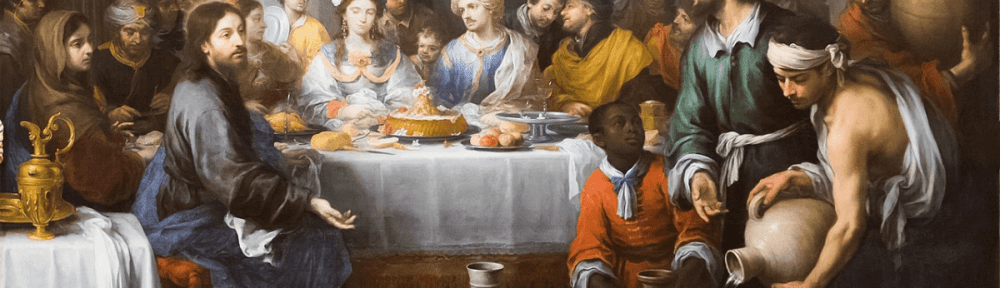
This coming Sunday is the 2nd Sunday of Ordinary Time in Lectionary Cycle C. In the previous post we noted that while Cycle C’s primary gospel is Luke, this reading is from the Gospel of John. Many scholars have noted that repeats the theme of Creation as he begins the narrative of the Gospel. Where the synoptic gospels focus on the events at the beginning of Jesus’ public life, John seems to assume that the reader is familiar with those accounts and calls our attention to the ways in which people respond in faith to him – yet, at the same time, unlike the other gospel writers, places the beginning events on a timeline.
The beginning is the testimony of John the Baptist (v.15) On the “next day” (John 1:29), the Baptist testifies to the more powerful, promised baptism of the Son of God. The Baptist has heralded the Anointed One, now he reveals the him to the world. The first response in faith comes on the “next day” (John 1:34) where John the Baptist continues his testimony (maryteria) to the Son of God. Upon seeing Jesus, the Baptist exclaims, “Behold, the Lamb of God!” Upon hearing this, two of the Baptist’s disciples (Andrew and John) are moved by grace to approach Jesus. The “next day” (v.43), Philip and Nathanael are added as disciples. “On the third day…” [following and after the 4rh day]] (John 2:1) we find ourselves, according to the Johannine imagery, on the seventh day at the wedding in Cana. It is believed that John is outlining a new “creation week” when on that 7th day this new creation week reaches its climax – the unveiling of the public life of the Anointed One of God.
Gail O’Day (John, The New Interpreter’s Bible, 535) neatly provides an overview of the larger context in the section following the Prologue and this “new creation” and possibility of new life:
John 2:1-5:47 is the first realization of the “greater things” promised by Jesus (1:51). The events of this unit – the two “signs” (2:1-11; 4:46-54), the cleansing of the Temple (2:13-22), Jesus’ conversations with Nicodemus (3:1-21) and the Samaritan woman (4:4-42), the renewed witness of John (3:22-36), the healing of the man beside the pool (5:1-9) — all demonstrate the authority of Jesus’ words and works. Jews and non-Jews, men and women all see and hear the “greater things” Jesus says and does. These chapters contain the full spectrum of responses to Jesus, from the faith of the disciples (2:11) to Jesus’ rejection by the Jews (5:16-18). These chapters establish the central themes and tensions of the entire Gospel: the possibilities of new life and faith made available through the words and works of Jesus, and the decisions individuals are called to in the face of those possibilities.
Image credit: The Marriage Feast at Cana | Bartolomé Estebán Murillo, 1672 | The Barber Institute of Fine Art | PD-US | Photograph by DeFacto – Wiki Commons | CC-SA-4.0
Discover more from friarmusings
Subscribe to get the latest posts sent to your email.
 friarmusings