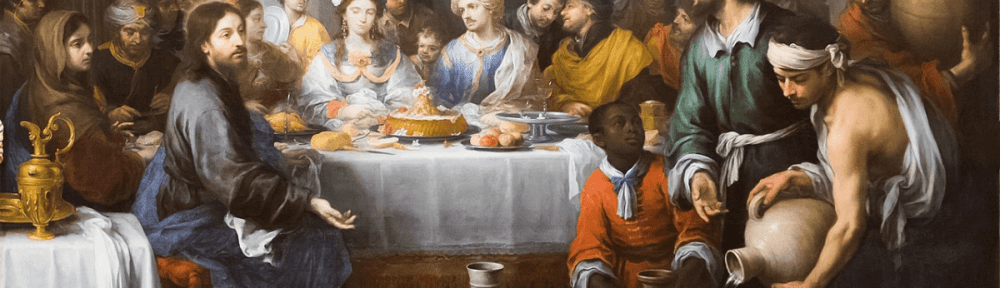
This coming Sunday is the 2nd Sunday of Ordinary Time. Our information about the details of marriage ceremonies (as distinct from marriage regulations) in first-century Judaism is very sketchy. There are later references and details about weddings, and so if one assumes the customs did not change a great deal, then perhaps we know more.
We know that marriage was preceded by a betrothal that was much more binding than our modern-day engagement. It included a solemn pledging of the couple, each to the other, and was so binding that to break it divorce proceedings were necessary. At the conclusion of the betrothal period the ceremony began with the bridegroom and his friends making their way in procession to the bride’s home. This was often done at night, when there could be a torchlight procession (such seems to be the case with the “Wise and Foolish Virgins” account.) Undoubtedly there were speeches and expressions of goodwill before the bride and groom went in procession to the groom’s house, where the wedding banquet was held. It can be assumed that there was a religious ceremony, but we actually have no details. The processions and the feast are the principal items of which we have knowledge. The feast was prolonged, and might last as long as a week (cf. Judg. 14:12).
Wedding and Wine Imagery in Scripture. The image of a gamos = “wedding [banquet]” is used in synoptic gospel parables, as Stoffregen points out:
- “The kingdom of heaven may be compared to a king who gave a wedding banquet for his son” (Mt 22:2-12)
- The kingdom of heaven will be like this….while the ten maidens went to buy more oil, the bridegroom came, and those who were ready went with him into the wedding banquet; and the door was shut (Mt 25:10)
- “be like those who are waiting for their master to return from the wedding banquet” (Lk 12:36)
- “When you are invited by someone to a wedding banquet,… (Lk 14:8).
- In Revelation we have the image of the “marriage [supper]” of the Lamb (19:7, 9).
Also from Stoffregen, “Wine was very important. It was the normal beverage at meals — and especially at festivals. Wine was a symbol of joy. One ancient rabbi stated, ‘Without wine there is no joy.’ At the same time, drunkenness was a great disgrace throughout scriptures. I don’t believe that Jesus intended all the guests to drink up all the wine that night. There was enough wine to satisfy a large number of guests throughout the rest of the wedding feast week.”
“Although the Greek word oinos is not used in any of the eucharist accounts — they all use ‘cup’ and the synoptics also use the phrase ‘fruit of the vine’ — the Cana miracle and the multiplication of the loaves early in church history became symbols for the bread and wine of the eucharist.”
“In the OT, an abundance of good wine is an eschatological symbol, a sign of the joyous arrival of God’s new age: On this mountain the LORD of hosts will make for all peoples a feast of rich food, a feast of well-aged wines, (Is 25:6a); The mountains shall drip sweet wine, and all the hills shall flow with it (Amos 9:13cd); In that day the mountains shall drip sweet wine, the hills shall flow with milk (Joel 3:18a)”
Image credit: The Marriage Feast at Cana | Bartolomé Estebán Murillo, 1672 | The Barber Institute of Fine Art | PD-US | Photograph by DeFacto – Wiki Commons | CC-SA-4.0
Discover more from friarmusings
Subscribe to get the latest posts sent to your email.
 friarmusings