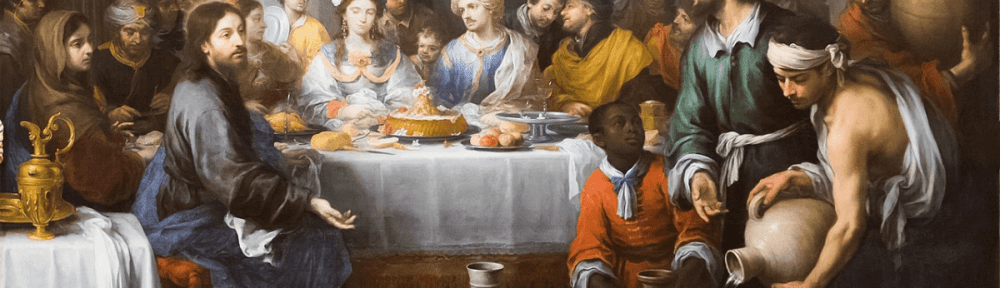
This coming Sunday is the 2nd Sunday of Ordinary Time. 4 (And) Jesus said to her, “Woman, how does your concern affect me? My hour has not yet come.” 5 His mother said to the servers, “Do whatever he tells you.”
Jesus’ mother asks nothing explicit of him in v. 3, but his response in v. 4 makes clear that her words carried an implied request. Jesus’ mother assumed her son would somehow attend to the problem. Why Mary would make such a request is the stuff of speculation. The suggestions range from her desire to save the groom embarrassment, forestalling a legal liability (see notes on v.3), her awareness of Jesus’ larger role, or any host of reasons.
It seems safe to say, Mary’s motivation is not a concern of John the gospel writer. His concern is Jesus, his salvific role, and the meaning of the miraculous sign that occurred.To our modern ear, Jesus’ response seems a bit “cold.” The literal translation seems less so: “Woman, what concern that to you and to me?” Jesus will often use the address “Woman” in speaking to women (e.g., Mt 15:28, Luke 22:57, John 4:21), although addressing one’s mother in the same way is unusual. As many have noted, it does create a distance between Jesus and his mother, downplaying the family relationship. The same separation and disengagement is present in the literal “what concern that to you and to me?” Gail O’Day [537] points out:
The reference to Jesus’ hour in v. 4b explains why Jesus adopts a posture of disengagement toward his mother. While “hour” (ὥρα hōra) is used in the Fourth Gospel to indicate the passing of time (e.g., 1:39), it also is used metaphorically to refer to the time of eschatological fulfillment (e.g., 4:21, 23; 5:25, 28) and, most characteristically, to refer to the hour of Jesus’ glorification—i.e., his death, resurrection, and ascension (see 7:30; 8:20; 12:23; 13:1; 17:1). Jesus’ reference to his hour thus establishes a link between what Jesus does during his ministry and his glorification. Mary’s concerns (v. 3) must be placed in the larger context of Jesus’ death and resurrection. Verse 4 thus points the reader beyond this particular story to a broader theological context by asserting Jesus’ freedom from all human control. Not even his mother has a privileged claim on him. Jesus’ actions will be governed by the hour set by God, not by anyone else’s time or will. Verse 4 also points beyond the immediate context by alluding to Jesus’ passion. Any act of self-revelation by Jesus during his ministry is of a piece with Jesus’ self-revelation at his “hour.”
All that being said, Mary is still his mother. Apparently she did not take Jesus’ words as harsh and perhaps understands that their relationship is changing because of a larger purpose. But she also understands that Jesus was not aware of the problem of the wine. She simply turns to the servers and tells them “Do whatever he tells you.” These are the last words Mary speaks in this Gospel. They are excellent advice for anyone who would call themselves disciples.
Image credit: The Marriage Feast at Cana | Bartolomé Estebán Murillo, 1672 | The Barber Institute of Fine Art | PD-US | Photograph by DeFacto – Wiki Commons | CC-SA-4.0
Discover more from friarmusings
Subscribe to get the latest posts sent to your email.
 friarmusings