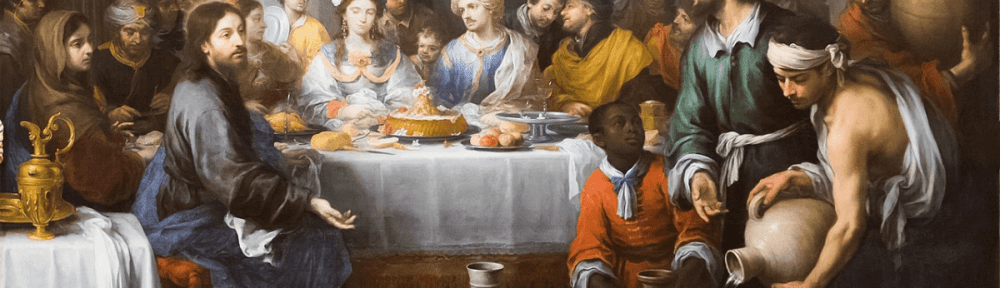
This coming Sunday is the 2nd Sunday of Ordinary Time. 6 Now there were six stone water jars there for Jewish ceremonial washings, each holding twenty to thirty gallons. 7 Jesus told them, “Fill the jars with water.” So they filled them to the brim.
The gospel provides an interesting amount of detail: the number of jars, their composition, purpose and size. The half dozen represented a good store of water for carrying out the kind of purification of which we read in Mark 7:1–4. Before the meal servants would have poured water over the hands of every guest. “Stone jars, in contrast to earthen jars, are free from the possibility of levitical impurity (Lev 11:33). The ‘rites of Jewish purification’ probably refers to the ritual cleansing of hands at meals (cf. John 3:25). Even taking into account the possibility of a large gathering at the wedding, the quantity of stone jars and their capacity is unusual. Everything about v. 6 is overdrawn, from the description of the jars to the amount of narrative space the Evangelist devotes to the description. The narrative technique mirrors the size of the jars in order to emphasize the extravagance of the miracle that is about to take place.” (O’Day, 537-38)
8 Then he told them, “Draw some out now and take it to the headwaiter.” So they took it. 9 And when the headwaiter tasted the water that had become wine, without knowing where it came from (although the servers who had drawn the water knew), the headwaiter called the bridegroom 10 and said to him, “Everyone serves good wine first, and then when people have drunk freely, an inferior one; but you have kept the good wine until now.”
We are told what happens before the miracle and what follows, but not the miraculous transformation itself. The jars from which the new wine is drawn were filled to the brim. Since each jar was 20-30 gallons, there is suddenly an astonishing amount of wine available for the wedding celebration. The extravagance is at the heart of the sign John wants us to consider. It is this extravagance which will be on display in the feeding of the 5,000 (John 6) and points to the superabundance of the gifts available through Jesus.
What is also presented is a pivotal question in this Gospel – the question of where Jesus’ gifts come from. It is asked of the wine, the Spirit (3:8), the Living Water (4:11), and the Bread of Life (6:5). The headwaiter, who was responsible for the wine, should have known, but did not. In some ways this character will prefigure Nicodemus, a leader of Israel, who also should have known where Jesus’ gifts come from and their deeper meaning. All those reported “in charge” are clueless as to the source of this superabundance; yet the servants know.
O’Day [358] also points out the quality of wine and its significance: “The steward’s initial words to the bridegroom sound like a hospitality maxim, although no exact parallel has been found in other documents from the period. His final words, “you have kept the good wine until now,” have a double meaning. They work on the level of the story line, but the steward’s words also inadvertently witness to the deeper truth. He attributes the good wine to the beneficence of the bridegroom whose wedding is being celebrated, when in fact the wine derives from the beneficence of Jesus, the true bridegroom (3:29).”
Does this miraculous sign have Eucharistic overtones? One has to acknowledge that the account is fully comprehensible without considering whether such allusions are present. That being said, a Eucharistic interpretation is consistent with the larger theme of the miracle – a superabundant gift available through Jesus. As many commentators have noted, wine (John 2) and bread (John 6) hold central positions in the Johannine narrative.
Image credit: The Marriage Feast at Cana | Bartolomé Estebán Murillo, 1672 | The Barber Institute of Fine Art | PD-US | Photograph by DeFacto – Wiki Commons | CC-SA-4.0
Discover more from friarmusings
Subscribe to get the latest posts sent to your email.
 friarmusings