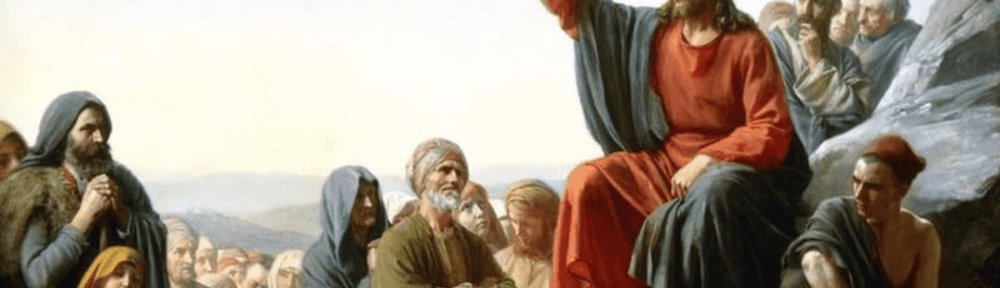
The gospel for the 6th Sunday, Year C is St. Luke’s version of the Matthean “Sermon on the Mount”, referred to as the Sermon on the Plain. The Beatitudes, which begin each of the “Sermons”, have a tendency to lead readers/hearers of the text to assume that the sacred author has constructed a general ethical code which forms the core message. Craig Keener (A Commentary on the Gospel of Matthew, 160) notes that there are more than thirty-six discrete views about the sermon’s message. He summarizes 8 of them:
- The predominant medieval view, reserving a higher ethic for clergy, especially in monastic orders;
- Martin Luther’s view that the sermon represents an impossible demand like the law;
- the Anabaptist view, which applies the teachings literally for the civil sphere;
- the traditional liberal social gospel position;
- existentialist interpreters’ application of the sermon’s specific moral demands as a more general challenge to decision;
- Schweitzer’s view that the sermon embodies an interim ethic rooted in the mistaken expectation of imminent eschatology;
- the traditional dispensational application primarily to a future millennial kingdom; and
- the view of an “inaugurated eschatology,” in which the sermon’s ethic remains the ideal or goal, but which will never be fully realized until the consummation of the kingdom.”
It is perhaps the ethical view that is most common. Many scholars trace this popular predominance to the influence of Russian novelist Leo Tolstoy whose literal interpretation of the ethical teachings of Jesus centered on the Sermon on the Mount (The Kingdom of God Is Within You). But this ethical reading alone does not do justice to the whole of the text. Jesus is describing a standard that is nothing less than wholeness/completeness, being like God. As St. Irenaeus wrote in the 2nd Century, “The glory of God is the human person fully alive.”
Jesus’ use of black-and-white categories lays down a challenge which can not simply be converted into a set of rules and regulations for life in the real world. The essence of life in the kingdom of heaven is the antithesis of a legalistic code. The discourse is intended as a guide to life – but only for those who are committed to the kingdom of heaven. And, paradoxically, even they will always find that its reach exceeds their grasp.
The Cultural Fabric of the Beatitudes
One core value among Mediterranean people – that is often missed by Western readers – is that a key cultural thread is that of honor. It is a central value that drives all behavior. Honor is a public claim to worth and a public acknowledgment by others of that claim. John Pilch describes how this concept is woven into the fabric of the Beatitudes:
“Poor” in the Bible is never an economic designation. It rather describes someone who has temporarily lost honorable status and must seek at all costs to regain but never surpass that status.
“Poor” thus refers to a revolving class of people. The customary association of poor with widows and orphans confirms this notion of losing status. Widows and orphans did not have to retain this position forever. Widows could remarry (see the serious discussion of “real” widows in 1 Tim 5:3-16); orphans could be reabsorbed into an extended family. Those who lost status were culturally obliged to regain it.
In Jesus’ view, true honor and esteem are determined and bestowed by God, very publicly, for all to see. And the things that God considers truly honorable and worthy of praise are almost always the opposite of what human beings of any culture think.
Malina and Rohrbaugh (47) suggest: “Within an honor-shame setting, perhaps the best translation for ‘blessed is/are’ would be ‘How honorable …,’ ‘How full of honor …,’ ‘How honor bringing …,’ and the like. The counter to ‘beatitudes’ are the ‘woes’ or reproaches in Matt. 23:13-35; there the formula: ‘Woe to you scribes and Pharisees, hypocrites …’ ought be translated: ‘How shameless you are….’”
We will have more to say on how Luke employs this background in his version of the Beatitudes.
Image credit: Sermon on the Mount | Carl Block, 1887 | Museum of Natural History at Frederlksborg Castle – Hillerod, Denmark | PD-US
Discover more from friarmusings
Subscribe to get the latest posts sent to your email.
 friarmusings