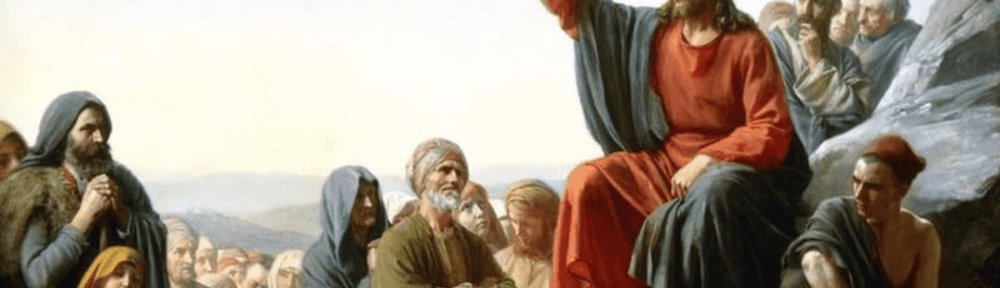
The gospel for this coming Sunday, the 6th Sunday, Year C is St. Luke’s “Sermon on the Plain.” In the 5th Sunday readings (Lk 5:1-11) we had the account of the calling of the first apostles from their labors as fishermen: “Do not be afraid; from now on you will be catching men.” (v.10). The remainder of Luke 5 then quickly recounts miracles that we see as Messianic signs (curing a leper, curing the man on the stretcher/forgiving sins, answering why Jesus ate with sinners), and then moves into Luke 6 where Luke narrates encounters with the Pharisees and scribes who question Jesus on the Mosaic Law. And then, Jesus “reconstitutes” a new Israel as he calls 12 apostles.
Luke places the choice of the Twelve just before the “Sermon on the Plain” so that it can take on the character of an official instruction for the whole church assembled under its leaders. The importance of Jesus’ decision in selecting the Twelve is underscored by mention of his all-night vigil. Luke’s account sets forth Jesus’ apostolic instruction/ethic for daily life in detail. The sermon begins with a recognition of the disciples’ blessing as a result of God’s grace. The rest of the sermon gives the ethical response to being such a beneficiary. Disciples are to live and relate to others in a way that stands out from how people relate to one another in the world. They are to love and pray for their enemies. Righteousness requires that they respond wisely to Jesus’ words by building their lives around his teaching. In sum, disciples are to live and look different from the rest of the world, even as they reach out compassionately to that world.
With verse 17 (and the missing vv.18-19) Luke sets up the sermon by summarizing Jesus’ ministry activity (4:14-15, 31-32, 40-41).
17 And he came down with them and stood on a stretch of level ground. A great crowd of his disciples and a large number of the people from all Judea and Jerusalem and the coastal region of Tyre and Sidon (18 came to hear him and to be healed of their diseases; and even those who were tormented by unclean spirits were cured. 19 Everyone in the crowd sought to touch him because power came forth from him and healed them all.)
Jesus’ ministry reflects the compassion and love he claims God has for humanity. So he heals people with disease and casts out demons. The text emphasizes the power that flows out from him. Whether they are apostles, disciples or part of the crowd, all sorts of people receive Jesus’ ministry. Jesus’ teaching and ministry extends beyond insiders. He attempts to reach those outside his new community.
The Theological Setting
As we have already noted, this Lucan passage is very similar to Matthew’s “Sermon on the Mount” – often referred to “The Beatitudes” (which is a misnomer as the “Beatitudes” are a few verses out of the Sermon which ranges over 3 chapters). Both versions of the Sermon are (and will, no doubt, continue to be) the source of much scholarly inquiry and debate. While questions about origin, sources, and redaction of the text are certainly valid and interesting, it will probably be sufficient here simply to acknowledge the fact that Luke and Matthew differ in how they use the sermon. Each writer is emphasizing different theological points for a particular community of faith that had particular needs. They are each shaping the Gospel tradition in their own way to address those needs.
This is even evident in the geographical/topological settings employed. Each echoes different metaphors and features to communicate in ways that emphasize a key point.. The book of Matthew was closely connected with Jewish elements in the early church, so he presented Jesus in the imagery of Moses. As Moses had once brought the torah from a mountain (Sinai), so Jesus now brought the new authoritative torah (“it has been said . . .but I say”) from a mountain. The theological purpose of the geographical setting was to establish the authority of Jesus as a lawgiver in the tradition of Moses.
For Luke, geography serves a different theological role here. The mountain was the place of piety and worship, the place Jesus retreated to pray (6:12) and the place where God was encountered (9:28). For Jesus to be on the mountain to pray, and then return to “a level place” was a way to anchor his actions in communion with God, yet to identify him with crowds on the level of ordinary, everyday human existence. The issue for Luke was not authority, but the working out of the implications of the Kingdom in everyday life. Prayer and piety are crucial to provide a basis of God’s presence for Jesus’ work, but the message of the Kingdom and the arena for Jesus’ work is the “level place” where the crowds are milling; a central motif seen again in Luke’s Gospel.
The Crowd
The crowd itself is also interesting. Luke presents it as a mixed group of people with different reasons for being there. In addition to the apostles and disciples, there are also “a great multitude of people” from Judea and Jerusalem to the south as well as from the Phoenician territory (Tyre and Sidon) to the northwest. However, there is some ambiguity in the reference to people from Tyre and Sidon. Since this area borders Galilee on the west, the people from this area could have been Jews, and some scholars interpret “people” of verse 18 to mean the “people of God,” i.e., Jews. However, it seems much more likely that Luke intends to refer to Gentiles by placing “Tyre and Sidon” with “Judea and Jerusalem.” In the only other pairing of the Phoenician towns in Luke (10:13-14), they are contrasted with Chorazin and Bethsaida, two Jewish towns just north of the Sea of Galilee. In that passage Luke draws the contrast between the Jewish towns that failed to respond to Jesus even though he had done “deeds of power” there, and Tyre and Sidon that would have gratefully responded to such actions had they had the chance.
All this means that there are three identifiable groups of people in the crowds. While we should be careful not to take this into allegory, there does seem to be some intention on Luke’s part to distinguish the groups. First, there are the just-chosen group of Twelve disciples who would carry on the ministry of Jesus. Much of what unfolds in the next chapters will revolve around these twelve. Next, there are the larger crowds of disciples who are followers of Jesus, who have responded to his ministry, but who have not received a special call from Jesus. And then there are the others, both Jews and Gentiles, who are there for various reasons but who have not yet become disciples. It is this mixed group that provides the setting for the “sermon.” Where Matthew is speaking to a Jewish audience. From the beginning, Luke’s audience is a wider world of Hellenistic influence.
Luke is again careful, as he has before, to emphasize Jesus’ actions in connection with his words, and so he places the sermon in the context of reports about healing (v. 19). It is part of the central message of Luke that the proclamation of the word of God must also be accompanied by faithful response worked out in real life. For Jesus, as well as for the apostles in Acts, his words of teaching were affirmed by his deeds (vv. 18-19); the actions gave authority to the words. And for those who would follow him, hearing alone would not be enough. This connection between hearing the words and acting on them will become the climax of this entire sermon in Luke (6:46-49).
Image credit: Sermon on the Mount | Carl Block, 1887 | Museum of Natural History at Frederlksborg Castle – Hillerod, Denmark | PD-US
Discover more from friarmusings
Subscribe to get the latest posts sent to your email.
 friarmusings