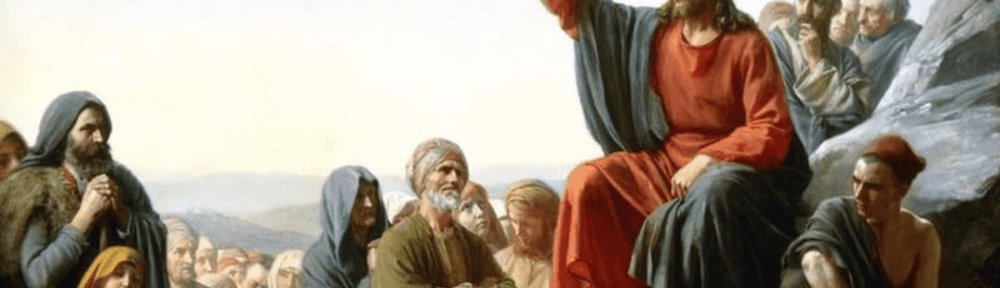
The gospel for this coming Sunday, the 6th Sunday, Year C is St. Luke’s “Sermon on the Plain.” Luke incorporates part of the same material that Matthew had included in the Sermon on the Mount (Matt 5–7). There is a rhythm like a call and response: a condition not of the kingdom followed by a promise that the Kingdom will heal the problem. All of it is cast in the repetition of blessings and woes.
And raising his eyes toward his disciples he said: “Blessed are you who are poor, for the kingdom of God is yours. Blessed are you who are now hungry, for you will be satisfied. Blessed are you who are now weeping, for you will laugh. Blessed are you when people hate you, and when they exclude and insult you, and denounce your name as evil on account of the Son of Man. Rejoice and leap for joy on that day! Behold, your reward will be great in heaven. For their ancestors treated the prophets in the same way. But woe to you who are rich, for you have received your consolation. But woe to you who are filled now, for you will be hungry. Woe to you who laugh now, for you will grieve and weep. Woe to you when all speak well of you, for their ancestors treated the false prophets in this way.
Jesus’ authority was not limited to his healing activity. He also taught with authority. Nothing indicates this more than the blessing and woe section of the Sermon on the Plain. It recalls the Old Testament prophets (remember that in the synagogue in Nazareth Jesus had taken on the mantle of the prophet Isaiah). Jesus proclaims the truth with promises of blessing and judgment. The four blessings are followed by four parallel woes.
Reversal of Fortunes
This balance reflected the theme of reversal of fortunes. Its presence in Luke is marked by a number of texts in addition to this one—for example, the Magnificat (1:46–55), Jesus’ instructions on table fellowship (14:7–24), the story of the rich man and Lazarus (16:19–31), the story of the Pharisee and the toll collector (18:9–14), and, most importantly, the Lukan account of the exaltation of the crucified Jesus (Luke 22–24).
Theme reversal of fortune theme highlights that God does not always see things as we do. He looks at the heart, not at externals. He gives promises for those who enter into grace humbly, while warning of judgment for those who remain callous.
The Poor and Rich
“Blessed are you who are poor, for the kingdom of God is yours…But woe to you who are rich, for you have received your consolation.
The key to the section is found in the remarks about the Son of Man and the comparison to the faithful and unfaithful of old. There are several perspectives to consider. First, let us consider how Luke understands and uses “wealthy” in the later chapters of his gospel. Green [267] notes:
“Crucial to this way of understanding Jesus’ audience is how one construes the “poor” and “rich,” and how one understands Jesus’ purpose at this early point in his discourse. We have seen that “the poor” in Luke refers above all to those who have been marginalized in the larger world, whether on the basis of economic or other measures…, those for whom only God can bring good news. “Wealthy” is interpreted along similar lines in this Gospel. Thus, for example, in 1:51–53 the proud and mighty are contrasted with the humble, the rich (who are well fed) with the hungry; in 12:16–21 and 16:19–31 the rich are those with significant resources at their disposal, yet who fail to consider the plight of others; and in 14:12 “rich neighbors” are catalogued with one’s “inner circle”—friends, brothers, kin—persons with whom one enjoys relationships of equality and mutuality. Like “poor,” then, “rich” is not simply a declaration of economic class; it is related fundamentally to issues of power and privilege, social location as an insider, and arrogant self-security apart from God.36 “Poor” and “rich,” then, are socially defined constructs—and Jesus is overturning the way these terms have been constructed in ordinary discourse. In effect, he insists, you who are poor are accustomed to living on the margins of society and you who are rich routinely find yourselves surrounded by friends as you use your resources to solidify your position in society, but the reality under which you have been operating has been overturned. By asserting that the kingdom of God belongs to the poor, then, Jesus is redefining the working assumptions, the values that determine daily existence.”
Promise of Faithfulness and Justice
One must remember that Jesus is calling people to the “kingdom” to be covenant people with a new or renewed spiritual relationship with God – all leading to a new community that constitutes the “people of God.” There are both Old Testament and spiritual roots. Even though Jesus is not advocating a political or social philosophy, entrance into this new community has political and social consequences. In this light the beatitudes and woes serve as a call to be responsive to God and his promise of faithfulness to those who are his.
Beyond our Sunday gospel text, Luke 6:27-36 offers clear examples of what “love of enemies” means in practical terms. Yet those commands are difficult to follow unless one can trust that God will one day exercise justice. The premise of these commands form the basis of a sacrificial spiritual life rooted in the promise of God’s faithful justice. These blessings are not a way for a person to “earn” salvation but represent an invitation to let God mold followers into what they ought to be as members of the people of God. The Beatitudes in Luke serve to those who are needy that God will care for them.
Jesus offers promises to the poor, the hungry, those who weep and those who suffer religious persecution – that God sees their spiritual commitment. To people such as these God promises the kingdom now and blessings later, including enough to eat, laughter and heavenly reward.
Unlike Matthew, Luke includes woes, not just blessings. Jesus divides humankind into two camps (3:15-18; the purging Spirit of fire). In contrast to the blessed stand the rich, those who are well fed, those who laugh and those who receive praise. Their fate is sorrow, hunger, mourning and a life like those who followed the false prophets. The contrast is stark. The “woes” serve not just as a warning to the rich and a call to repent, the woes also serve to assure the poor that God’s justice is waiting for the unrepentant.
Image credit: Sermon on the Mount | Carl Block, 1887 | Museum of Natural History at Frederlksborg Castle – Hillerod, Denmark | PD-US
Discover more from friarmusings
Subscribe to get the latest posts sent to your email.
 friarmusings