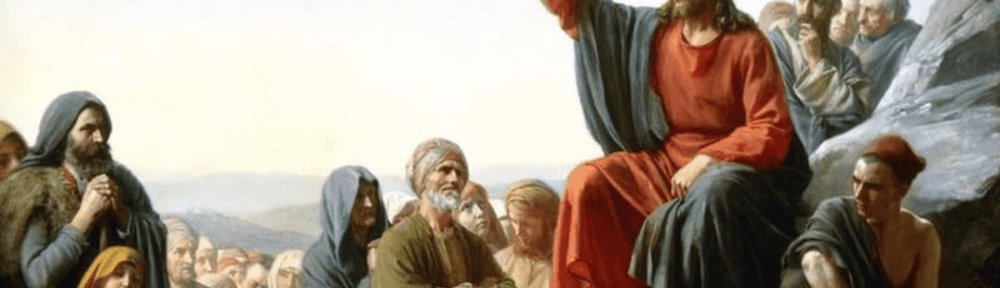
The gospel for this coming Sunday, the 6th Sunday, Year C is St. Luke’s “Sermon on the Plain.” Jesus uses this word in a totally different way. It is not the elite who are blessed. It is not the rich and powerful who are blessed. It is not the high and mighty who are blessed. It is not the people living in huge mansions or expensive penthouses who are blessed. Rather, Jesus pronounces God’s blessings on the lowly: the poor, the hungry, the crying, and the hated. Throughout the history of this word, it had always been the other people who were considered blessed: the rich, the filled up, the laughing. Jesus turns it all upside-down. The elite in God’s kingdom, the blessed ones in God’s kingdom, are those who are at the bottom of the heap of humanity.
But despite such opposition, disciples are blessed, since God promises to care for them. They belong to his kingdom and are under his rule. The poor here are like the Old Testament anawim, the pious poor. These beatitudes serve to comfort and reassure those who belong to God. They stand in a long line of the faithful, including the prophets of old. It is often the case that standing up for Jesus and the truth brings ostracism, but God has promised blessing to his children.
The woes also reflect prophetic tradition. A woe warns of lament or sorrow about the current condition and attitudes of some people, which left unchanged leads to condemnation. Here Jesus addresses the judgment of God to the callous rich and others who are comfortable with their state in life while being unconcerned about the needs of others. The lack of a genuine spiritual dimension in their life is seen in the comparison Jesus makes between them and the false prophets. For those who do not engage God on the divinity’s terms there looms nothing but the terrible expectation of a day of reckoning. One of the dangers of wealth is that it can lead one to believe a life of independence is possible–a view that Jesus teaches is arrogant and misguided (12:13-21). The world’s values are not God’s values. The reversal portrayed in the beatitudes and woes reflects the idea that “the one with the most toys” often loses. God’s blessing can be found in surprising places. It rests on those who rest in Him.
An Old Testament Background
We have already noted that the idea of a reversal of fortune is an important theme for Luke. That is, Luke uses this Old Testament idea as a way to proclaim and define the new future that Jesus is bringing into the world. Here, he is again using that motif to continue explaining the nature of discipleship.
There is no way to know for certain whether Luke was using the similar sequence of blessings and curses in Deuteronomy as a model for these (28:3-6, 16-19), but the similarity seems more than coincidence. While there are certainly differences between them, it seems fair to ask what the similarities might reveal about Luke’s focus.
The context in Deuteronomy is a covenant ceremony in which the people are called to faithfulness in obeying the torah, the instructions of God that shaped and gave identity to the people. The promise there to those who faithfully obey God will be that “God will set you above all the nations of the earth.” While in the historical context of the OT those blessings are translated into physical security, there is still the dimension of “mission” as the people of God (Dt 28:8-10):
“The LORD will affirm his blessing upon you, on your barns and on all your undertakings, blessing you in the land that the LORD, your God, gives you. Provided that you keep the commandments of the LORD, your God, and walk in his ways, he will establish you as a people sacred to himself, as he swore to you; So that, when all the nations of the earth see you bearing the name of the LORD, they will stand in awe of you.”
Likewise, the curses warn that failure to obey God’s instructions will lead to “defeat and frustration in every enterprise you undertake” (28:20). The emphasis is clearly on the responsibility of the people to follow God and his instructions faithfully as the only way to fulfill who they are as God’s people. It is this dimension of a strong call to faithfulness that echoes in Jesus’ words and in Luke’s pairing of the blessings and woes here.
And yet, in Deuteronomy the blessings and woes are dependent on how the people would respond. That is, the people themselves would bring on either blessings or curses by how they lived. Here in Luke, they are simply pronounced by Jesus on groups of people depending on their current state of life not on their behavior.
Unless we assume absolutely no connection to the OT ideas, which is unlikely given Luke’s heavy use of the OT to this point, this echo of a call to responsibility and yet an emphasis on the state of life of the people introduces a tension into the text. If the people of God in the OT were to be blessed based on obedience, what is the significance of Jesus pronouncing blessings on the people now simply because they are poor, or hungry, or weeping, or hated? The answer to this is not immediately obvious but raises the possibility that there is a direct connection with being poor and being a follower of Jesus. It is easily observable that Matthew’s version of the blessings is much more “spiritual” than Luke’s. Where Matthew speaks of “poor in spirit” (5:3), Luke has simply “poor” (v. 20); where Matthew says “hunger and thirst for righteousness” (5:6), Luke clearly means simply those “who are hungry” in a physical sense (v. 21). It has usually been assumed that this reflects Luke’s social agenda, that he is presenting a Gospel for the poor and oppressed. There is certainly this dimension in Luke, a concern for the powerless and outcast of society. And since there is little question that Luke is talking about real physical needs here, we dare not spiritualize away those physical needs. We must take seriously the fact that this is real poverty, real hunger, real weeping, and real hatred.
Now and Future Days
The time references in the sequence of sayings are also of interest. There is an intriguing blending of present and future. This is especially highlighted in the second and third pair with the repeated “now” followed by a future condition; there is a condition “now” that “will be” changed into the opposite. This clearly gives these sayings an eschatological dimension; there will come a time when the inequities of the present will be resolved. This dimension is reinforced in the fourth blessing by the reference to “that day” (v. 23), a common way of referring to a future act of God.
And yet, in the first pair, the emphasis is decidedly on the present. The poor already have the kingdom, and the rich already have their consolation. This term has been used once before in Luke, to describe the hope for which the old man Simeon was looking, and which he saw in the infant Jesus (2:25). The implication is that the “consolation” that the rich already have in their riches and security may cause them to miss the consolation of Israel manifest in the Kingdom that Jesus is bringing, and which is available to the poor (v. 20) in ways that it is not available to the rich.
Image credit: Sermon on the Mount | Carl Block, 1887 | Museum of Natural History at Frederlksborg Castle – Hillerod, Denmark | PD-US
Discover more from friarmusings
Subscribe to get the latest posts sent to your email.
 friarmusings