This coming Sunday is the 8th Sunday of Ordinary Time in lectionary cycle C. An astute observer will notice that in Ordinary Time, depending on the year, we “skip” several Sunday liturgies between the portions of Ordinary Time that come before and after the Lent/Triduum/Easter cycle. The skips are not consistent from year to year. For example, in Ordinary Time of 2022, we omitted 4 Sundays (9th through 12th). In 2023, we omitted only 3 Sundays (8th through 10th). Why the variation you might ask?
While Christmas Day is affixed to December 25, the date of Easter Sunday can fall anywhere between March 22 and April 25, as it is the first Sunday after the first full moon after the spring equinox. Therefore, Ash Wednesday, which precedes Easter Sunday by 46 days, can fall anywhere between the 4th and 10th Weeks of Ordinary Time. In 2025 Easter falls a little later and so this is one of those years when we celebrate the 8th Sunday.
Up until now
In the 5th Sunday readings (Lk 5:1-11) we have the account of the calling of the first apostles from their labors as fishermen: “Do not be afraid; from now on you will be catching men.” (v.10). Luke 5 quickly recounts miracles that we see as Messianic signs (curing a leper, curing the man on the stretcher/forgiving sins, answering why He ate with sinners), and then moves into Luke 6 where he narrates encounters with the Pharisees and scribes who question Jesus on the Mosaic Law. And then, Jesus “reconstitutes” a new Israel as he calls 12 apostles.
In the 6th Sunday gospel (Luke 6:17, 20-26) and the 7th Sunday (Luke 6:26-38) we have the Lucan version of the great interpretation of the Mosaic Law: The Sermon on the Plains (Matthew’s account is referred to as the Sermon on the Mount). With the apostles present the Sermon takes on the character of an official instruction for the whole church assembled under its leaders.
Luke’s “Sermon on the Plain” sets forth Jesus’ apostolic instruction/ethic for daily life in detail. The sermon begins with a recognition of the disciples’ blessing as a result of God’s grace. The rest of the sermon gives the ethical response to the grace of being such a beneficiary. Disciples are to live and relate to others in a way that stands out from how people relate to one another in the world. Jesus points the disciples to understand the nature of their heavenly Father: love and mercy – even to those who do not deserve it – including ourselves.
This is the transformation needed to become a disciple – and then go into the world to bring others into the Kingdom.
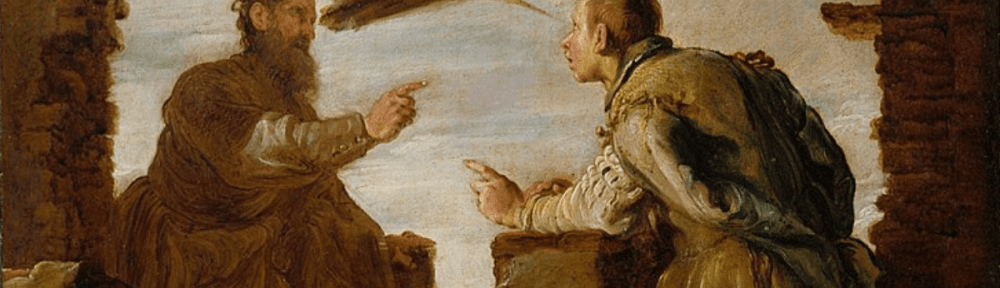
Image credit: A detail of The Parable of the Mote and the Beam | Domenico Fetti, 1619 | Metropolitan Museum of Art NYC | PD-US
Discover more from friarmusings
Subscribe to get the latest posts sent to your email.
 friarmusings