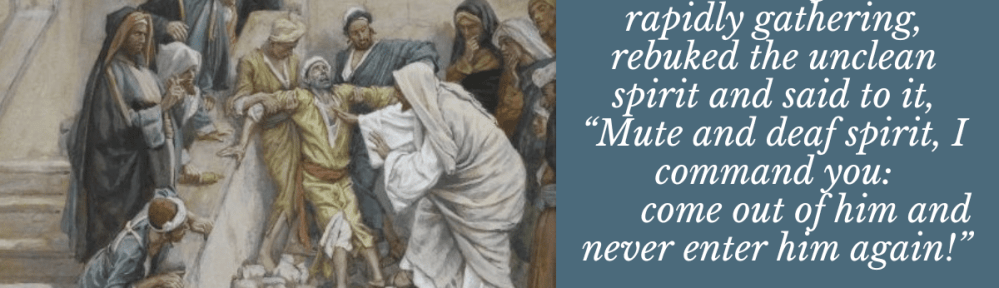
The opening of the gospel reading is not a direct quote from Scripture, but as often happens for liturgical readings, the opening verse is modified to give context and continuity with the Gospel text itself. In Scripture the context is that Jesus and three disciples (Peter, James, and John) are descending from the mountain top and the event known as the Transfiguration of the Lord. The quote from Mark 9:14 is “When they came to the disciples, they saw a large crowd around them and scribes arguing with them.” It loses the location and leaves “they” undefined. For the gospel proclaimed they borrow from previous verses in Mark 9 to provide us with: “As Jesus came down from the mountain with Peter, James, John and approached the other disciples they saw a large crowd around them and scribes arguing with them.” (Liturgical reading)
The gospel reading is a vivid account of Jesus casting out a demon from a possessed young boy that has no parallel in either Matthew or Luke. Like many of these stories, the attention quickly focuses on Jesus and his actions/words. But there is more going on in this passage. Why are the disciples (not including Peter, James and John) arguing with the scribes as a large crowd listens in?
Later on in the text we learn that the disciples had attempted to cast the demon out from the boy and were not successful. The presence of the scribes may indicate witnesses sent out by the Sanhedrin in Jerusalem to gather evidence against Jesus, who was suspected of misleading the people. The prescribed procedure of exorcism demanded a thorough investigation by official envoys. Perhaps the argument is one focused on (a) a lack of success (and thus authenticity of Jesus’ ministry) and (b) their standing or their authorization to even attempt an exorcism.
Jesus’ question was probably addressed to the scribes, who had taken advantage of his absence to embarrass the disciples. Jesus was answered by the boy’s father who explained the situation which had erupted in the intense dispute between the disciples and the scribes. The description is particularly graphic and seems to indicate a level of demonic possession not encountered elsewhere in the New Testament. St. Augustine commented that the violence of the seizures, and the reference to repeated attempts to destroy the youth by hurling him into a fire or water indicate that the purpose of demonic possession is to distort and destroy the image of God in man.
At the end of the report the father says: “I asked your disciples to drive it out, but they were unable to do so.” Jesus said to them… to who? Most likely, the disciples as they were the last group mentioned. Jesus said to them: “O faithless generation, how long will I be with you? How long will I endure you?” (Mark 9:18-19)
“The father had appealed to the disciples to exercise the power known to belong to Jesus because the principle basic to discipleship was that ‘the messenger of a man is as the man himself.’ In Jesus’ absence the disciples stood in his place and were regarded as he is. It was therefore legitimate to expect that they possessed the power of their master. For their part, the disciples had good reason to believe that they could cast out the demon because they had been commissioned to expel demons in the context of their mission, and they had been successful (Ch. 6:7, 13). They undoubtedly tried in various ways to heal the boy, but they were inadequate to the resistance they encountered. They possessed the power of God only in personal faith, but during Jesus’ absence an attitude of unbelief and self-confidence, based on past success, had exposed them to failure. Their inability appears to have shaken the father’s confidence in Jesus’ ability to do anything (cf. Ch. 9:22 “if you can”). He appealed for Jesus’ help directly only after another violent convulsion, and then with doubt and hesitation.” (William Lane, The Gospel of Mark, 332)
Although the disciples had been privileged to be with Jesus and possessed the charism of healing, they had been defeated through unbelief when they stood in his place and sought to exercise his power. The lack of faith and hardness of heart reproved on other occasions continued to characterize the disciples and betrayed a costly failure to understand the nature of their task and of the relationship that they must sustain to Jesus.
“When he entered the house, his disciples asked him in private, “\’Why could we not drive it out?’ He said to them, ‘This kind can only come out through prayer.’” (Mark 9:28-29) What might this mean? I have always been curious but had not pursued it… until now.
At one level, since the disciples had previously cast out demons (Mark 6:13), yet they failed here, perhaps they might have become overconfident in their ability rather than relying fully on God. This put Jesus’ remark (“O faithless generation”) into a context that points to a failure due to a lack (weakness) of faith, prayer, and total dependence on God.
“This kind” suggests that some demons are more resistant than others, indicating a hierarchy of evil forces (cf. Ephesians 6:12: “We wrestle not against flesh and blood, but against principalities and powers…”). The disciples may have assumed that all demons were equally easy to cast out, but Jesus teaches them that greater spiritual challenges require deeper spiritual preparation, more than routine faith or authority. This demands a deep connection with God through prayer. This suggests that prayer is not just a request for divine power but a means of aligning oneself with God’s will and strength. St. Augustine and St. John Chrysostom interpreted this as a reminder that exorcism is not a mechanical act but requires a life deeply rooted in prayer and dependence on God.
This is why the Church has an Office of Exorcists, men who are spiritually trained and ready to take action in the name of God for those possessed. Does it happen often? According to the Vatican’s guidelines issued in 1999, “…the person who claims to be possessed must be evaluated by doctors to rule out a mental or physical illness.” It is estimated that only 1 in 5,000 people who are put in contact with an installed Exorcist require such action. The majority of claims about the demons (not possessions) are handled locally by parish priests in prayer and counseling.
“When the Church asks publicly and authoritatively in the name of Jesus Christ that a person or object be protected against the power of the Evil One and withdrawn from his dominion, it is called exorcism. Jesus performed exorcisms, and from him the Church has received the power and office of exorcizing. In a simple form, exorcism is performed at the celebration of Baptism. The solemn exorcism, called ‘a major exorcism,’ can be performed only by a priest and with the permission of the bishop. The priest must proceed with prudence, strictly observing the rules established by the Church. Exorcism is directed at the expulsion of demons or the liberation from demonic possession through the spiritual authority which Jesus entrusted to his Church. Illness, especially psychological illness, is a very different matter; treating this is the concern of medical science. Therefore, before an exorcism is performed, it is important to ascertain that one is dealing with the presence of the Evil One, and not an illness.” (Catechism of the Catholic Church para. 1673)
Image credit: Jesus Casting Out A Demon | James Tissot, 1864 | Brooklyn Museum | PD-US
Discover more from friarmusings
Subscribe to get the latest posts sent to your email.
 friarmusings