This coming Sunday is the 3rd Sunday in Lent, Year C. In the previous post we considered the meaning of “repentance” in the light of Jesus’ admonition that we do not know the time of the end of our days, but the day will come and so we are to repent of sin and seek righteousness before God.
6 And he told them this parable: “There once was a person who had a fig tree planted in his orchard, and when he came in search of fruit on it but found none, 7 he said to the gardener, ‘For three years now I have come in search of fruit on this fig tree but have found none. (So) cut it down. Why should it exhaust the soil?’ 8 He said to him in reply, ‘Sir, leave it for this year also, and I shall cultivate the ground around it and fertilize it; 9 it may bear fruit in the future. If not you can cut it down.’”
As with all parables, there is a lot of room for understanding. Is this an agrarian parable where a fig tree is just a fig tree? Or is Jesus’ parable using a familiar OT symbol for Judah or Israel (cf. Jer. 8:13; 24:1–10; Hos. 9:10; Mic. 7:1). The fact that the fig tree is situated in a vineyard may suggest that Jesus wanted his listeners to think of Isa. 5:1–7, in which the prophet compares the inhabitants of Jerusalem and the people of Judah with a vineyard that yields only wild grapes. If this is correct, then the vineyard stands for Israel, and the fig tree represents Israel’s barren leadership. In any case, we continue.
“For three years now I have come in search of fruit on this fig tree but have found none” (v.7). If one takes literally the practice of Leviticus 19:23, then the first three years of a fig tree’s fruit were allowed to go unharvested in order that the fruit be declared clean. In such a scenario, six years have already passed since the fig trees were planted. One could consider this tree hopelessly barren. And even barrenness has a price – fig trees take a disproportionate amount of nutrients and minerals from the soil – thus depriving other trees and vines from a needed source of growth. By any measure of agriculture, this tree should be removed and discarded.
The importance of fruit-bearing has been emphasized repeatedly in Luke’s Gospel. In the Sermon on the Plain Jesus notes the importance of bearing good fruit (6:43–45), but this element is especially well developed in his parable/ teaching on sowing (8:4–15). There, “authentic hearing” of the word of God is demonstrated in “bearing fruit.” This accent on fruit-bearing goes hand-in-hand with the emphasis on repentance in vv 3 and 5; both signify expected responses from Jesus’ audience to the manifestation of God’s purpose in his mission.
Despite the lack of fruitfulness, the gardener proposes to take another year and dedicate special care and attention in the hope that it will, at last, bear fruit. Perhaps this is an echo of Jesus’ proclamation in the Nazareth synagogue of “a year acceptable to the Lord” (Luke 4:19) To that point, Joe Green [515] notes: “Not incidentally, the parable also holds for the possibility of fruit-bearing in spite of a history of sterility—or, in human terms, the possibility of change leading to faith expressed in obedience to God’s purpose. If it announces a warning of judgment, then, it also dramatizes hope.”
In vv.6-9, Jesus’ telling of the parable of the fig tree is a different rendering than the cursing of the fig tree in Matthew 21:18 ff and Mark 11:20 ff. In both those accounts the fig tree has no time – judgment has come. That was the message of John the Baptist: “Even now the ax lies at the root of the trees. Therefore every tree that does not produce good fruit will be cut down and thrown into the fire.” (Luke 3:9). But Jesus’ message is different. He continues to warn the people of the judgment, but there is an element of mercy in Jesus’ parable: allow more time, another year before the axe is lifted. John the Baptist expected the Messiah to bring judgment upon Israel (7:18 ff), instead, Jesus was healing disease, casting out evil spirits, and giving sight to the blind (7:21-23). God’s judgment has been delayed through the gracious works of the Messiah.
The parable has many potential interpretations. In Jesus’ days it is perhaps that the vineyard owner represents God the Father, the gardener is Jesus, the vineyard is the nation of Israel, and the particular fig-tree is the “leadership” of religious Israel. In such an analysis, the justice of judgment is rightly proposed by the owner, yet the gracious of God’s mercy is seen in the request of the gardener for time. To this point, Father Gerry Pierse, C.Ss.R, recounts the following story:
Emperor Napoleon had a rule in his army that anyone who went absent without leave, on being captured would be shot the next morning at breakfast time. There was a boy of seventeen who had seen many of his companions die. Scared, he ran away, but he was caught and was sentenced to be executed next morning at breakfast time. It so happened that this boy was the son of Napoleon’s cook. The mother went to plead for mercy. Eventually, Napoleon orders her out of his sight saying, “Woman, your son does not deserve mercy.” To this she replied, “Yes, of course, you are right. He does not deserve mercy. If he deserved it, it would no longer be mercy.”
Jesus uses an agricultural parable to make this point. The nature of a fig tree is to bear fruit and in Israel the average person would know that means, on average, 10 months a year. This barren tree is corrupted at the very level of nature and deserves nothing, yet mercy is extended to it in hopes of fruitfulness. It has a year to repent and become fruitful.
The preclude to this parable was Jesus telling the disciples that in the present age good fortune and disaster are no indication of a person’s spiritual state. Jesus makes a similar point elsewhere: “But I say to you, love your enemies, and pray for those who persecute you, that you may be children of your heavenly Father, for he makes his sun rise on the bad and the good, and causes rain to fall on the just and the unjust.” (Mt 5:44-5). Yet, in the judgment to come, those who have been evil will certainly experience disaster. And so today is the time for repentance and to produce evidence of a life dedicated to the kingdom: “A good tree does not bear rotten fruit, nor does a rotten tree bear good fruit. For every tree is known by its own fruit. For people do not pick figs from thornbushes, nor do they gather grapes from brambles” (Luke 6:43–44). The time may even be extended for us as for the fig tree. But ultimately the judgment will come.
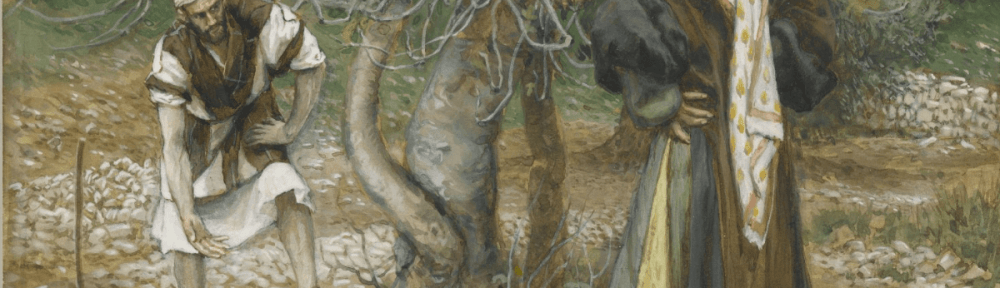
Image credit: The Vine Dresser and the Fig Tree | James Tissot, 1886-1894 | Brooklyn Museum | PD-US
Discover more from friarmusings
Subscribe to get the latest posts sent to your email.
 friarmusings