
The first year at the US Naval Academy is… shall we say…challenging. It is called “plebe year.” The word “plebe” originates from the Latin word plebs, which referred to the common people of ancient Rome, as opposed to the elite class – in this case being the upper class midshipmen who have already proven their mettle. The purpose of Plebe Year at the U.S. Naval Academy is to transition civilians into midshipmen and future Navy and Marine Corps officers by instilling the foundational military, academic, and physical standards required for service. It is an intensive, year-long process—especially demanding in the first summer, known as Plebe Summer—that serves several key purposes:
Discipline and Military Indoctrination – Plebes (first-year students) learn military customs, courtesies, regulations, and traditions. They’re taught to follow orders, uphold high standards, and function in a chain of command.
Character and Leadership Development – the year tests and builds mental toughness, ethical decision-making, accountability, and resilience—key traits for leadership in high-stakes environments.
Teamwork and Unity – Plebes must work closely with their classmates, fostering a strong sense of camaraderie and unit cohesion essential for military effectiveness.
Academic and Physical Readiness – Rigorous academics, physical training, and time management are emphasized to prepare plebes for the demands of the remaining years at the Academy and their future careers.
Humility and Service Orientation – The demanding nature of the year is designed to break down individual ego and instill a mindset of service before self.
In short, Plebe Year transforms young civilians into disciplined, capable, and committed future officers ready to lead with integrity in the naval service.
The US Naval Academy also has a tradition to mark the end of plebe year: the climb of Herndon Monument, The Herndon Monument is named for Commander William Lewis Herndon, 1813-1857, who possessed the qualities of discipline, teamwork and courage. Herndon went down with his ship, the SS Central America, after a gallant effort to save it, its sailors and its passengers during a hurricane. A monument was erected on the Yard in his honor shortly after his death.
The monument is an obelisk, a tall, rectangular pillar with a pointed top that tapers towards the apex. It is 21 feet high and on the appointed day, it is completely greased with vegetable shortening – 200 lbs worth. Atop the monument is the “dixie cup” the blue rimmed sailor’s cap emblematic of plebe year.
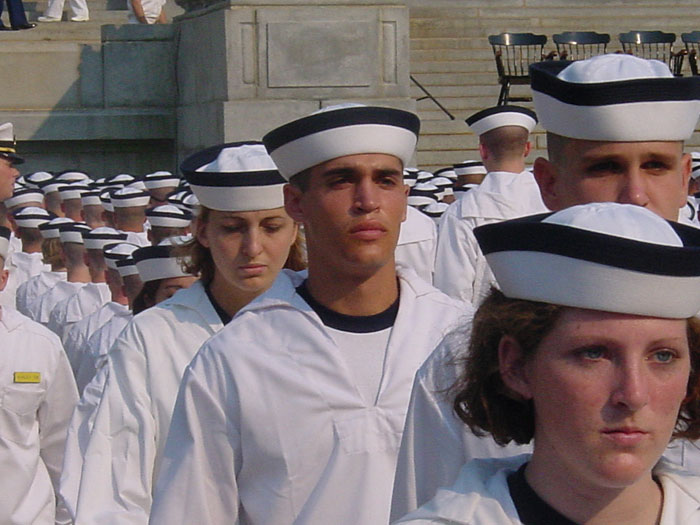
When the plebes demonstrate the teamwork and perseverance they have learned during their first year at the academy by building a human pyramid to retrieve the hat at the top, and said hat is indeed retrieved, plebe year is officially ended.
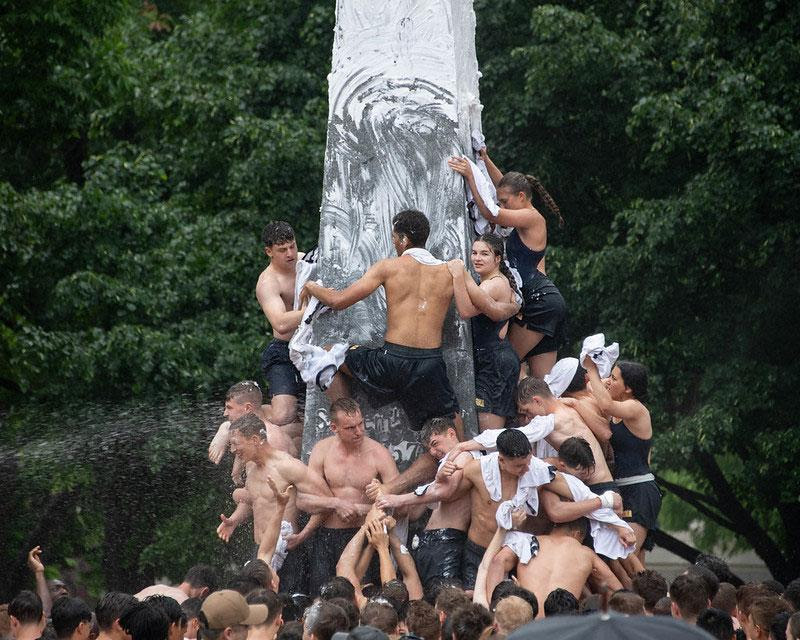
The fastest time was recorded by the Class of 1972 – 1 minute, 30 seconds. It seems that the monument was not greased that years, so sorry ’72, you’re still plebes. The longest time: Class of 1998 – 4:05:17. That year, in a act that no doubt violated the Geneva Accords and Sokovia Accords, the dixie cup was glued and taped to the top.
The Herdon Monument Climb is scheduled for tomorrow. The forecast is rain. Somehow that just seems a fitting end to plebe year.
Image credits: US Naval Academy Alumni Association
Discover more from friarmusings
Subscribe to get the latest posts sent to your email.
 friarmusings