Our gospel text for the 6th Sunday of Easter comes from a section of the “Farewell Discourse” that focuses on Jesus’ departure and discusses the disciples’ relation to Jesus and their conflict with the world. Our gospel pericope falls at the end of this section.
“I will be with you only a little while longer…Where I go you cannot come. And now the questions come:
Peter (13:36–14:4): “Master, where are you going?” (13:36). Peter has sworn he will follow Jesus anywhere, yet his denials lay just ahead and in vv.37-38 Jesus predicts just that but also predicts that Peter would follow him in death: “though you will follow later” (v.36)
The opening verses of Chapter 14 are the well-known “in my father’s house there are many rooms” passage wherein Jesus tries to comfort the disciples, insist on the necessity of faith and be assured that He will return for them. Jesus asserts that they know the way.
So Thomas (14:5–7) asks, “How can we know the way?” Jesus’ answer states that Christian hope is not in a method, not in a procedure, but in a person. Jesus himself is “the way and the truth and the life” (v. 6). Through and in Jesus, one comes to the Father, knows the Father, sees the Father.
Philip (14:8–21) seizes on that final phrase to ask: “Master, show us the Father ….” (v. 8). One can hear the sigh of weariness in Jesus’ voice: “Have I been with you for so long a time and you still do not know me, Philip? Whoever has seen me has seen the Father” (v. 9). And the discussion continues, pointing to the perfect union of Jesus with the Father: both his words and his works are the Father’s (vv. 10–11). With this, Jesus turns his attention to the disciples. They, too, will do the works that Jesus has done because he will respond according to their petitions, so that God will be manifested in the Son. The disciples’ love will bring from the Father another Paraclete, the Spirit of truth, to remain with them always (v. 16). In this sense, Jesus will come back; they will not be left orphans (v. 18).
What seemed to be a conversation of assurance that Jesus was preparing a place for them in the kingdom of heaven has instead been revealed as being found within the believers themselves: “On that day you will realize that I am in my Father and you are in me and I in you. Whoever has my commandments and observes them is the one who loves me. And whoever loves me will be loved by my Father, and I will love him and reveal myself to him.” (John 14:20-21) This return will be connected to the arrival of another Paraclete (cf. 1 John 2:1, where Jesus is called the first one) who takes Jesus’ place as both advocate and revealer.
This provokes the Judas (not Iscariot) sequence (14:22–31). Judas makes it clear that their expectation was a visible return in majesty accompanied by a fearsome display of celestial fireworks. “Master, [then] what happened that you will reveal yourself to us and not to the world?” (v. 22). Jesus’ answer almost avoids the question as it merely insists on what has already been proclaimed. Jesus repeated that He and the Father will come to those who love and will dwell with them (vv. 23–24). (This, for John, is the all-important coming, parousia, of the Lord.) This coming is directly related to the Paraclete whom the Father will send to instruct and to remind.
This brings us to our gospel pericope.
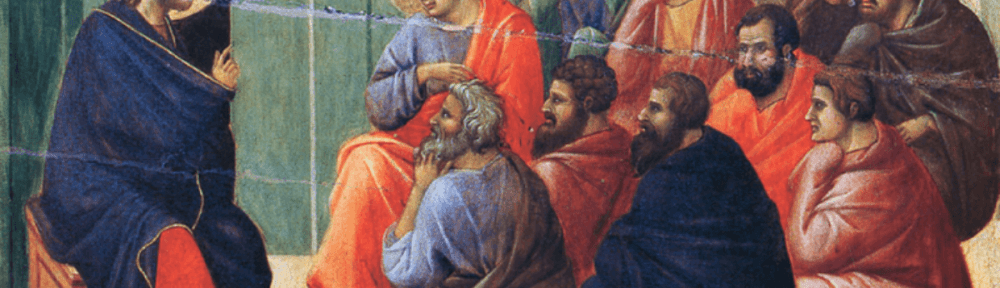
Image credit: Christ’s Final Address to the Apostles | Bona Duccio di Buoninsegna, 1380 | from the Maesta Altar | Siena, Museo dell’Opera del Duomo | PD-US
Discover more from friarmusings
Subscribe to get the latest posts sent to your email.
 friarmusings