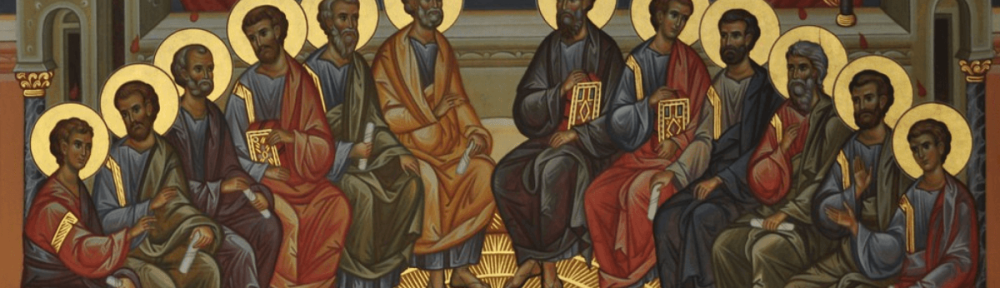
This coming Sunday is Pentecost Sunday. The gospel for Pentecost Sunday has two options. The first option is the beginning part of the same gospel used on the 2nd Sunday of Easter. The second option, also from John, is taken from the “Farewell Discourse” of John 14 when Jesus promises the disciples that although he is going away, he will send the “Advocate.” This commentary focuses on the first option.
19 On the evening of that first day of the week, when the doors were locked, where the disciples were, for fear of the Jews, Jesus came and stood in their midst and said to them, “Peace be with you.” 20 When he had said this, he showed them his hands and his side. The disciples rejoiced when they saw the Lord. 21 (Jesus) said to them again, “Peace be with you. As the Father has sent me, so I send you.” 22 And when he had said this, he breathed on them and said to them, “Receive the holy Spirit. 23 Whose sins you forgive are forgiven them, and whose sins you retain are retained.” (John 20:19-23)
This Johannine account of the appearance of Jesus follows upon the heels of the events that took place at the tomb in the early morning of the first day of the week (John 20:1–18). There near the empty tomb of Jesus, the risen Savior first appeared to Mary Magdalene. Our gospel contains the second and third appearances of the risen Jesus. These three appearances take place in Jerusalem. There is a fourth and final appearance of Jesus later in a section referred to as the “Epilogue” of John. This appearance is at the “Sea of Tiberias” in Galilee (John 21).
The people involved in the Johannine scene in the garden (20:1-18), despite the testimony of Mary Magdalene, are locked in a room for fear of the Jews (v.19). The proclamation of Jesus’ resurrection has not dispelled the fear. The “we” and “they” of v.2 are still active forces in the account. The disciples (we) have not overcome the fear that the Jewish leadership (they) have created throughout the Passion.
Pentecost – The Greek name (pentēkostē) for the Jewish Feast of Weeks, deriving from its occurrence 50 days after Passover (Acts 20:16; 1 Cor 16:8). Because the early Christians received the baptism of the Holy Spirit on this day, the term is now more commonly used to refer to that event recounted in Acts 2:1–13.
The Feast of Weeks was the second of the three great Jewish feasts. Its name signified that it concluded the period of seven weeks which began with the presentation of the first sheaf of the barley harvest during the Passover celebration (Lev 23:15–16; Deut 16:9). Thus it was originally an agricultural feast marking the end of the grain harvest and was celebrated during the month of Sivan (May/June). Both Josephus (Ant 3.10.6 §252; JW1.13.3 §253) and Jewish intertestamental writings (Tob 2:1; 2 Macc 12:31–32) refer to the feast as Pentecost. [AYBD 5:222-23]
Image credit: Descent of the Holy Spirit | Artist unknown | traditional Greek icon | Wikimedia Commons | PD-US
Discover more from friarmusings
Subscribe to get the latest posts sent to your email.
 friarmusings