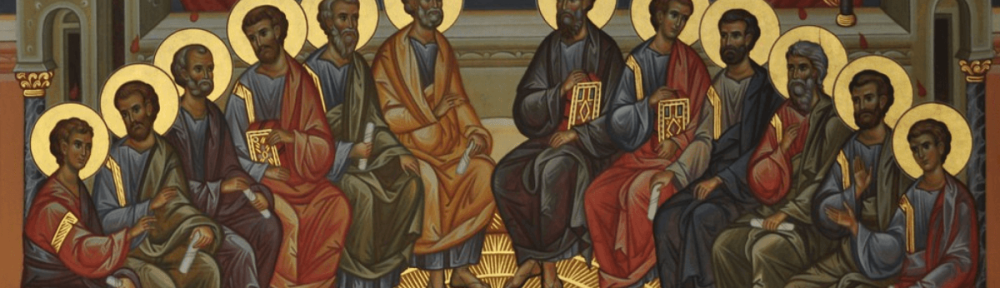
The first reading for Pentecost Sunday is the account from Acts 2 so familiar to every Christian. Luke’s account is a very public event compared to the very private Johannine account. Why the difference? Some scholars defend the basic historicity of the entire Lucan narrative; others conclude that it is essentially Luke’s theological attempt to explain the coming of the Spirit, not an historical account of actual events. Some, holding to the historicity of the Lucan account in Acts 2 hold that John’s account is symbolic only. The Second Council of Constantinople (AD 533) condemned the view of Theodore of Mopsuestia that Jesus did not really give the Spirit on that Easter evening but acted only figuratively and by way of promise. Some, like John Chrysostom, held that the giving of the purpose was for one particular gift or another; others have said that Easter’s coming of the Spirit is personal while Pentecost is ecclesial or missionary. And another set of scholars posit a narrower coming of the Spirit targeting special gifts intended for specific ministry (e.g., the forgiveness) versus a more general coming of the Spirit as a blessing and empowerment for the larger Johannine ministry of discipleship: love and holding to the commandments of Jesus. Some simply conjecture that since John is not overly concerned about date/setting but rather the theological implications, that the Johannine account is the same event – John has simply re-located the events.
The Roman Catholic view coincides with its theological sense of “both-and”. In a sense the very order of the Readings for Pentecost Sunday (Year A) outlines the sense of “both-and” as follows:
- Acts 2:1-11: the general coming of the Spirit
- 1 Corinthians 12:3-7, 12-13: the variety of gifts given – personal, ecclesial, missionary and more
3 Therefore, I tell you that nobody speaking by the spirit of God says, “Jesus be accursed.” And no one can say, “Jesus is Lord,” except by the holy Spirit. 4 There are different kinds of spiritual gifts but the same Spirit; 5 there are different forms of service but the same Lord; 6 there are different workings but the same God who produces all of them in everyone. 7 To each individual the manifestation of the Spirit is given for some benefit. 8 To one is given through the Spirit the expression of wisdom; to another the expression of knowledge according to the same Spirit; 9 to another faith by the same Spirit; to another gifts of healing by the one Spirit; 10 to another mighty deeds; to another prophecy; to another discernment of spirits; to another varieties of tongues; to another interpretation of tongues. 11 But one and the same Spirit produces all of these, distributing them individually to each person as he wishes.
- John 20:19-23: the gifts given for specific ministry, e.g., continuation of the priesthood of Jesus is those that the community raises up for that particular ministry – in this case, the Catholic tradition sees the Sacrament of Reconciliation given to particular ministers to celebrate in the name of the community
22 And when he had said this, he breathed on them and said to them, “Receive the holy Spirit. 23 Whose sins you forgive are forgiven them, and whose sins you retain are retained.”
Image credit: Descent of the Holy Spirit | Artist unknown | traditional Greek icon | Wikimedia Commons | PD-US
Discover more from friarmusings
Subscribe to get the latest posts sent to your email.
 friarmusings