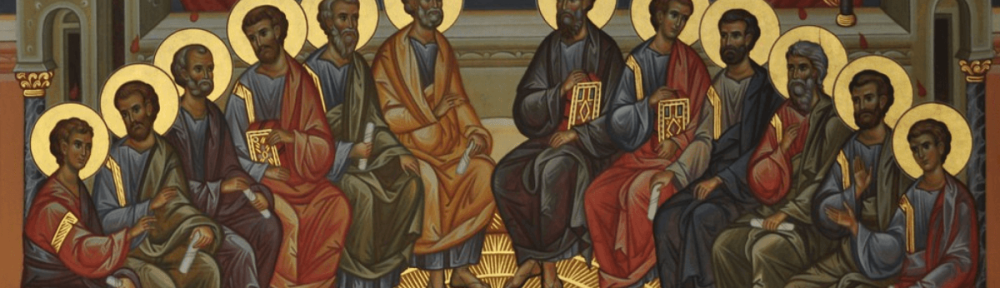
This coming Sunday is Pentecost Sunday. The Johannine account of the first post-resurrection appearance to the gathered disciples is linked to the events of the Resurrection by the simple expression “that first day.” As the startling and disturbing events of the last three days had unfolded the community’s overriding response was fear. They had gathered, but had locked themselves away out of fear of what persecutions the religious authorities might bring against them. It is into this complex of uncertainty, perhaps doubt and hesitation, that Jesus appears
“Peace be with you” is in some way a conventional greeting (cf. Rom 1:7; 1 Cor 1:3; 2 Cor 1:3; Gal 1:3) used by St Paul in his letters as a reflection of a standard option for the opening of a Greek letter. But here the greeting has an additional purpose – Jesus is fulfilling a promise from his Farewell Discourse: his gift of peace (John 14:27). The peace is given to a community who will experience the world’s opposition always and its persecution often. The gift of peace is an explicit reminder that their way in the world will be graced with the enduring promise of Christ.
The biblical idea of “peace” is complex, but simply but, peace is not simply the absence of war or hostilities. Peace is a positive notion in the biblical sense and has meaning of its own. At its root, the biblical idea of “peace” stems from the Hebrew šālôm which means to be hale, whole and complete [AYBD 5:2-6]. The Greek word eirene (peace) appears in almost every writing of the NT. It describes a relationship of goodwill between God and humans.
The Fourth Gospel affirms that peace is intimately related to Jesus himself. It is a gift related to the commission to forgive sins (20:19, 21, 26) and go forth in the power of the Holy Spirit, but also before his death he promises them: “Peace I leave with you; my peace I give to you. Not as the world gives do I give it to you. Do not let your hearts be troubled or afraid” (14:27). The difference between the world’s peace and that of Jesus is not explained, but it has to do with John’s notion of the world (kosmos). “In the world you will have trouble. But take courage! I have conquered the world” (16:33). In Christ peace is available to them. The difference must not be drawn along philosophical lines, as if the peace of Christ “has nothing to do with the absence of warfare nor … with an end to psychological tension, nor with a sentimental feeling of well-being” (Brown, 653). Caesar’s peace enforced by violence is not the same as the peace of Christ which derives from his victory over evil through the absorption of suffering. The two are dramatically different ways of bringing peace.
Prior to his death, Jesus told his disciples they would all be scattered and abandon him (16:32). Jesus was alone before the high priest and eventually before Pilate as he was condemned to death. The disciples, and especially Peter who had denied him three times (18:17–18, 25–27), would have felt deeply ashamed that they had abandoned Jesus in his hour. Thus when Jesus appeared to them behind locked doors, his greeting of ‘Peace be with you!’ showed he was not holding their failures against them; rather, he was offering a restored relationship – that they remained in the goodwill of God.
“When he had said this, he showed them his hands and side.” By showing them the nail prints in his hands and the spear wound in his side Jesus removed any doubt they had that the one who stood before them in that locked room was Jesus crucified but now risen from the dead. He predicted that the disciples’ sorrow at his death would be turned to joy following his resurrection (16:20–22), and now “the disciples rejoiced when they saw the Lord.”
Image credit: Descent of the Holy Spirit | Artist unknown | traditional Greek icon | Wikimedia Commons | PD-US
Discover more from friarmusings
Subscribe to get the latest posts sent to your email.
 friarmusings