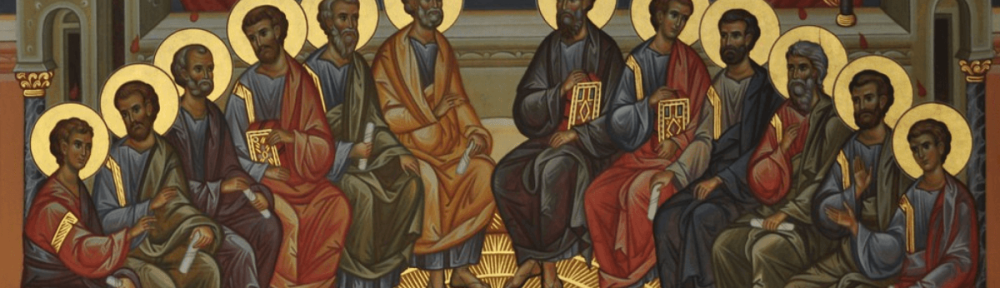
This coming Sunday is Pentecost Sunday. “And when he had said this, he breathed on them and said to them, “Receive the holy Spirit. Whose sins you forgive are forgiven them, and whose sins you retain are retained.” (John 20:22-23)
The Catholic Church sees this moment — right after Jesus’ resurrection — as Jesus giving his apostles a special authority to continue a part of the ministry of Jesus: the power to forgive sins. Here’s the key idea:
- Jesus breathed on them — a strong symbol of giving divine life or divine mission (similar to how God breathed life into Adam in Genesis).
- “Receive the Holy Spirit” — connects this mission to the Holy Spirit, showing it’s not just human authority, but God working through them.
- “Forgive” or “retain” sins — the apostles are commissioned to continue Jesus’ work of reconciliation, meaning they must somehow hear confessions to know whether to forgive or retain.
From this passage, Catholics believe Christ instituted the Sacrament of Reconciliation by giving the apostles (and their successors — bishops and priests) the authority to forgive sins in His name. Also that it’s not just a general “everyone forgive everyone” command. It’s a specific, sacramental power linked to the Holy Spirit and the apostles’ ministry. In short: The Church teaches that in John 20:22-23, Jesus established the structure by which sinners could be reconciled to God through the ministry of the Church.
Most non-Catholic Christians read John 20:22-23 differently because of their views about authority, sacraments, and how forgiveness works. In general, non-Catholic Christian denominations don’t see John 20:22-23 as establishing priestly confession for a variety of reasons
- Direct Access to God: Many Protestants and Reformed believers hold that because of Jesus’ death and resurrection, every believer has direct access to God for forgiveness. They point to verses like 1 John 1:9 (“If we acknowledge our sins, he is faithful and just and will forgive our sins and cleanse us from every wrongdoing.“) that don’t mention a human mediator. So they see confession as something between the believer and God directly, not something needing an ordained minister.
- There is a different understanding of “forgive/retain.” Non-Catholics often interpret Jesus’ words in John 20:23 not as giving a sacramental power but as saying that the apostles declare God’s forgiveness based on someone’s faith and repentance — they announce forgiveness, not cause it. It is like a preacher saying, “Your sins are forgiven if you believe in Christ” — not personally deciding who’s forgiven.
- Also, Reformers and Protestants generally reject the idea that the apostles passed down priestly powers to successors. In other words, it was a gift only for that limited number of first generation apostles. This goes to further the idea that there is no sacramental confession.
- Suspicion of Confession as a “Work.” With the emphasis on “faith alone” and not “works,” there are some that worry that requiring confession to a priest makes forgiveness feel like a human work rather than a free gift of grace, thus undermining the idea of salvation by faith alone.
At the core these Christians believe forgiveness comes directly from God, not through a human priest. They see John 20:22-23 as commissioning the apostles to proclaim the Gospel (which brings forgiveness), not to set up a sacramental system like the Catholic Sacrament of Reconciliation.
The Early Church Fathers Speak – Which view is consistent with the early witness and understanding of the early Church Fathers? Their writings support the Catholic view that it wasn’t just “confess to God privately,” but involved the Church — especially bishops and priests. Here are some key examples:
The Didache (ca. 70–90 AD) is one of the earliest Christian writings outside the Bible. “Confess your sins in church, and do not go up to your prayer with an evil conscience.” (Didache 4:14) This shows public confession connected to the Church community very early on — not just private prayer.
St. Irenaeus of Lyons (ca. 180 A.D.) in his writing Against Heresies (Book 1, Chapter 22): “Some [Gnostics] confess their sins to a priest in secret, others publicly.” He’s not criticizing confession itself — he’s describing that even heretics realized the importance of confessing sins to a minister of the Church.
Tertullian (ca. 200 A.D.) in his work On Repentance, Chapter 10: “The Church has the power of forgiving sins. I acknowledge it and repent; and I am saved because I repent, not because I am not guilty.” He talks about repentance needing to be expressed openly, through the Church, for real forgiveness.
St. Cyprian of Carthage (ca. 250 A.D.) in this writing The Lapsed, Chapter 28: “Let each confess his sin while he who has sinned is still in this world, while his confession is still admissible, while satisfaction and the remission made through the priests are still pleasing before the Lord.” Cyprian is clear: confession to priests is the normal way to have sins forgiven.*
St. Ambrose of Milan (ca. 380 A.D.) in his work On the Holy Spirit, Book 3: “The Lord forgave sins through His apostles. What He did then, He continues to do now through His bishops.” His point is exactly that forgiveness of sins was a charism passed on from the Apostles through their successors of bishops and priests.
From these (and other) early Church Fathers it is evident that early Christians believed that forgiveness of sins was mediated through the Church, through ordained ministers. Private confession straight to God alone was not the normal understanding. And that they saw John 20:22-23 as the apostolic foundation for the sacramental authority to forgive sins.
A Final Thought: This gospel passage makes clear that there is a strong relationship between the Resurrection and the coming of the Holy Spirit – and Jesus’ gift of the Holy Spirit points to the Resurrection as the start, the source and the reason for mission. As Jesus has been sent, so too are we sent on mission. Those are the final words of the celebration of the Mass: Ita misa est – Go! [the church] is mission!
Image credit: Descent of the Holy Spirit | Artist unknown | traditional Greek icon | Wikimedia Commons | PD-US
Discover more from friarmusings
Subscribe to get the latest posts sent to your email.
 friarmusings