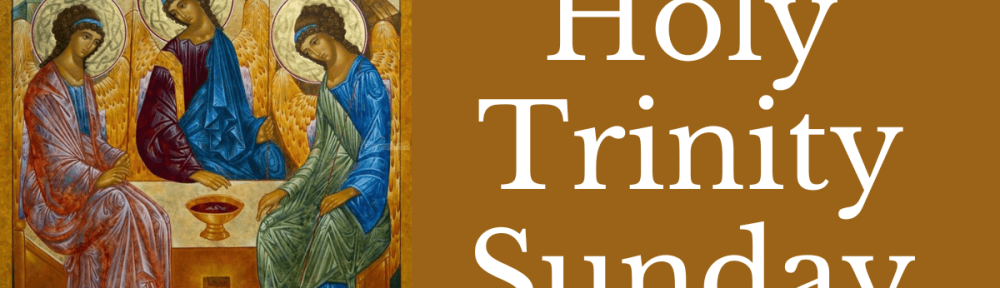
The celebration of Holy Trinity Sunday — the Sunday dedicated to honoring the mystery of the Triune God (Father, Son, and Holy Spirit) — has an interesting development in the history of the Catholic Church. In the early Church (first few centuries), there was no specific feast day solely dedicated to the Holy Trinity. Instead, belief in the Trinity was celebrated implicitly in almost every Mass, because Christian worship was (and is) always directed to the Father, through the Son, in the Holy Spirit. The early Church was more focused on defining the doctrine of the Trinity, especially during controversies like Arianism (which denied the full divinity of Jesus). The Council of Nicaea (325 AD) and later Council of Constantinople (381 AD) formally articulated Trinitarian doctrine.
As heresies continued in the Post-Nicene era and the Church’s doctrine matured, there was a growing desire to have a specific liturgical celebration that explicitly honored the Trinity. By the 8th century, some monasteries, especially in parts of France and Germany, began celebrating a local feast in honor of the Holy Trinity. In the 9th–10th centuries devotion grew, especially promoted by monks and theologians (like the Benedictines). In the 11th century Pope Alexander II reportedly opposed making it a universal feast, saying that the Church daily honored the Trinity liturgically. However, the idea continued gaining ground in various regions.
Pope John XXII (reigned 1316–1334) finally made the Feast of the Holy Trinity an official, universal celebration for the entire Roman Church. It was placed on the Sunday after Pentecost, a symbolic time: after celebrating the coming of the Holy Spirit (Pentecost), the Church turns to glorify the full mystery of the Triune God. The Sunday after Pentecost is well suited because Pentecost celebrates the final event of God’s self-revelation (sending the Holy Spirit), and Trinity Sunday reflects on the fullness of God’s mystery as revealed in salvation history. In the Roman Rite, Trinity Sunday is now a Solemnity, the highest rank of liturgical feasts.
Eastern Catholics (those who follow Eastern liturgical traditions but are in full communion with Rome) do not have a “Trinity Sunday” exactly like the Roman Rite. However, they celebrate Pentecost very grandly and immediately afterward honor the Trinity. Pentecost Monday is sometimes called “Monday of the Holy Trinity.” The Easter Catholics retain a sense of the early Church in that their entire liturgical season after Pentecost (called “Ordinary Time” in the West) is considered living in the light of the Trinity.
The Gospel Readings – Before the reforms of Vatican II, each year, the same Gospel was read on Holy Trinity Sunday: Matthew 28:18–20: “Go, therefore, and make disciples of all nations, baptizing them in the name of the Father, and of the Son, and of the Holy Spirit…” The role of the Holy Spirit in animating the nascent Church was made clear in the Great Commission. After Vatican II, with the creation of the three liturgical years, there was a broader and more varying use of readings in the Sunday gospels in general. The same held true for Holy Trinity Sunday. Accordingly, the selected gospel reading vary with the liturgical year:
- A: John 3:16-18, “God so loved the world that he gave his only Son….”
- B: Matthew 28:16-20, “Go, therefore, and make disciples of all nations, baptizing them in the name of the Father, and of the Son, and of the holy Spirit”
- C: John 16:12-15, “But when he comes, the Spirit of Truth, he will guide you to all truth”
Year A emphasizes the Father-Son-Spirit mission. Year B highlights the Father’s love expressed in sending the Son. Year C shows the Spirit’s role in leading the Church into full truth. Even with the different readings, the core theme every year remains the same: God is One in Three Persons, revealed through salvation history.
Here in Year C, if you have been following the Gospel readings from weekday Masses, you will find that this Sunday gospel is very much in continuity with those readings. They come from the Farewell Discourse within the Gospel of John. A synopsis of the discourse can be understood as: the warning of Jesus’ coming death, that He is going away to a place they know and where the Father has a room prepared for them, not to worry, the Holy Spirit will come to enlighten their minds, enflame their hearts and remind them of all they have been taught. On Pentecost Sunday, just a week ago, that promise was fulfilled with the coming of the Holy Spirit. Before fully entering “Ordinary Time” in the liturgical year, we shift gears to celebrate Holy Trinity Sunday followed by Corpus Christi.
Discover more from friarmusings
Subscribe to get the latest posts sent to your email.
 friarmusings