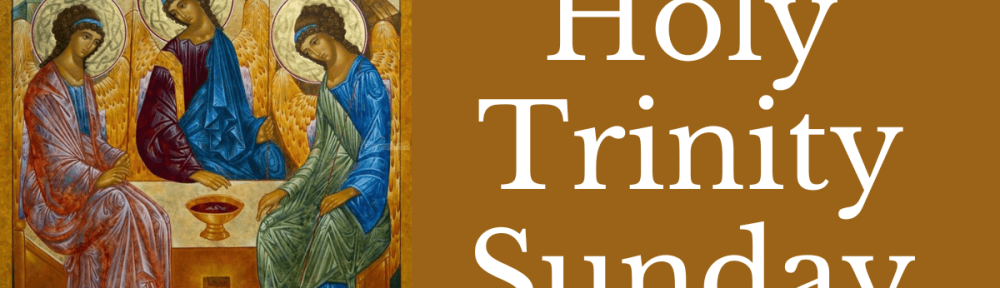
Rublev’s Trinity is one of the most famous religious icons in the world, and it’s a deeply symbolic and theological work of art. Painted by Andrei Rublev, a 15th-century Russian monk and iconographer, it visually represents the Holy Trinity — not as an abstract doctrine, but as a deeply relational and spiritual mystery. The inspiration for the icon is the Old Testament story in Genesis 18, where three angelic visitors come to Abraham and Sarah, a scene often called “The Hospitality of Abraham.” Yet Abraham and Sarah are notably absent from the scene. This shifts the focus from a narrative scene to a theological vision: not a story about the Trinity, but an icon of the Trinity.

The Three Figures Represent: God The Father (left), the Son (center) and the Holy Spirit (right). All are equal in form and appearance, reflecting the doctrine of co-equality and unity in the Trinity. But subtle symbols distinguish them.
The Father’s clothing is a shimmering, almost transparent robe symbolizing divine mystery and transcendence. With serene authority the Father looks lovingly at the Son. In the background is a house — often interpreted as a symbol of the Father’s dwelling (“In my Father’s house are many rooms” – John 14:2).
The Son’s clothing is an earth-toned inner garment (symbolizing humanity) and a blue outer cloak (divinity). The Son reaches out to the cup on the table — a symbol of His future sacrifice (the Eucharist and the Passion). In the background is a tree, symbolic of the Cross.
The Holy Spirit’s clothing is blue (divinity) and green (new life, regeneration). The Spirit looks towards the Father and the Son in communion and humility. In the background is a mountain, symbolizing spiritual ascent, inspiration, and the hidden workings of the Spirit.
The three figures sit around a white table that resembles an altar. At the center is a chalice with what seems to be a roasted lamb or calf — symbol of the Eucharist, and foreshadowing the sacrifice of Christ.
The icon has a circular composition, forming a visual theology. The figures are arranged in a circle, symbolizing unity, eternal communion, and divine love. The open side of the circle (facing the viewer) invites participation — an invitation into the divine life of the Trinity.
Rublev’s Trinity is a visual meditation on the mystery of God as a communion of love — Father, Son, and Holy Spirit — inviting us into that divine life. It fuses Scripture, theology, and art into a single, silent, yet profoundly eloquent image.
Discover more from friarmusings
Subscribe to get the latest posts sent to your email.
 friarmusings