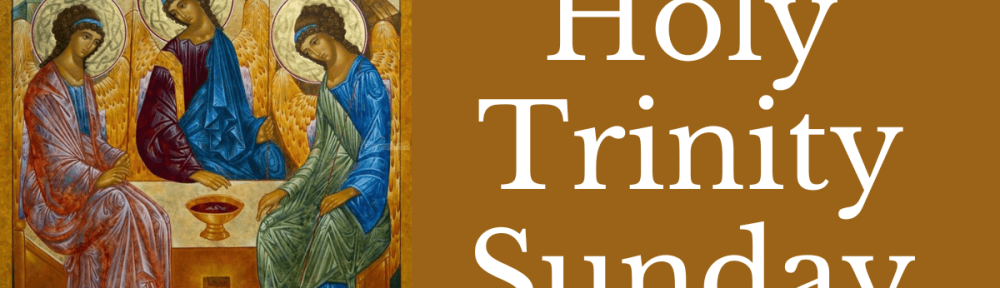
As we celebrate Holy Trinity Sunday, we do well to remember the connection between the Holy Spirit and Wisdom. I would typically provide some insight to the upcoming Gospel, but this passage of The Book of Proverbs is captivating and so I thought perhaps we might look at the first reading for the upcoming Trinity Sunday.
22 “The LORD begot me, the first-born of his ways, the forerunner of his prodigies of long ago; 23 From of old I was poured forth, at the first, before the earth. 24 When there were no depths I was brought forth, when there were no fountains or springs of water; 25 Before the mountains were settled into place, before the hills, I was brought forth; 26 While as yet the earth and the fields were not made, nor the first clods of the world.
27 “When he established the heavens I was there, when he marked out the vault over the face of the deep; 28 When he made firm the skies above, when he fixed fast the foundations of the earth;
29 When he set for the sea its limit, so that the waters should not transgress his command; 30 Then was I beside him as his craftsman, and I was his delight day by day, Playing before him all the while, 31 playing on the surface of his earth; and I found delight in the sons of men.
32 “So now, O children, listen to me; 33 instruction and wisdom do not reject! Happy the man who obeys me, and happy those who keep my ways, 34 Happy the man watching daily at my gates, waiting at my doorposts; 35 For he who finds me finds life, and wins favor from the LORD; 36 But he who misses me harms himself; all who hate me love death.” (Proverbs 8:22–36)
Context – An Overview of the Book of Proverbs
(adapted from the Reading Guide by Rev. Donald Senior in “Catholic Study Bible”)
The Book of Proverbs is a compendium of collections of sayings and instructions. Many of the sayings and perhaps some instructions were composed during the era of the kings of Judah and Israel. (late eleventh to the early sixth centuries BC). Most scholars believe the book reached final compilation and written form in the period immediately after the Exile in Babylon – when chapters 10-31 were “pulled together – and chapters 1–9 were added as the introduction. There is a verse (25:1) that suggests the materials could be traced to King Solomon and the scribes of the royal court: “These also are proverbs of Solomon. The servants of Hezekiah, king of Judah, transmitted them.” This perhaps refers to the task of compiling what seems to have its roots in the traditions of the tribes of Israel. The origin of the material, however, need not be imagined in an either/or scenario. Folk wisdom could have well been taken up and re-expressed by royal scribes. In any case Proverbs wins over readers with its compelling portrait of wisdom and inviting them to see life afresh, “wisely,” through its wit, originality, and shrewd observation.
Purpose. The primary purpose of the book is to teach wisdom and to young and old alike: “That people may know wisdom and discipline, may understand intelligent sayings; May receive instruction in wise conduct, in what is right, just and fair; That resourcefulness may be imparted to the naive, knowledge and discretion to the young. The wise by hearing them will advance in learning, the intelligent will gain sound guidance.” (1:2-4) What is being taught is not theoretical knowledge but practical expertise. Jewelers who cut precious stones were wise; kings who made their dominion peaceful and prosperous were wise. One could be wise in daily life, too, in knowing how to have a prosperous household while living a long and healthy life without trouble in God’s universe. Ultimately wisdom, or “sound guidance” (1:5), aims at the formation of Godly character.
Wisdom. In the ancient Near East (ANE), people assumed that wisdom belonged to the gods, who were wise by reason of their divinity; human beings needed to have wisdom granted them by the gods. Many of the “beginning of the world” accounts found in surrounding ANE cultures depict creation in two stages. In the first stage, human beings lived an animal-like existence, without clothes, writing, or kingship (seen as proper governance). Over time, the gods came to realize that such a low grade of existence made the human race inadequate as their servants, so they endowed the race with “wisdom,” which consisted of culture (e.g., kingship) and crafts (e.g., knowledge of farming, ability to weave). Such wisdom elevated the race to a “human” level and made them effective servants of the gods. Furthermore, divine wisdom was mediated to human beings through earthly institutions—the king, scribes (who produced wise writings), and heads of families (fathers, sometimes mothers). These traditional mediators appear in Proverbs – in fact, the book is credited to King Solomon. Throughout the book kings are mentioned as pillars of society (e.g., 16:12–15); writings are a source of wisdom (1:1–7); the father instructing his son is the major paradigm of teaching. Proverbs differs, however, from other wisdom books in concentrating on wisdom itself, treating it as a virtually independent entity and personifying it as an attractive woman. Other books urge readers to perform wise acts, but Proverbs urges them to seek wisdom itself and portrays wisdom as a woman seeking human beings as disciples and companions.
Audience. The original audience of the instructions and sayings seems to have been male. The father addresses his son, marriage is finding a wife, success often is serving the king or farming effectively. The book itself, however, expands the traditional audience of youths (1:4) to include older, more experienced, people (1:5). It broadens the father-son language by mentioning the mother, and incorporates sayings on human experience generally. The father teaching his son becomes a model for anyone teaching a way of life to another person.
Structure. The Book of Proverbs has nine sections. Chapters 1–9 introduce the book, drawing attention to wisdom itself and its inherent value rather than exhorting particular wise actions. The chapters personify wisdom as a woman and draw an extended analogy between finding a wife, or founding and maintaining a house(hold), and finding wisdom. The collections following chap. 9 consist largely of independent, two-line sayings, yielding their often indirect or paradoxical meaning only to readers willing to ponder them. To reflect on the sayings is perhaps what chapters 1–9 mean by living with Wisdom and dwelling in her house.
Place in Our Tradition. The Book of Proverbs places the pursuit of wisdom over the performance of individual wise acts. To seek wisdom above all things is a fundamental option and a way of life. Second, it portrays the quest as filled with obstacles. There are men and women who offer a substitute for the real thing; discernment is required. Third, the book teaches that acquiring wisdom is both a human task and a divine gift. One can make oneself ready to receive by discipline, but one cannot “grab” such a divine gift. Fourth, wisdom is in the world but it is not obvious to people entirely caught up with daily activities. The instructions and the aphorisms of the book can free the mind to see new things. Christians will see in personified Wisdom aspects of Jesus Christ, who they believe is divine wisdom sent to give human beings true and full life. Yet there is a universal dimension to Proverbs, for in its attention to human experience it creates a link to all people of good will.
The genres and themes of Proverbs continued on in Sirach, Wisdom of Solomon, and the later Jewish writings. The New Testament saw Jesus as a wisdom teacher and employed the tradition of personified wisdom of chaps. 2 and 8 to express his incarnation. The Letter of James is an instruction resembling those in Proverbs. Wisdom traditions influenced the Gospels of Matthew and Luke through a common source (see, e.g., Mt 11:25–27 and Lk 10:21–22, which seem to derive their father-son language, at least in part, from the parental language of Proverbs). The Gospel of John regards Jesus as incarnate wisdom descended from on high to offer human beings life and truth and make disciples of them, a view largely reflected in Proverbs 1–9.
Discover more from friarmusings
Subscribe to get the latest posts sent to your email.
 friarmusings