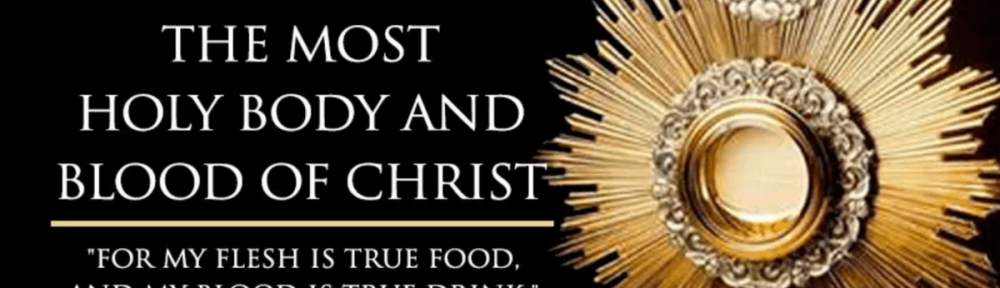
Each year on the Solemnity of Corpus Christi the gospel is taken from one of the miraculous feeding of the multitudes. This year the reading is from the Gospel of Luke 9:10-17 when five loaves and two fish become the starting point for feeding more than 5,000 people.
This Lukan passage comes at a “breaking point” in the narrative of the gospel. In Luke 8, we come to a “kind of ending” of the Galilean mission. Up to and through Luke 8 the accounts have focused on Jesus – the telling of parables (sower and the seed, 8:4-15; lamp, 8:16-18) and performance of miracles (calming of the sea, 8:22-25; healing of the demoniac, 8:26-39; healing of Jairus’ daughter, 8:40-56). At the beginning of Luke 9, the Twelve are sent on mission, “He summoned the Twelve and gave them power and authority over all demons and to cure diseases, and he sent them to proclaim the kingdom of God and to heal (the sick)” (vv1-2). These were prophetic actions that Jesus had already given to the people and the leaders of the Jews. As the leaders began to reject Jesus, even while the outcasts began to accept him, there was a growing gap in religious leadership. And thus Jesus, already having taught his disciples the meaning of the Kingdom, now sends them to proclaim God’s reign in word and deed. We are only told of the summary of their missionary endeavors: “Then they set out and went from village to village proclaiming the good news and curing diseases everywhere.” (Luke 9:6)
Joel Green (352) provides us with additional context for the Lukan narrative: “The break between chs. 8 and 9 is not abrupt. In fact, the groundwork for the twin focus of 9:1–50, christology and discipleship, is laid in ch. 8, with its concerns with perceptiveness and active faith. This new section is distinguished from the previous one primarily by the explicitness of its portrayal of the disciples and by its heightened, even candid concern with Jesus’ identity. Already in ch. 8, the presence of the disciples with Jesus had become more pointed than at any other time since their being called in chs. 5–6. Now, however, they are active agents involved in the mission of Jesus, and they begin to be developed less as companions and more as characters in their own right within the larger narrative of Luke-Acts. The end of this new section is clearly marked, with Jesus departing from his divine mission in the region of Galilee (cf. 4:14–15; §10) in order to begin the meandering journey to Jerusalem (see 9:51, 53). Consequently, 9:1–50 should be regarded as a transitional unit, bringing the Galilean segment of Jesus’ ministry to a close and setting the stage for the next major stage of his mission. With the closing of the Galilean section, the central issues of Jesus’ identity and mission and the character of discipleship are on display in a way that renders necessary the more concentrated periods of discipleship instruction and formation that will characterize the journey.”
Between the sending and the return of the disciples, there is a short episode: “7 Herod the tetrarch heard about all that was happening, and he was greatly perplexed because some were saying, “John has been raised from the dead”;8 others were saying, “Elijah has appeared”; still others, “One of the ancient prophets has arisen.”9 But Herod said, “John I beheaded. Who then is this about whom I hear such things?” And he kept trying to see him.” (Luke 9:7-10) Clearly, Luke has raised the question of Jesus’ identity – something that will continue to be revealed in what he does and what he calls others to do. By the same token, those who desire to see who Jesus is will see him only if they respond to his call to preach the gospel, heal the sick, and feed the hungry. There is still truth in Albert Schweitzer’s immortal words at the conclusion of The Quest of the Historical Jesus:
He speaks to us the same word: “Follow thou me!” and sets us to the tasks which He has to fulfil for our time. He commands. And to those who obey Him, whether they be wise or simple, He will reveal Himself in the toils, the conflicts, the sufferings which they shall pass through in His fellowship, and, as an ineffable mystery, they shall learn in their own experience Who He is.”
Image credit: Pexels modified with Canva, CC-0
Discover more from friarmusings
Subscribe to get the latest posts sent to your email.
 friarmusings