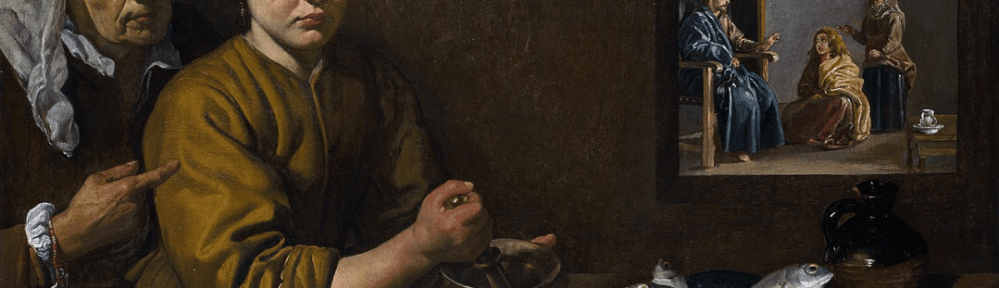
This coming Sunday is the 16th Sunday of Ordinary Time and the story of Martha and Mary. In yesterday’s post we provided some context and raised the question of this gospel and the one in which the lawyer asks Jesus what he must do to gain eternal life.
Looking at these stories together, it suggests that the contrast is not between doing and listening, but between being anxious and not. Green (The Gospel of Luke) notes in a footnote (p. 436) that the contrast is not really between Martha’s doing or service and Mary’s listening, but between “hearing the word” (namely, discipleship) and “anxious” behavior (namely, the antithesis of discipleship).
Martha’s service (Greek: diakonia) is a good and honorable act—hospitality was highly valued in Jewish life. However, her anxiety and worry (v. 41) show that her service has become a source of stress and resentment. The issue is not Martha’s activity but her divided heart. She is “burdened” and perhaps distracted from recognizing what is truly important: the presence and teaching of the Lord. Mary “chose the better part” (v. 42), not because hospitality is bad, but because hearing the word of the Lord is the essential and lasting part of discipleship.
In Christian tradition, this passage has often been interpreted allegorically as the balance between the active (Martha) and contemplative (Mary) life. While both are necessary, contemplation—being with God—is ultimately the “better part” because it aligns us directly with the source of all action. St. Augustine (Sermon 103) wrote: “Martha symbolizes the present life of activity and care, while Mary reflects the future life of rest and contemplation.”
Culpepper (Luke, New Interpreter’s Bible, 231) makes these observations:
The story of the good Samaritan then develops the meaning of the command to love one’s neighbor, and the story of Mary and Martha highlights the overriding importance of devotion to the Lord’s Word as an expression of one’s love for God. The story of the good Samaritan features “a certain man” (v. 30), while Martha is introduced as “a certain woman” (v. 38). The good Samaritan exemplifies the disciples’ seeing; in a similar way, Mary exemplifies the virtue of hearing (see 10:23-24). Moreover, both the Samaritan and Mary, a woman, represent marginalized persons — unlikely heroes. As a composite, they are model disciples: “those who hear the word of God and do it” (8:21).
All of the above is a continuation of Jesus’ journey to Jerusalem (begun in 9:51) – where hospitality had been refused by the Samaritan villagers. Here in our passage, Jesus and the disciples are welcomed into a home by Martha.
Image credit: Jesus at the home of Martha and Mary | Diego Velázquez, 1618 | National Gallery, London| PD-US
Discover more from friarmusings
Subscribe to get the latest posts sent to your email.
 friarmusings