The dispute and the parable appears only in Luke among the gospels, situated within the on-going travel narrative as Jesus and the disciples move ever forward towards Jerusalem. Although the inheritance in question (v.13) is not specifically mentioned as land, given the parable’s setting (v.16) one might safely assume land was the issue.
In the western legal system, inheritance law, the core function of inheritance laws is to provide a legal framework for the transfer of ownership of a deceased person’s assets (real estate, personal property, financial accounts, etc.). The laws prioritize the rights of certain family members, particularly spouses and children, ensuring they receive a share of the estate. In general, the western version of the law does not serve a social function, e.g., helping to manage wealth distribution and prevent excessive concentration of wealth in the hands of a few.
In ancient Israel there were biblical laws regarding land and inheritance (see Num. 27:1–11; 36:7–9; Deut. 21:16–17 – shown at the end of this post.
The bêt-āb was the basic unit of Israel’s system of land tenure, each having its own naḥălâ (inheritance) of land, and therefore intended to be economically self-sufficient. The intention of Israel’s land tenure system, namely that ownership of land should be as widely spread as possible with broad equality over the network of economically viable family units, was embodied in and protected by the principle of inalienability. This was the rule that the land should remain in the family to which it had been apportioned, and could not be sold permanently outside the family. It was a rule tenaciously adhered to through Israel’s history, as far as the evidence points. The whole OT gives us no single example of an Israelite voluntarily selling land outside his family. Recorded land transfers were either kinship redemption (Jeremiah 32, Ruth), sale by non-Israelites (2 Samuel 24; 1 Kgs 16:24), or nonvoluntary mortgage of land for debt (Neh 5:3). Nor is there any inscriptional evidence from Palestine of Israelite sale and purchase of land, even though there are abundant records of such transactions from Canaanite and surrounding societies. The only legal method by which land in the OT period “changed hands” was by inheritance within the family. Even Ahab recognized this, when faced with Naboth’s stand on this principle (1 Kings 21). The means used to circumvent it and the forcible confiscation of Naboth’s family land show the grim fulfillment of Samuel’s prediction as to what monarchy would entail for the previously economically autonomous families of Israel. [ABD 2:763]
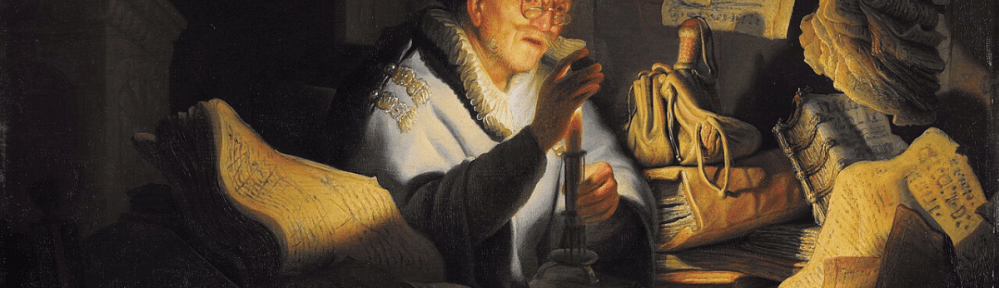
Image credit: The Parable of the Rich Fool | Rembrandt, 1627 | Gemäldegalerie, Berlin | PD-US | also known as The Money Changer
Old Testament Laws on Inheritance
Numbers 27
1 Zelophehad, son of Hepher, son of Gilead, son of Machir, son of Manasseh, son of Joseph, had daughters named Mahlah, Noah, Hoglah, Milcah and Tirzah. They came forward, 2 and standing in the presence of Moses, the priest Eleazar, the princes, and the whole community at the entrance of the meeting tent, said: 3 “Our father died in the desert. Although he did not join those who banded together against the LORD (in Korah’s band), he died for his own sin without leaving any sons. 4 But why should our father’s name be withdrawn from his clan merely because he had no son? Let us, therefore, have property among our father’s kinsmen.” 5 When Moses laid their case before the LORD, 6 the LORD said to him, 7 “The plea of Zelophehad’s daughters is just; you shall give them hereditary property among their father’s kinsmen, letting their father’s heritage pass on to them. 8 Therefore, tell the Israelites: If a man dies without leaving a son, you shall let his heritage pass on to his daughter; 9 if he has no daughter, you shall give his heritage to his brothers; 10 if he has no brothers, you shall give his heritage to his father’s brothers; 11 if his father had no brothers, you shall give his heritage to his nearest relative in his clan, who shall then take possession of it.” This is the legal norm for the Israelites, as the LORD commanded Moses.
Numbers 36
6 This is what the LORD commands with regard to the daughters of Zelophehad: They may marry anyone they please, provided they marry into a clan of their ancestral tribe, 7 so that no heritage of the Israelites will pass from one tribe to another, but all the Israelites will retain their own ancestral heritage. 8 Therefore, every daughter who inherits property in any of the Israelite tribes shall marry someone belonging to a clan of her own ancestral tribe, in order that all the Israelites may remain in possession of their own ancestral heritage. 9 Thus, no heritage can pass from one tribe to another, but all the Israelite tribes will retain their own ancestral heritage.”
Deuteronomy 21
15 “If a man with two wives loves one and dislikes the other; and if both bear him sons, but the first-born is of her whom he dislikes: 16 when he comes to bequeath his property to his sons he may not consider as his first-born the son of the wife he loves, in preference to his true first-born, the son of the wife whom he dislikes. 17 On the contrary, he shall recognize as his first-born the son of her whom he dislikes, giving him a double share of whatever he happens to own, since he is the first fruits of his manhood, and to him belong the rights of the first-born.
Discover more from friarmusings
Subscribe to get the latest posts sent to your email.
 friarmusings