Honor and Humility

We can probably spend the next hour telling humorous and outrageous stories about seating.  From seats at school, seats on airplanes, and stories of being seated at wedding receptions with folks that are, …what can I say?  “Unique” seems like a good word. We even have stories about seats at church.

Did you know that until the early/mid twentieth century, it was common practice in Anglican, Catholic, and Presbyterian churches to rent pews in churches to families or individuals as a means of raising income? This was especially common in the United States where, unlike Europe, churches lacked governmental financial support. So, churches rented pews to families, which of course enforced a sort of social status in church seating within a parish. It led to all kinds of problems. Should the pew rents simply be renegotiated, should they occasionally be subject to auction, can they be included in the will, bequeathed to the next generation?  

Continue reading

Reflections: a different Kingdom

Be you host or guest, Alan Culpepper [287-88] offers these final thoughts on the gospel for the upcoming Sunday. 

These are liberating words [the gospel] that can free us from the necessity of succeeding in our culture’s contests of power and esteem. They free us from over-under relationships and the attitudes and barriers they create, so that we may be free to create human community and enjoy the security of God’s grace.

This commentary on ancient meal practices and social stratification makes two points. First, one should cultivate and practice humility, if only because it is a prudent means of avoiding embarrassment. The eschatological application at the end of each of the two sections drives home a deeper meaning. Although the practice of humility is proper and prudent for disciples, the kingdom of God will bring about an even more revolutionary reversal. The very standards and practices of discrimination will be overthrown. The outcasts will be accepted as equals. Those who live by kingdom standards and values now will not only bear witness to the kingdom but also will be rewarded in “the resurrection of the righteous” (v. 14). Righteousness, not social position or the esteem of others, should be our goal. God does not look on the glitter of our guest list. Instead, God looks to see that we have practiced the generosity and inclusiveness of the kingdom in our daily social relationships. One standard offers the reward of social position, the other the reward of God’s favor.

The distinctiveness of Jesus’ vision of the kingdom was nowhere clearer than in his protest against discriminatory meal practices. Jesus and the Pharisees ate differently. For Jesus, meals were times of celebration and an inclusive fellowship that foreshadowed the inclusiveness of God’s kingdom. The last supper, therefore, not only pointed ahead to the eschatological banquet, but also it reflected on Jesus’ meals with the disciples, Pharisees, crowds, and outcasts in Galilee. The greatest crisis the early church faced, moreover, was not the delay of the parousia but the burning issue of whom one ate with (see Acts 10:9–16, 28; 15:19–20; Gal 2:11–14). Perhaps it is time we learned new table manners.


Image credit: Jesus at Supper | Caravaggio (1606) | National Gallery London | PD-US

Japanese Intelligence: Past as Prelude

The Japanese could intercept Allied radio traffic, but they lacked the computational resources and personnel to break complex Allied codes like Naval Cypher No. 5. Their cryptanalytic efforts were centralized and bureaucratically fragmented, lacking the scale and success of U.S. or British efforts. As a result Japan remained largely blind to Allied operational planning, especially in the Central Pacific campaigns. In addition, their intelligence analysis and interpretation – especially on a strategic level – was hindered by their rigid military culture and intense rivalry between the Army and Navy. Their military intelligence units operated as though in silos. Intelligence was often ignored or suppressed if it conflicted with existing assumptions or the wishes of senior commanders who operated on biases about the lack of a warrior spirit among allied soldiers and sailors. The senior commanders also underestimated American industrial strength, technological innovation, and the ability to sustain large-scale operations across the Pacific.

But it does not mean they were uninformed.

Continue reading

Advice for the Hosts

The gospel for the upcoming Sunday is taken from the Gospel of Luke describing an encounter with the Pharisees at a banquet.  Just as Jesus’ fellow guests had occupied themselves in normal, honor-seeking pursuits upon arrival at the meal, so Jesus’ host had followed ordinary conventions in putting together his invitation list. Invitations served as “currency in the marketplace of prestige and power” [Green, 552] for those whose framework was the world as we know it. Seen through the framework of the Kingdom of God, a different currency is the “gold standard.”

Jesus expands the picture of humility by exhorting his audience to invite to their dinner table the needy and those who cannot repay such kindness. Hospitality should be open to all. This kind of reversal of expectations and status is thematic in Luke (e.g., 1:52; 6:20-26; 18:14). In fact, in the very next passage, our meal story continues with Jesus reemphasizing the notion of inviting the poor, the crippled, the lame, and the blind (14:21), this time in a parable representing the eschatological banquet of God, which will include just such marginalized ones, with the “invited guest list” being left out (14:24). 

Continue reading

This day in history

The Battle of Midway (June 4, 1942) was one of the key battles in World War II and in naval history. It marked the first major aircraft carrier v. aircraft carrier engagement in naval history and was the first defeat in the onslaught of what were otherwise victory after victory for the armed forces of the Empire of Japan.

On this day in history in 1867, Captain William Reynolds of the screw sloop Lackawanna raised the American flag over Brooks’ Islands (later renamed Midway Atoll). It was formally annexed on 28 December. by the United States as the Unincorporated Territory of Midway Island and was administered by the United States Navy.

There were attempts to settle the island but the first successful effort was by the Commercial Pacific Cable Company as part of the effort to lay a trans-Pacific telegraph cable. A small contingent of US Marines were stationed on the island. In 1935 Pan American Airlines operated out of the island as part of it trans-Pacific routes – and as a tourist destination.

Continue reading

War of Resolve and Propaganda

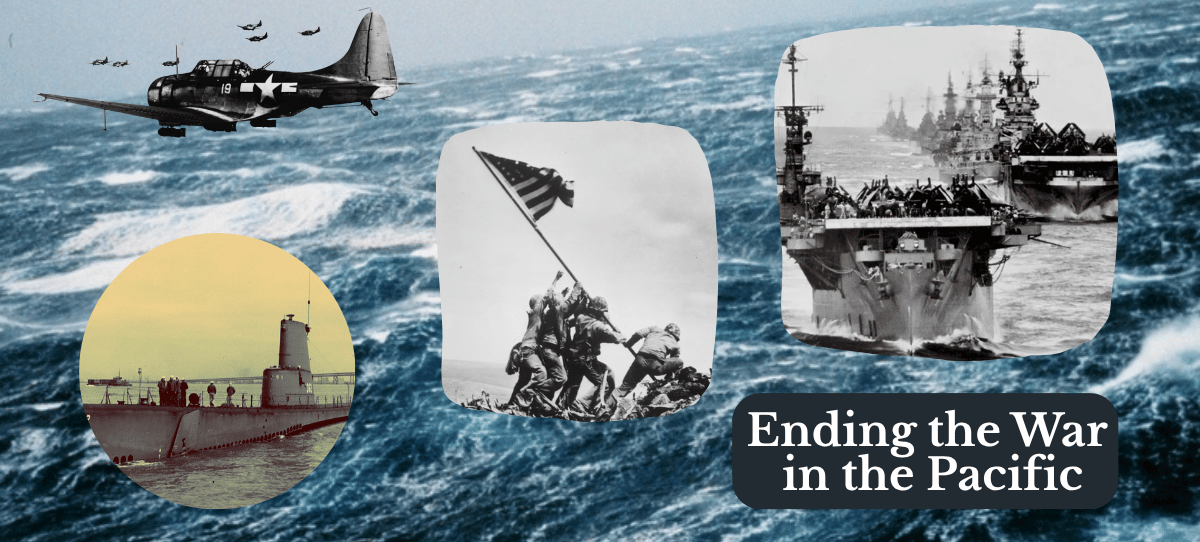
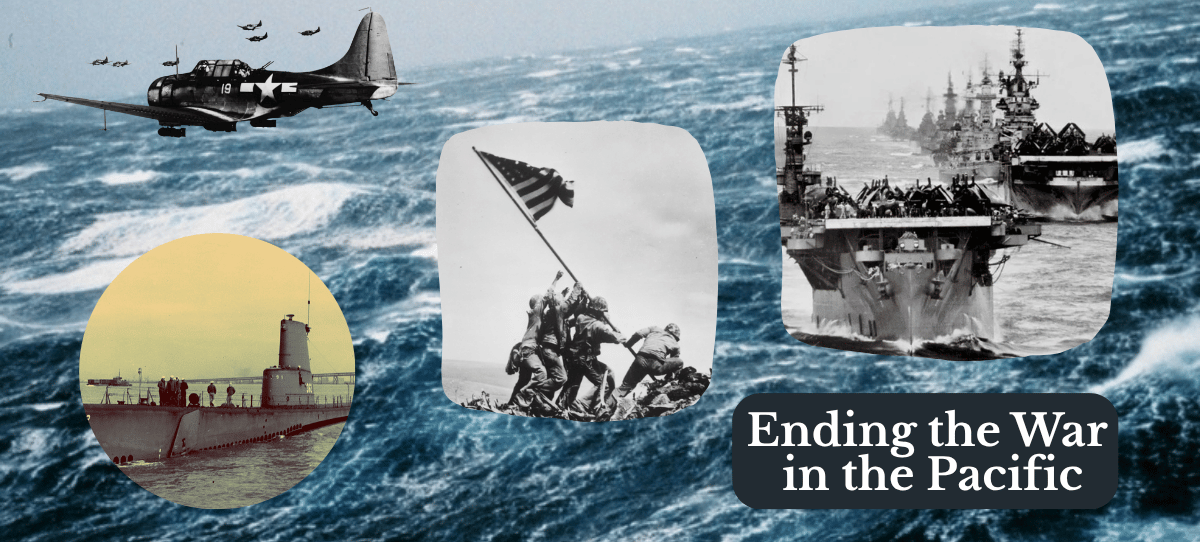
As the war in the Pacific moved into the summer of 1945 combatant casualties continued to mount as discussed in the previous post – so too did civilian deaths. On Saipan the Imperial Japanese Army (IJA) incorporated civilians into combat roles – it was the first but not the last time allied forces would encounter this blurring of military and civilian roles: Guam, Tinian, Iwo Jima, Okinawa and Manilla in the Philippines. By any measure, these were war crimes, but the effect was to implant in allied war planners the seeds of what they might expect if and when it came time to invade the main Japanese home islands of Kyushu and Honshu where the civilian populations were in the tens of millions

Historian Richard Frank (in Downfall: The End of the Imperial Japanese Empire) and John Dower (in War Without Mercy) detail this evolution. Both historians see evidence of a “total-war” mindset that developed as the war in the Pacific progressed when it was clear to Japanese military leadership that they were fighting a war of attrition. Twin allied advances in the Southwest and Central Pacific campaigns were inexorably driving towards the Japanese home islands leading into the brutal logic of late-war defense. By mid-1944, Japanese commanders had recognized that defeating U.S. forces in head-to-head combat was unrealistic. Their goal became to:

Continue reading

St. Augustine of Hippo

Today is the Feast Day of St. Augustine of Hippo and perhaps it is good for a quick refresher of this person that so influenced Christianity. He was born in Thagaste, in Roman North Africa (present-day Algeria), growing up with his mother, Monica, was a devout Christian, while his father remained a pagan until late in life. His early life did not follow in his mother’s faith tradition, rather he pursued studies in rhetoric and philosophy, eventually teaching in Carthage, Rome, and Milan. His was the pursuit of truth which he sought in various philosophies and religious movements – none of which seemed to address his greater questions. In the interim, as was the tradition of the day, he was – shall we say – morally unsettled. Meanwhile his mother prayed for his conversion.

At the age of 31 he was moved by the preaching of St. Ambrose in Milan and by an experience of divine prompting while reading Scripture. It was in this period that he remarked: “Lord make me chaste, but not just yet” – a good indication of the on-going internal struggle. Soon enough Augustine was baptized and soon returned to North Africa founding a monastic community. He was later ordained a priest, becoming bishop of Hippo (North Africa) four years later, a position he held for 35 years.

Here are five pivotal moments in Augustine’s life and the impact of these moments that resonant even up to today:

Continue reading

Advice for the Guests

The gospel for the upcoming Sunday is taken from the Gospel of Luke describing an encounter with the Pharisees at a banquet.  In a wedding banquet setting it was expected that power and prestige would be placed closest to the head of the table (see Note on 14:7 below). This was probably more formal than most meals, but the words apply to any banquet.  Jesus points out the danger in pursuing seats of honor. He tells the story of a wedding where someone quickly grabs a high seat of honor. But then a person more distinguished walks in, and the host insists that the interloper vacate his position. At that point he may find all the other places occupied, so that the only course open to him is to take the lowest place, with all the shame and loss of face implied (cf. Prov. 25:7). So humiliated, the presumptuous one must head to the last seat. The description of the move down the social ladder is drawn out in Greek to underline the person’s shame (you begin with shame… to head for the last seat) It is as if every step hurts.

However, if one chooses the lowest place, the only way one can go is up. Rabbi Simeon b. Azzai is reported to have advised guests to take a place two or three seats lower than that to which they were entitled: ‘Better that people say to you “come up, come up,” and not say to you, “go down, go down”’ (Leviticus Rabbah I.5). 

Continue reading

Kokutai

Kokutai is a uniquely Japanese concept often translated as ‘national polity’ or ‘national essence.’ 

It refers to the unique constitutional and spiritual essence of the Japanese nation and its people, centered historically on the Emperor as a symbol of continuity and unity. Kokutai is not just a political constitution but a broader idea of Japan’s national identity and political order. It embodies ideas about the Emperor’s divine descent (from Amaterasu, the sun goddess), Japan’s unique historical destiny, and the special relationship between the ruler and subjects.

In prewar and wartime Japan, Kokutai was used to legitimize the Emperor’s absolute sovereignty and Japan’s political system. It was often invoked to promote national unity, loyalty, and resistance to foreign political ideas like liberal democracy or socialism. Kokutai placed the Emperor at the center of sovereignty and moral authority. This made Kokutai both a political doctrine and a national ideology that justified Japan’s imperial system and mobilized the population. 

Continue reading

Honor at Meals

The gospel for the upcoming Sunday is taken from the Gospel of Luke describing an encounter with the Pharisees at a banquet. In yesterday’s post we discussed “humility”. Today we consider “honor.” The meal setting is common in many of the gospels as a metaphor for the celebration of the Kingdom’s come. But it is also often a setting of controversy. Consider that 14:1-6 centered on the debate at table regarding the lawfulness of curing on the Sabbath – reminiscent of earlier discussions about appropriate behavior on the Sabbath (e.g., 6:2, 9; 13:14–16). When Jesus asks if it would be lawful to cure the man with dropsy, those at the table are silent. When Jesus next asks if their son or oxen fell into a cistern would they pull them out, again, they are silent. The easiest take on their reaction is that Jesus has them timid and stumped. But there was a long standing tradition for debate about the understanding of the Law. I would suggest that given Jesus’ challenging questions, one would need time to think about the reasoning – and in the face of such challenging wisdom, perhaps there is a struggle for the host to figure out exactly where this wandering preacher from Nazareth should be sitting.

That dynamic then opens the way for Jesus’ larger questions about honor at meals. Notice that vv.7-11, addressed to guests, is parallel to vv. 12-14, addressed to hosts, both showing a common pattern in which humility plays out.

Continue reading