As noted in the previous post, “War in the Pacific to this Point”, the series has focused on the strategic plans and tactical experience that has shaped the war on land and sea, and in the air. 1944 ended with the Philippine island of Leyte under Allied control. An invasion of Luzon was next with the hope that Japan would declare Manila an “open city” as MacAruthur had done in 1942.
After Luzon, the “road to Tokyo” was clear: Iwo Jima, Okinawa, and then (most likely) the southern Japanese home island of Kyushu.
This is a good point in the series to look at Japan and consider its governance, national identity, and their plans to defend the home islands. From the Allied perspective it is clear that the Imperial Japanese Army has effective control of future war plans and actions, but as allied intelligence operations reveal (via diplomatic code MAGIC) there are some misgivings about the military dominated governance. What remains a point of uncertainty is the role of Emperor Hirohito.
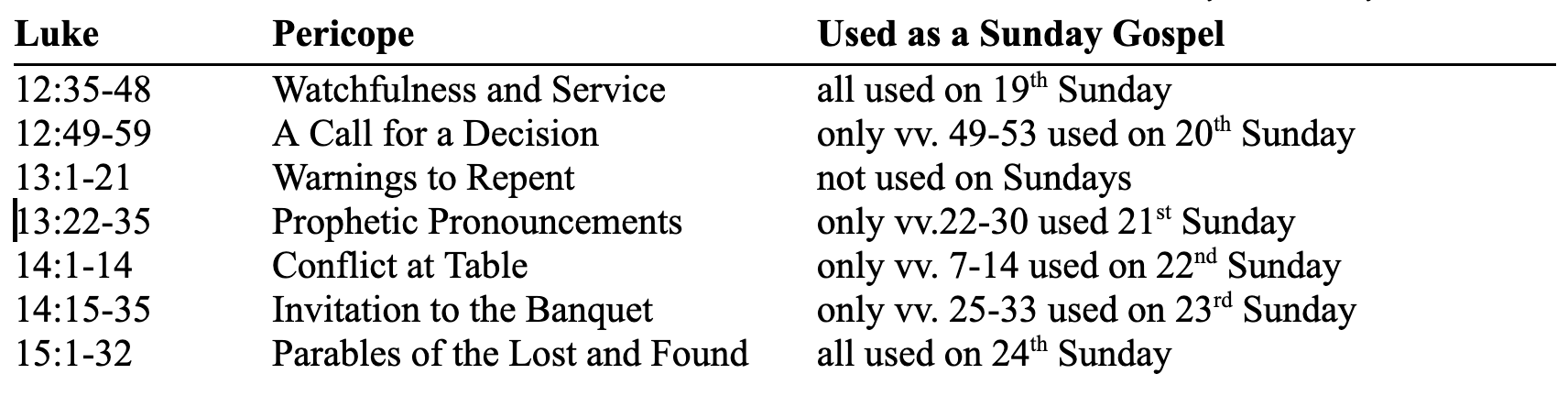
The gospel for the upcoming 22nd Sunday (Year C) is taken from the Gospel of Luke. On the journey to Jerusalem one of the principal themes has been that of discipleship. Much of Luke 12 attends to that theme especially in terms of preparedness and service. As Luke’s gospel narrative moves ahead, Jesus continues to teach about the nature of discipleship (see, judge, and act), the urgency of the decision to become a faithful and prudent disciple, and that our decisions and actions have consequences in terms of the kingdom of heaven. To that end, here is the recent progression of Sunday gospels. You’ll notice there are gaps and skips.
Among the portions missing from the Sunday gospels are
Jesus’ call to read the signs of the times as well as one reads the weather in order that one may judge rightly (12:54-59)
The parable of the fig tree that is permitted to remain in the vineyard for another season even though it has not yet produced fruit (13:1-9)
A healing of a woman, afflicted for 18 years, who was healed on the Sabbath that Jesus might again teach the meaning of the kingdom of God (13:10-17)
The parable of the mustard seed (13:18-21)
The lament of Jerusalem’s unfaithfulness (13:31-35)
A healing on the Sabbath at table (14:2-6)
The parable of the great feast (14:15-24)
The cost of discipleship and the necessity of preparations (14:25-35)
Some of the verses missing from Sunday gospels are well covered in the gospels of daily Mass, but there are some great images (reading the signs of time, the fig tree, and others) that would be great to have for Sunday homilies.
That being said, one does well to remember and understand that these verses come after Jesus exhortation to strive to enter that place where are gathered “Abraham, Isaac, and Jacob and all the prophets in the kingdom of God” (13:28) (from last Sunday’s gospel) and before the parable of the great feast (14:15-24) which speaks to the OT image of the kingdom of God as likened to a great banquet. The placement points out that the attitudes of discipleship in this life are reflected in the banquet of the kingdom of God.
This week’s gospel is at table. As Johnson [Luke, 223] notes: “If Jesus eats a meal with a Pharisee on the Sabbath, there surely will be conflict! During the meal Jesus addresses a fundamental attitude that is a constituent portion of discipleship: humility. This is not a new topic addressed to his disciples. Consider Luke 9:
46 An argument arose among the disciples about which of them was the greatest. 47 Jesus realized the intention of their hearts and took a child and placed it by his side 48 and said to them, “Whoever receives this child in my name receives me, and whoever receives me receives the one who sent me. For the one who is least among all of you is the one who is the greatest.”
Image credit: Jesus at Supper | Caravaggio (1606) | National Gallery London | PD-US

 friarmusings