
This day in history

The Battle of Midway (June 4, 1942) was one of the key battles in World War II and in naval history. It marked the first major aircraft carrier v. aircraft carrier engagement in naval history and was the first defeat in the onslaught of what were otherwise victory after victory for the armed forces of the Empire of Japan.

On this day in history in 1867, Captain William Reynolds of the screw sloop Lackawanna raised the American flag over Brooks’ Islands (later renamed Midway Atoll). It was formally annexed on 28 December. by the United States as the Unincorporated Territory of Midway Island and was administered by the United States Navy.

There were attempts to settle the island but the first successful effort was by the Commercial Pacific Cable Company as part of the effort to lay a trans-Pacific telegraph cable. A small contingent of US Marines were stationed on the island. In 1935 Pan American Airlines operated out of the island as part of it trans-Pacific routes – and as a tourist destination.

Continue reading
War of Resolve and Propaganda

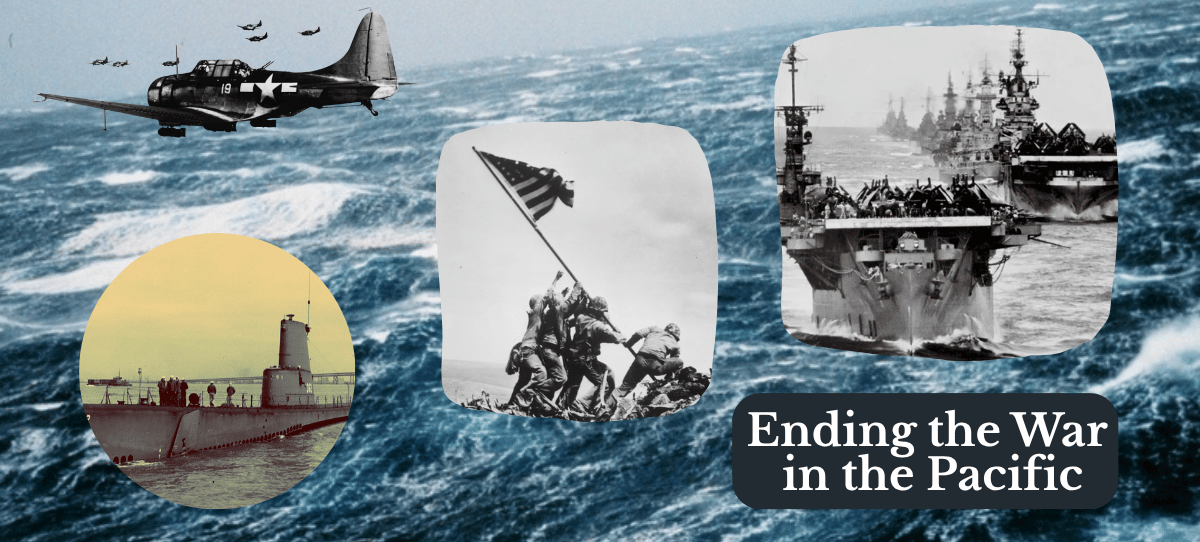
As the war in the Pacific moved into the summer of 1945 combatant casualties continued to mount as discussed in the previous post – so too did civilian deaths. On Saipan the Imperial Japanese Army (IJA) incorporated civilians into combat roles – it was the first but not the last time allied forces would encounter this blurring of military and civilian roles: Guam, Tinian, Iwo Jima, Okinawa and Manilla in the Philippines. By any measure, these were war crimes, but the effect was to implant in allied war planners the seeds of what they might expect if and when it came time to invade the main Japanese home islands of Kyushu and Honshu where the civilian populations were in the tens of millions

Historian Richard Frank (in Downfall: The End of the Imperial Japanese Empire) and John Dower (in War Without Mercy) detail this evolution. Both historians see evidence of a “total-war” mindset that developed as the war in the Pacific progressed when it was clear to Japanese military leadership that they were fighting a war of attrition. Twin allied advances in the Southwest and Central Pacific campaigns were inexorably driving towards the Japanese home islands leading into the brutal logic of late-war defense. By mid-1944, Japanese commanders had recognized that defeating U.S. forces in head-to-head combat was unrealistic. Their goal became to:

Continue reading

St. Augustine of Hippo

Today is the Feast Day of St. Augustine of Hippo and perhaps it is good for a quick refresher of this person that so influenced Christianity. He was born in Thagaste, in Roman North Africa (present-day Algeria), growing up with his mother, Monica, was a devout Christian, while his father remained a pagan until late in life. His early life did not follow in his mother’s faith tradition, rather he pursued studies in rhetoric and philosophy, eventually teaching in Carthage, Rome, and Milan. His was the pursuit of truth which he sought in various philosophies and religious movements – none of which seemed to address his greater questions. In the interim, as was the tradition of the day, he was – shall we say – morally unsettled. Meanwhile his mother prayed for his conversion.

At the age of 31 he was moved by the preaching of St. Ambrose in Milan and by an experience of divine prompting while reading Scripture. It was in this period that he remarked: “Lord make me chaste, but not just yet” – a good indication of the on-going internal struggle. Soon enough Augustine was baptized and soon returned to North Africa founding a monastic community. He was later ordained a priest, becoming bishop of Hippo (North Africa) four years later, a position he held for 35 years.

Here are five pivotal moments in Augustine’s life and the impact of these moments that resonant even up to today:

Continue reading

Advice for the Guests

The gospel for the upcoming Sunday is taken from the Gospel of Luke describing an encounter with the Pharisees at a banquet.  In a wedding banquet setting it was expected that power and prestige would be placed closest to the head of the table (see Note on 14:7 below). This was probably more formal than most meals, but the words apply to any banquet.  Jesus points out the danger in pursuing seats of honor. He tells the story of a wedding where someone quickly grabs a high seat of honor. But then a person more distinguished walks in, and the host insists that the interloper vacate his position. At that point he may find all the other places occupied, so that the only course open to him is to take the lowest place, with all the shame and loss of face implied (cf. Prov. 25:7). So humiliated, the presumptuous one must head to the last seat. The description of the move down the social ladder is drawn out in Greek to underline the person’s shame (you begin with shame… to head for the last seat) It is as if every step hurts.

However, if one chooses the lowest place, the only way one can go is up. Rabbi Simeon b. Azzai is reported to have advised guests to take a place two or three seats lower than that to which they were entitled: ‘Better that people say to you “come up, come up,” and not say to you, “go down, go down”’ (Leviticus Rabbah I.5). 

Continue reading