
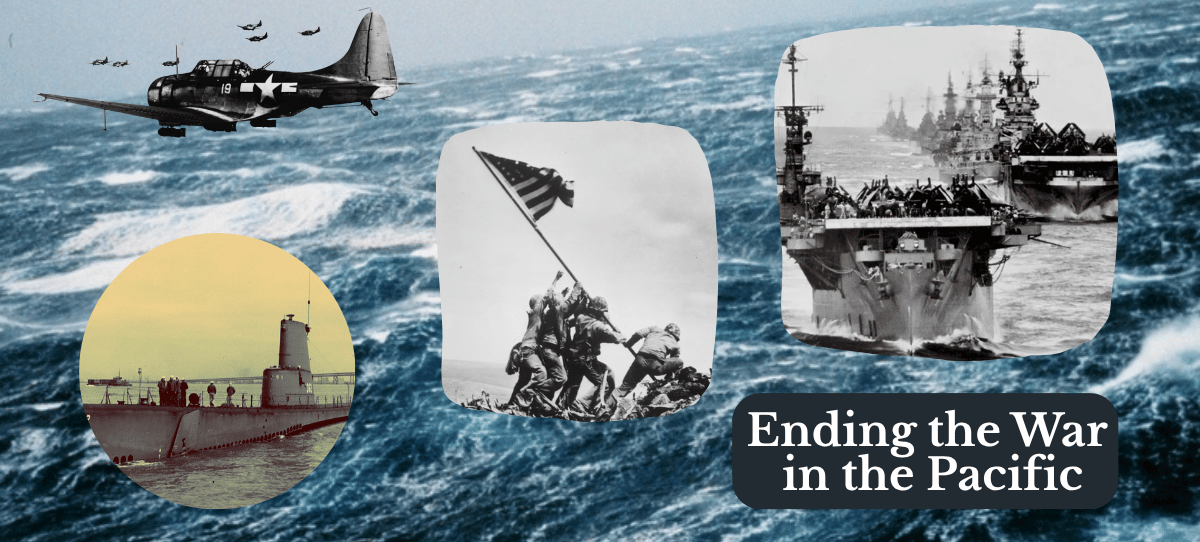
Ketsu-Go (“Operation Decisive”) was Japan’s final defense plan in World War II. It outlined the defense of the Japanese home island. At this point in the war the plan is an Imperial Army-led plan with the Imperial Navy playing a limited role apart from Naval Aviation. As noted in the previous post, as from the outset of the war the Imperial Army was “in charge” – not only in the Supreme War Council but in operational planning.
The goal of Ketsu-Go was to mass Japan’s remaining troops, planes, and special attack units (kamikaze) to repel the invasion, especially on the southern island of Kyushu, expected to be the first invasion point – as it would be in the Allied plan for invasion. The hope of Ketsu-Go was to make the battle so bloody and costly for the Allies that they would lose the will to continue the invasion and offer better surrender terms than complete and absolute surrender. At stake was Kokutai, an expression that literally means “national body” or “national essence”. This is explored in greater detail in the next post, but sufficient for now, this concept was not differentiated from the Emperor and the royal household.
In Ketsu-Go there was a fundamental realization that this would not be a repeat of their 1905 naval victory at Tsushima but only a last ditch effort to achieve what was always the goal of the original Kantai Kessen – an armistice with the United States that left Japan and its early war gains intact. Ketsu-Go would run head-long into the Allied demand for unconditional surrender that had no intention of leaving Japan militarized or with any of its early war gains. The allied demand for unconditional surrender had already been decided at the Casablanca Conference two years earlier (January 1943).
In addition there was a more fundamental issue at play: the idea of surrender. For the western soldier, surrender was not good, but it was logical. When the circumstances indicated that you’d run out of options the only “reasonable” options were retreat (live to fight another day) or simply live and place yourself at the mercy of your captor. For the Japanese soldier, surrender was the greater shame. The view was grounded in a complex mix of military indoctrination, cultural values, and fear of dishonor. Surrender was considered not only shameful but a betrayal of one’s duty to the Emperor and nation – to the Kokutai.
This difference was clear from the beginning of the war. Consider General Wainwright’s decision to surrender the Bataan Peninsula (Philippines) at the beginning of the war. The Filipino and American troops were out of ammunition and food; further resistance meant sure death. Their Japanese captors considered them shameful cowards who had betrayed their country – and were treated as such, the Death March of Bataan giving ample evidence.
The Japanese resolve to not surrender was experienced in every land battle from Guadalcanal to Okinawa. In campaigns such as Tarawa, Biak, Kwajalein, Saipan, Tinian, Guam, Peliliu, Iwo Jima, and Okinawa fewer than 2% of the Japanese garrison was captured. The remainder fought to the death. At the same time the casualty rates among allied ground troops in the Pacific were rising especially in comparison to the European Theater of Operations. Here are comparative casualty rates:
- D-Day Normandy France – 6-7%
- Tarawa – 20%
- Peliliu – 35%
- Iwo Jima – 37%
- Okinawa – 27%
These differences were well known to the American public.
From the high-levels of strategy to the on-the-ground reality of war, the mindset of the warring parties could not be farther apart. Ketsu-Go was not a strategy to win a battle or defend the Japanese home islands from devastation and death. It was a strategy to exact a high price of Allied casualties to avoid the shame of surrender. Ketsu-Go reflected a mindset that, if implemented, would extract an unimaginable price in human life and leave the survivors with scars for a lifetime.
Ketsu-Go was first presented to the Emperor in January 1945. In the background of the plan was the uniquely Japanese concept of kokutai.
Image credit: various photographs from Naval Aviation Museum, National World War II Museum, and US Navy Archives.
Discover more from friarmusings
Subscribe to get the latest posts sent to your email.
 friarmusings