
A previous post offered a brief discussion of a complicated issue – the governance of wartime Japan. Such governance was a complicated, ritual process involving Emperor Hirohito and the Supreme War Council (“Big 6”). In the shadows of the ritual were the Lord of the Privy Seal (Kido) and other confidants of the royal family. Rather than detail the process, it is perhaps best explained by decisions around Ketsu Go.
On January 20, 1945 there was an Imperial audience in which senior Army and Navy leaders briefed the Emperor on the strategic concept for Ketsu Go. This was not a formal Gozen Kaigi (Imperial Conference), but an Imperial audience in which senior Army and Navy leaders briefed Hirohito. The principals in attendance were War Minister Anami and Army Chief Umezu – both hardliners – and Navy Chief Toyoda who at his point was supportive of the Army’s position.
It was not a detailed plan, but a strategic overview of Ketsu-Go in the context of the war: Leyte Island in the Philippines had fallen, there was no doubt that Iwo Jima and Okinawa would soon be invaded, and routine bombing of the home islands by B-29s had begun. All indications were that the southern island of Kyushu would be invaded in the late-summer to early-autumn of 1944. Most likely after the end of typhoon season which traditionally “ended” November 1st.
At this stage the presentation was focused on a concentration of forces for the defense of Kyushu. The goal of the meeting was to secure his personal imperial sanction to proceed with detailed operational planning.
Hirohito was informed that the defense of the Home Islands would rely on mass mobilization, kamikaze tactics, and stockpiling for a decisive battle. He raised no objections, effectively giving conditional assent to develop the plan further. This allowed the Army and Navy General Staffs to commit resources and refine the plan for formal cabinet-level adoption.
There was no expectation that the Emperor would verbally approve. While he asked questions, his silence fit the wartime pattern where the Emperor approved the presentation by that very silence.
Two months later, as Iwo Jima was falling into Allied control, on March 20th a formal Gozen Kaigi (Imperial Conference) was held with the Emperor and Supreme War Council (“Big 6”) were present.
According to postwar testimony from key figures such as Umezu and Anami, Hirohito did not give an explicit, enthusiastic approval in the way he sometimes had for earlier military operations in China. Instead, his assent appears to have been passive and tacit: he listened to the presentations, asked a few questions, and made no objection to the plan moving forward. Japanese historian Sugiyama Hajime notes that Hirohito’s silence in this setting was understood in the court-military culture as implied consent—particularly because a refusal or objection would have been extraordinary for a reigning emperor in a formal war council.
The Army presentation was unchanged from the January meeting: concentrate the bulk of remaining forces, land and air units, for a decisive battle in Kyushu – not on the beaches – but with an in-depth defense took advantage of prepared defensive positions, inland terrain and avenues of advance that lent themselves to inflict massive casualties on the allies. It was a repeat of the “playbook” from Biak, Peleliu, Leyte and Iwo Jima – as well as the preparations being finalized on Okinawa. Two additional features were planned: kamikaze attacks from Army air units and a mobilized civilian Volunteer Fight Corps. This corps, Kokumin Giyūtai, was formally established by Imperial Edict No. 519 on March 23, 1945.
The Navy presentation was largely centered on Special Attack Unit (kamikaze) operation and coastal defense. At this point all parties knew that the once proud and powerful Combined Fleet was effectively gone as a fighting force.
The strategic and tactical goal was to inflict massive casualties on the U.S. to force a negotiated settlement preserving the kokutai of the nation of Japan War Minister Anami strongly promoted the plan, framing it as the “last chance to preserve the nation’s honor and independence.” Prime Minister Suzuki later told post-war Allied interviewers that he had serious reservations but knew that opposing the Army was futile – and so did not oppose the plan. Foreign Minister Tōgō raised concerns about Japan’s isolation and the danger of total destruction, but did not openly challenge Ketsu-Go. According to postwar accounts, testimony and memoirs, the general mood in the room was committed to a “decisive battle” strategy as the best means to a negotiated peace that would preserve the nation – and possibly some war gains in Southeast Asia.
As before in the Imperial audience of January, the Emperor asked a small number of factual questions, mostly clarifying military dispositions and the timing of U.S. operations. He made no explicit expression of approval such as “I concur,” but also made no objection—in the context of an Imperial Conference, silence was taken as assent.
The conference formally adopted Ketsu-Go as the strategic and tactical war plan. Orders were immediately drawn up by Army and Navy staff, directing all military branches to prepare for the decisive battle.
It is important to understand that the Emperor also received frequent, sometimes daily, briefings on the war situation. He knew of the steady advance on all fronts of the Allies, the depletion and destruction of Japanese Army and Navy personnel and resources. There is no historical record that the Emperor did not fully understand the all-in implications of Ketsu-Go. There are (still) some who claim the lack of positive assent was a sign of the Emperor’s tacit disapproval and that he was a puppet of the military. Such views do not understand the process of governance in wartime Japan.
As mentioned in an earlier post the critical factor was unanimity within the Supreme War Council. While there was unanimity in March 1945, as the war progressed, divisions within the Council led to indecision and lost time in making any “course changes” other than the approved Kastu-Go. There was no precedent for Emperor Hirohito to step in and take charge. It simply wasn’t done.
As we move farther into 1945 the Army faction (Anami and Umezu) will remain firmly entrenched in their commitment to Ketus-Go as the only honorable course of action. There will never be unanimity in any offered proposal that would direct the War Council to other than Ketsu-Go.
At this point, the Japanese are preparing for invasion. The Allies are giving every indication that is their intent. The way forward can only be described as “total war.” It is as though it is all a fast moving train lunging full speed down a single track with no alternatives.
What then can move the conflict off the path of total-war? And even if an alternative is offered the decision process “behind the current” seems to offer no one decision maker.
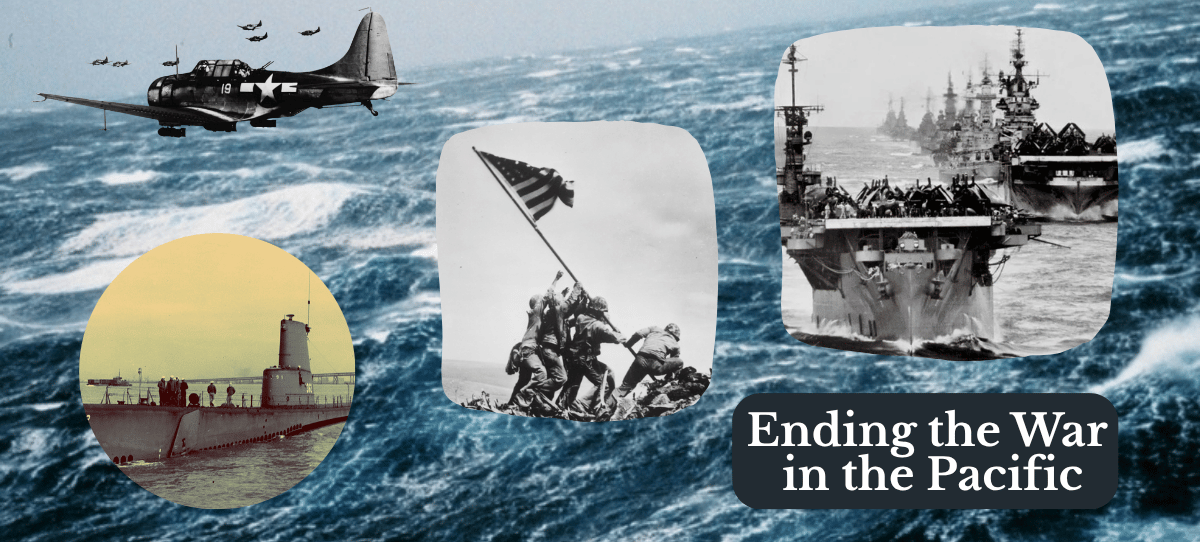
Image credit: various photographs from Naval Aviation Museum, National World War II Museum, and US Navy Archives.
Discover more from friarmusings
Subscribe to get the latest posts sent to your email.
 friarmusings
Hi Fr. George. Off topic. Can you give me the church’s doctrine or rule when it comes to a pet being euthanized? I’m ready having difficulty on this subject. Much gratitude. Perpetua
Good morning and may the peace and grace of Christ be with you. In general, I try not to be an “Ask a Priest” column and encourage people to connect to the local faith community, but every so often a question comes up that I realize: “If one of my parishioners asked me this question, I would not be well prepared to answer.” So I’ll give this one a go.
The Catechism of the Catholic Church does not explicitly address the topic of animal euthanasia in a direct manner and there is no stated doctrine on the topic. However, there are principles one can and should use regarding the treatment of animals and the moral considerations that come into play when dealing with living beings.
To be clear, the Church’s strong opposition to human euthanasia is based on the unique dignity of humans as beings made in God’s image, a dignity that animals do not share in the same way. Yet there is a general dignity of creation and the responsibility humans have towards animals. For instance, the Church teaches that “animals are God’s creatures” and that “men owe them kindness” (Catechism of the Catholic Church, 2416). This highlights the moral obligation to treat animals with respect and care, as they are part of God’s creation. In that same vein, the Catechism discusses the moral implications of using animals for food, clothing, and experimentation, asserting that such uses must be conducted with respect for the animal’s well-being (CCC, 2415). The underlying principle is that while humans have dominion over animals, this dominion must be exercised with a sense of stewardship and ethical consideration.
While the Catechism does not specifically mention euthanasia for animals, it provides a framework for understanding the moral responsibilities humans have towards animals. There are fundamental principles of kindness, respect, and stewardship that can be applied to discussions about euthanasia of pets. In part it also goes to the human intention behind any decision. The human choice should always be based on relieving animal irreversible suffering when there is no hope of recovery or relief from suffering, not for reasons of convenience or cost. Alleviating such suffering in a beloved pet can be a compassionate act in God’s sight and aligns with the biblical call for mercy.
Is there some quantitative point at which such mercy is called for? No, it most likely a qualitative one. If you know the condition is terminal or critical and there are more bad days than good, is that the point? Are the medications and treatments no longer sufficient to keep the pet comfortable?
Dr. Alice Villalobos developed what she calls the HHHHHMM scale
• Hurt: Is the pet’s pain or breathing managed effectively?
• Hunger: Are they eating and getting enough nutrition?
• Hydration: Are they able to drink enough on their own?
• Hygiene: Can they stay clean, or are they frequently soiled?
• Happiness: Does the pet still show joy and engage with family and toys, or are they withdrawn and anxious?
• Mobility: Can they get up and move around without assistance or stumbling?
• More Good Days Than Bad: Do the pet’s good hours or days outweigh the bad ones
The scale strikes me as practical and observable – and can form a solid foundation for reflecting on the mercy and dignity due to the pet as part of God’s creation.
I hope this is helpful. God bless.
Thank you for responding. God bless your heart. It took me a lot of courage and prayers before I placed this query before you. I searched the Catholic based sites and I am still not satisfied with the information provided. Guided by the Holy Spirit, I turned to you not expecting a reply. I needed to ask a priest. Lo and behold, my prayers were answered. A thorough response.
Again, with a grateful heart, thank you for responding.
Pax Tecum