
In the previous post we considered, in broad terms, that the Meiji Reforms of 19th Century Japan was the seedbed for an elevated position of the military in government and in the minds of the people. This rise occurred in the context of an essential idea that Japan needed to take its place among the powerful nations of the world, not only as an economic necessity but as a moral imperative rooted in its self-understanding through the eyes of Shinto religion. It is perhaps best understood in the Western parlance as Japan’s “Manifest Destiny.”
State Shinto. The role of Shinto beliefs in shaping Japan’s foreign policy, especially annexation and trade dominance in the late 19th and early 20th centuries, was not straightforward — it wasn’t Shinto in its ancient, folk-religious sense, but rather State Shinto, deliberately reshaped by the Meiji government to provide an ideological foundation for empire.
Traditional Shinto centered on reverence for kami (spirits) and the emperor as a sacred descendant of Amaterasu, the sun goddess. In the Meiji period, the state institutionalized Shinto into “State Shinto” — a civic religion binding loyalty to the emperor, seen as divine and the head of the Japanese nation. This created a spiritual justification for national unity, obedience, and expansion, since the Japanese people were cast as a uniquely sacred nation with a special destiny.
If the emperor’s will was divine, then Japan’s policies (whether modernization, annexation, or war) could be framed as the fulfillment of a sacred mission. For example, in annexing Korea, Japanese officials and ideologues claimed they were “bringing civilization and order” under the emperor’s benevolent guidance.
Shinto-based ideology taught that Japan was the land of the gods (shinkoku), uniquely pure and chosen. This translated into foreign policy as a belief that Japan had a moral right and duty to lead other Asian peoples (Korea, Taiwan, eventually China) — even if this meant dominating them. Unlike Western colonial powers, which often justified empire through Christianity or “civilizing missions,” Japan used State Shinto and emperor-centered nationalism to claim it was liberating Asia from Chinese decay or Western imperialism. In this, Japan crafted a Pan-Asian and hierarchical view of the Asia Pacific region.
This view underpinned Japan’s expansion which was more than military force projection, it included economic and trade justifications – all connected to Japan’s need for markets, raw materials, labor, and trade routes. State Shinto teachings linked these economic aims to national survival and divine destiny. Securing resources in Korea, Taiwan, and later Manchuria wasn’t framed as “colonization,” but as fulfilling the emperor’s sacred mandate to protect and enrich his people. Thus, trade dominance and annexation were sacralized as part of a divine mission, not just pragmatic policy.
This was fully integrated into civilian life with an end-view to mobilize the Japanese people. School rituals, shrine visits, and patriotic festivals tied everyday life to emperor worship. This religious-nationalist framework made it easier to mobilize society in support of expansion, presenting annexation not as aggression but as a sacred duty. In Korea, colonial authorities built Shinto shrines and compelled attendance as a way to symbolically integrate Koreans into Japan’s spiritual order under the emperor.
Shinto in its traditional form was not imperialist, but State Shinto provided the ideological glue for Japan’s foreign policy. By sacralizing the emperor’s role, framing Japan as a divine nation, and presenting expansion as a moral duty, it gave religious legitimacy to annexation and economic dominance. Where Britain invoked Christianity and “civilization,” Japan invoked the emperor’s divine mission rooted in Shinto.
Japan’s Destiny. Korea’s annexation (and the wars surrounding it) were the first major steps in Japan’s effort to establish colonies and a wider sphere of influence in East Asia and the Pacific. It was not a coherent policy from the beginning but unfolded stages.
In the beginning colonization was seen as a defensive measure. After the Meiji Restoration (1868) Japan looked at how Western empires built spheres of influence through colonies, protectorates, and treaties that favored the more powerful. Japanese leaders feared that unless Japan did the same, it would be colonized by some Western power. Thus was born the idea of colonization as a form of self-defense and a means to establish Japan as a great power.
The first steps in colonization happened even before Korea, Japan consolidated territories closer to home. Hokkaidō in the North was developed and settled as a colony. The Ryūkyū Kingdom (Okinawa) was annexed (1879), despite Chinese objections. The Ogasawara Islands were also absorbed. These were Japan’s first moves to colonize in the Asia Pacific region, but Korea was the real geopolitical flashpoint.
The Sino-Japanese Wars (1894-1895 and 1937-1945) were about Korea, regional dominance, and each country’s view of its own divine destiny. While the history is interesting it is also complex. As result of the conflict and its own internal problems, China ceded its claims over Korea which became a Japenese protectorate (1905) and then was formally annexed by Japan (1910). At the same time Japan gained control of Taiwan (Formosa) and other island territories. At this point Japan stepped into the role of a Western-style imperial power.
Korea was also important in the geo-political sphere. Korea was often described as a “dagger pointed at the heart of Japan” because of its proximity across the Tsushima Strait. Any hostile power controlling Korea could threaten Japan’s national security. At the turn into the 20th century, the threat was Russia who also sought influence in Korea for its access to warm-water ports that remained ice-free all year. This directly clashed with Japan’s ambitions and security needs. The 1905 Russo-Japanese War centered on control of Korea and Manchuria. Japan’s victory confirmed its dominance in Korea and shocked the world as the first modern defeat of a European power by an Asian nation.
Control of Korea gave Japan a launchpad into Manchuria, control of the South Manchurian Railway, warm water ports, an economic sphere of influence and access to a wealth of raw materials needed by Japan to fulfill its destiny. Korea marked Japan’s first formal continental foothold beyond island territories. Japan now envisioned a regional order where it dominated Northeast Asia and in 1914 extended the domination to Southeast Asia and the Pacific by seizing German colonies in Micronesia during the First World War. It viewed itself as a rival empire to match Western powers in the Asia-Pacific.
The State Shinto and the Japanese military became the means for Japan to fulfill its sacred duty through loyalty to the Emperor and preservation of the kokutai. In the 1930s Emperor Hirohito and the Military were the means to state greatness.
In the next post, we explore how the kokutai, the Emperor and the military would strive to fulfill its vision of the “eight corners of the world.” As mentioned, this is part of a series of posts that will try to explain the inner mind and beliefs of a nation that would launch Asia and Pacific into war on December 7, 1941.
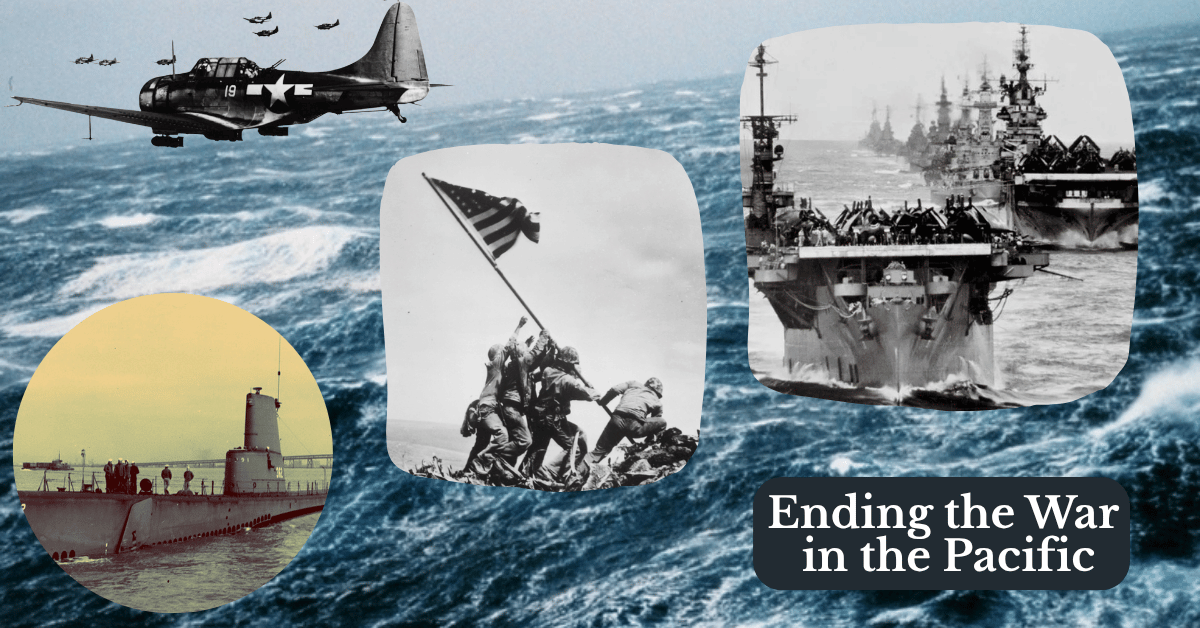
Image credit: various photographs from Naval Aviation Museum, National World War II Museum, and US Navy Archives.
Discover more from friarmusings
Subscribe to get the latest posts sent to your email.
 friarmusings
Thank you for this valuable history lesson. Miss talking with you personally after Mass