
The posts this week have been attempting to take a walk through Japan’s history from the end of the Shogunate period, into the Meiji Restoration of the 19th century, and following the flow of people, events and ideology that brought us into pre-War 1930s Japan. It is a decade during which the “manifest destiny” of Japan is evident in its Greater East Asia Co-Prosperity Sphere policy. As I wrote in the previous post:
“Asian countries should come together under Japan’s leadership to be free from Western colonial powers (like Britain, France, and the U.S.). On paper, it sounded like a partnership — ‘Asians helping Asians.’ Japan said it would bring prosperity, unity, and independence to Asia. In reality, though, it mostly meant that Japan would dominate the region, control its economies, and use its resources for Japan’s benefit. So instead of being true cooperation, it was more like Japan building an empire with kinder and gentler language and imagery.”
Within Japan, the slogan “Hakko ichiu” (“the eight corners of the world under one roof”) — drawn from Shinto mythology — became the fundamental idea, asserting that Japan had a divine mission to unify the world under the emperor’s benevolence. It is a big vision and it has to start somewhere. That “somewhere” was Manchuria.
The First Sino-Japanese War ended in 1895 with Japan’s victory. As part of the Treaty of Shimonoseki, the Qing Dynasty China granted territory on the Liaodong Peninsula. This area was expanded after the Russo-Japanese War (1904–05), when the Treaty of Portsmouth transferred Russia’s leased interest to Japan. This became known as the Kwantung Leased Territory. It was immensely valuable as a naval base, commercial hub, and springboard into Manchuria. It provided Japan with secure access to continental resources, a platform for military power projection, and the prestige of controlling former Russian territory. Japan was taking its first steps as an Asian Pacific colonial power.
Port Arthur and Darien were ports that gave Japan forward military bases on the Asian mainland. The Kwantung Garrison, later the Kwantung Army, was stationed there to defend the territory. In addition, Port Arthur was a warm-water port on the Yellow Sea, ice-free year-round—essential for Japan’s navy, which otherwise relied on more distant bases. Militarily the territory was a natural fortress projecting into the Bohai Gulf, guarding sea lanes to northern China and Korea.
The lease included rights to the South Manchuria Railway (SMR), running from Dairen north through Mukden. The SMR became Japan’s largest overseas enterprise—like a “state within a state”—with its own police, schools, research, and industries. Dairen became a modern port city and hub of trade, largely under Japanese management, linking Manchurian resources to Japan’s home islands. Those resources included coal and iron ore, soybeans, timber and vast territories of rich farmland.
Politically “Manchuria” became the symbol of Japan’s place among the world powers, gave them a permanent foothold in China for resources and population expansion, and the Kwantung Army became the elite Army unit from which arose the future leaders of the Imperial Japanese Army (IJA) for the decades to come. Manchuria was also far enough away that ambitious officers took unauthorized initiatives, sometimes even disobeyed orders to accomplish what they viewed as Japan’s destiny as a world power.
Japan’s military involvement in Manchuria in 1928 was not yet a full-scale occupation (which would come with the Mukden Incident of 1931), but rather a series of unauthorized moves by the Kwantung Army that revealed both Japanese ambitions in the region and the weakness of civilian control over the military.
Fallout from the Incident
Some officers of the Kwantung Army—without approval from Tokyo—plotted to eliminate Zhang Zuolin, the Chinese warlord of Manchuria. On June 4, 1928 they blew up Zhang’s train, killing him, in hopes that the Army could expand its control or at least install a more pliable Chinese leader. Zhang’s son quickly restored order and seized power. The Japanese civilian government in Tokyo was embarrassed by the Kwantung Army’s reckless action, but the officers involved were never punished—showing how the military operated increasingly outside civilian control. It was the start of a growing pattern of military insubordination to Tokyo’s civilian government.
In Tokyo the civilian government reaction was “mixed.” Prime Minister Tanaka tried to play both ends against the middle. He initially told the Emperor that the instigators should be punished and then discovered that the Cabinet had determined it would be “looked at” in an administrative review. Hirohito did not feel he could accept such insubordination among Army officers and was unwilling to sanction the Cabinet’s decision. In truth this was the “last straw” in a series of Tanaka’s slighting of the Imperial Court. Hirohito “called him” on his inconsistencies and suggested he resign as Prime Minister.
While as interesting as all that is, Hirohito later wrote that he regretted his “youthful” indiscretion of becoming too involved in governmental details. At this point we can see Hirohito’s first steps into what historian Stephen Large calls “self-induced neutrality.” Was he following in the footsteps of his father who largely “rubber stamped” civil government decisions and paid no attention to the military?
The Internal Divisions
In 1931 there was another “Manchurian Incident” also called the Mukden Incident. It is the most famous of the “incidents.” On the night of September 18, 1931, the Kwantung Army staged a small explosion on the South Manchuria Railway near Mukden (modern Shenyang). They blamed Chinese troops for the sabotage and used it as a pretext to launch a full-scale military takeover of Manchuria. Within months, Japan occupied the whole region and, in 1932, proclaimed the puppet state of Manchukuo under former Qing emperor Puyi. The League of Nations condemned Japan’s aggression in the Lytton Report (1932). Japan responded by withdrawing from the League in 1933.
These two years were, in a sense, life between the “rock and the hard place.” Manchuria and the League of Nations became the acid test for political alignment in 1930s Japan. The dynamic is far more complex that can be described herein, but it pitted nationalists/militarists vs. internationalist/accomodationists on the other. One side saw the League of Nations as simply the means by which the Western World could maintain their privileged position, maintaining their Pacific/Asian colonies while denying Japan its rightful place as the leader of the Eastern World. The other side saw the League of Nations – about which they too had reservations and problems – as a means for Japan, in time, to take its rightful place in the modern world. In a terribly oversimplified summary, both sides held a type of manifest destiny for Japan in the Asia Pacific region. They disagreed on the means and timing to get there. The nationalist/militarists were of the view, take what is rightfully ours and let others try to take it from us. The internationalists (accomodationists) believed that such a path would lead to the next world war – which they did not believe Japan could win given their lack of natural resources. This is 1931.
At the same time 1931 was the year of “incidents.” Fresh in everyone’s mind was the 1930 assassination of then Prime Minister Osachi who the ultranationalists blamed for committing Japan to the London Naval Treaty which limited expansion of the Imperial Fleet. In 1931 there were no less than four assassination plots, all stemming from the military or nationalists groups that sought to take over the government. It is uncertain what they planned for the Imperial House. At best it would have reduced the Emperor to a ceremonial figurehead.
Assassination incidents continued in 1932 taking the life of the Prime Minister. A bombing event just missed Hirohito. The remainder of 1932 and 1933 were filled with incidents in which Hirohito vacillated on the use of his imperial influence. Hirohito continued to seek balance in his imperial role. He seemed to continue to seek balance (and historians are not in agreement with the balance he found) as Japan withdrew from the naval treaties and aggressively began to build ships of war, initiated the second Sino-Japanese War in 1937,
Historian Peter Wetzler notes: “Hirohito advocated British constitutional norms not only as a model for governing, but, more important, to preserve, protect, and legitimize in modern terms the imperial line and the supreme position of his house in Japanese society.” Wetzler suggests that this thinking allowed the emperor to participate in military policy making and claim his non-participation in the process. “Hirohito could simultaneously explain himself and justify his actions, or lack of actions, in terms of Western constitutional monarchy.” However one wants to nuance the balance, the historical record is that between 1935 and late 1941, Japan’s empire expanded dramatically:
From Manchuria → northern China → central/eastern China (1935–38).
Failed expansion north into Mongolia where they were defeated by the Soviets (1939).
Southward expansion into French Indochina (1940–41).
By December 1941, Japan controlled Manchuria, much of eastern China, Korea, Taiwan, and French Indochina, and was preparing to seize Southeast Asia and the Pacific colonies when it attacked Pearl Harbor.
Who then is Emperor Hirohito? To be clear, historians do not agree on the role Hirohito was playing and would play in the path to the Asia Pacific War. He is the Commander-in-Chief of the armed forces, yet his Kwantung Army in Manchuria feels free to do what it wants, not expecting and not receiving punishment for their actions. Emperor Hirohito’s response is to “fire” the Prime Minister but not to take any action within Army ranks. This does not seem to indicate Hirohito feels he should be an absolute monarchy. It offers support for historian Stephen Large’s idea of “self-induced neutrality” or some version of historian Peter Wetzler’s version: the Emperor can put his thumb on the scale but he is not responsible for the result.
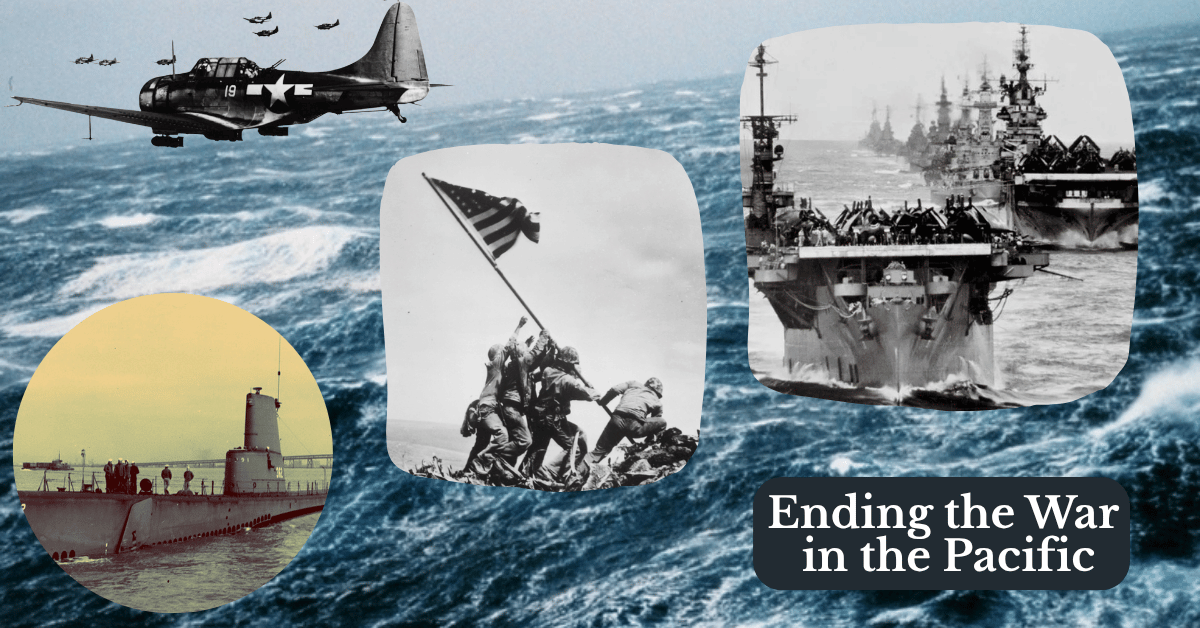
Image credit: various photographs from Naval Aviation Museum, National World War II Museum, and US Navy Archives.
Discover more from friarmusings
Subscribe to get the latest posts sent to your email.
 friarmusings