
In the previous posts we paused to look back to the historical currents that shaped Japan in the 19th and 20th centuries. The posts were an attempt to provide a sense of the influences, perspectives, aspirations, and national identity that formed Japan to see its destiny as the leader of an Asia-Pacific region – and the rise of nationalism and militarism that were the means to accomplish its vision. The posts also pointed to the body-politics that was Japan: a divine Emperor, a civil government that resembled Britain, a constitution that assured a premier place for the military, and yet a great deal of uncertainty on how it all was governed. Historians agree about many things, but not the role of the Emperor, especially his degree of responsibility and decision authority for the war that engulfed the Asia-Pacific region in 1941.
Returning to the timeline of the unfolding war, in general, we have not gone into detail about naval and land battles. We have spoken about key engagements and their impact on the shape and prosecution of the war: Saipan (strategic importance and civil deaths) and a post, Battles that Changed War Strategy (Biak, Peliliu, and the air battles at Philippine Sea and Formosa) which pointed to the changing tactics and objectives of Japan as the war approached the home islands. The implications of all this was hinted at in the post Ketsu-Go outlining the strategic and tactical defense of the home islands.
There is still a long period of conflict that will mark the final 10 months of the war. Here is a brief summary of the major engagement from October 1944 until August 1945
Leyte & Leyte Gulf (Philippines, Oct – Dec 1944)
Luzon (Philippines, Jan – Mar 1945 with pockets of resistance until Aug 1945)
Allied Bombing campaign of Japan (Nov 1944 – Aug 1945)
Naval blockade of Japan (ongoing until Aug 1945)
Fast Carrier air raids ranging across the Pacific (Nov 1944 – Aug 1945)
Iwo Jima (Feb – Mar 1945)
Okinawa (Apr – Jun 1945)
Along the way there has been much that was not covered: campaigns in the Gilbert and Marshall Islands, the jungle warfare in the New Guinea and Northern Solomon Islands area, as well as battles in Burma, China, and other parts of the Southwest theater of operations. All of these have come at the cost of human lives, but what awaits will take the level of violence to new levels – not just among combatants, but increasingly among civilian populations.
The Battle of Guadalcanal was fought on an island whose population was small and for the most part (at least by comparison to later battles) were able to remain somewhat clear of the fighting. The Battle of Saipan provided the first real instance where civilians were not “caught in the crossfire” but were placed in the battle zone with intention and purpose. The battle for Manila and the fighting on Okinawa would bring civilians into the midst of the conflagration. As would the bombing campaign of the Japanese home islands.
The experience of in-depth defenses faced by allied troops on Biak, Peliliu and other battles also lead to increasing lethal weapons of war in the hands of allied troops. Perhaps most notable was the introduction of flame throwers – backpacked carried with a range of 65-150 feet and tracked vehicle (tank) mounted units with a range as high as 100 yards. These were deployed against pillbox-like defenses which had proved invulnerable to artillery, mortar fire, or naval shore bombardment – manned by defenders that would never surrender.
The next several posts will again return to combat operations to the extent that those operations shaped allied thinking about what lay beyond: invasion of the Japanese home islands. Just as the Japanese were shaping their Ketusu-Go decisive battle plan, the Allies were beginning to form their plan: Operation Downfall – the invasion of the home islands.
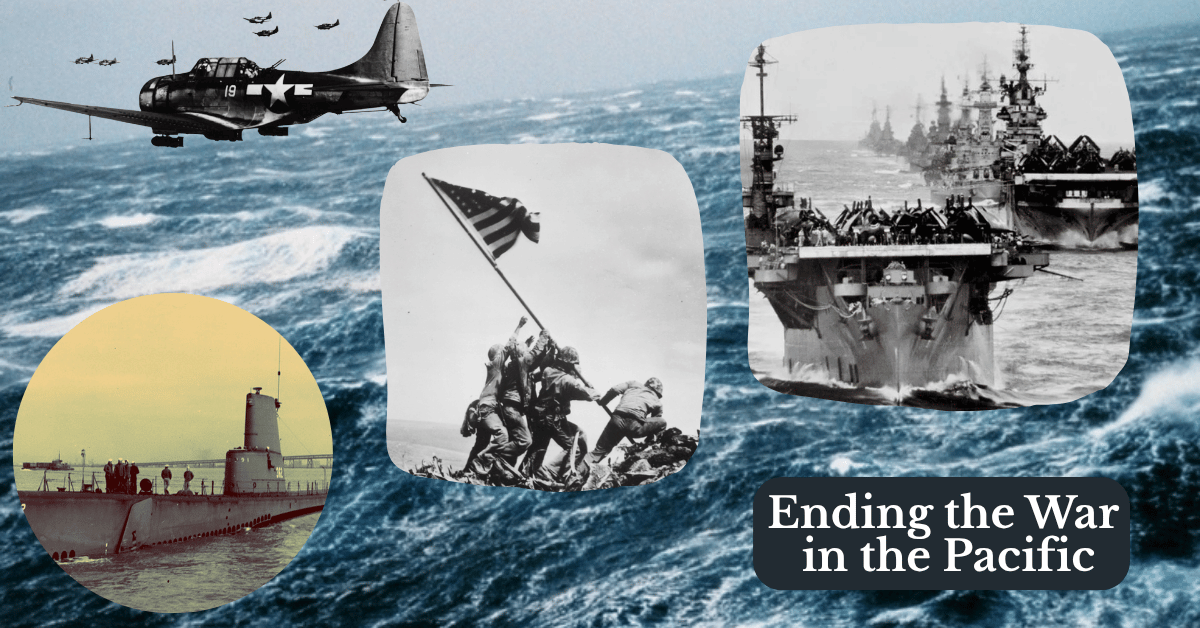
Image credit: various photographs from Naval Aviation Museum, National World War II Museum, and US Navy Archives.
Discover more from friarmusings
Subscribe to get the latest posts sent to your email.
 friarmusings