
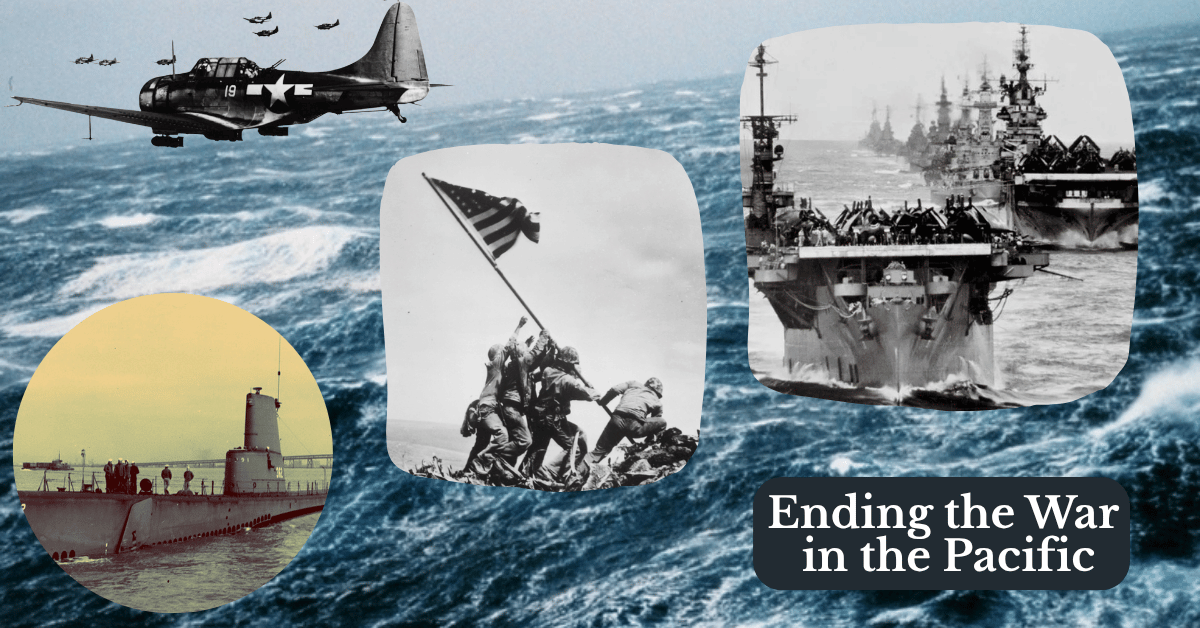
A reader mentioned that they were surprised that as a former naval officer I had not offered more coverage on the operations of the US Navy during the War in the Pacific. While it was perhaps inevitable given my goals for this series, nonetheless let me recount some of the major fleet actions and operations from Pearl Harbor until late 1944. Fair warning: it is a longer than average post.
It is important to remember that the first 12 months of the war in the Pacific was focused on stopping the advancing Japanese forces in the Southwest Pacific – especially stopping them from cutting off Australia and New Zealand from communications and supply lines to the US Pacific Forces. This led to a series of major naval battles in 1942 and 1943 miles away from Tokyo and from Pearl Harbor. Battles that were extremely critical to the war effort, yet unless you are interested in naval history, they are battles that are likely unknown to you. They were either surface-v-surface action and on several occasions aircraft carrier-v-carrier battles. Some of the key engagements are listed below.
Battle of the Coral Sea (May 4-8, 1942): The first naval battle fought almost entirely by aircraft carriers, the Battle of the Coral Sea checked a major Japanese offensive towards Australia/New Zealand, specifically an invasion of Port Morsby. The naval battle was fought in an area south east of New Guinea and south of the Solomon Islands. Because of the battle, the invasion convoy turned back, and the operation was cancelled. This was the first major Japanese offensive in the Pacific to be stopped. But it came at the cost of the fleet carrier USS Lexington and a fleet oil tanker – two assets we could ill afford to lose at that point in the war. The Japanese lost one aircraft carrier with a second one heavily damaged. Both of these carriers were expected to be part of the Battle of Midway. Their presence may well have changed the result of that engagement.
Battle of Midway (June 3-6, 1942): A decisive U.S. victory, this battle destroyed four Japanese aircraft carriers and more than 300 naval aircraft and their skilled aviators. The United States lost the USS Yorktown and 150 aircraft and their aviators. From this point the Imperial Japanese Navy (IJN) was largely on the defensive, unable to replace ships, pilots, and aircrews at the same rate as the United States. This was the first major Japanese defeat in the Pacific, fundamentally shifting the balance of naval power – still in favor of the Japanese. But there was enough of a shift to enable Allied offensive operations in the Solomon Islands – starting with Guadalcanal.
Naval Campaign of Guadalcanal (August 1942 – February 1943): Deserving of all accolades, the US Marine Corp “held the line” on Guadalcanal. What is not generally well known is the history of the series of intense naval battles fought around Guadalcanal to support the land campaign by preventing Japanese resupply and reinforcement. More naval personnel were killed in action during the naval campaign than Marines killed on the island. The fighting was horrific. Key engagements in and around Guadalcanal included:
- Battle of Savo Island: (August 1942) *
- Battle of the Eastern Solomons: (August 1942) – the third carrier vs. carrier battle of the war.
- Battle of Cape Esperance: (October 1942) aka 2nd Battle of Savo Island
- Battle of the Santa Cruz Islands: (October 1942) – the fourth carrier vs. carrier battle of the war
- Battle of Tassafaronga (November 1942) *
- Naval Battle of Guadalcanal: (November 1942) – the final and decisive naval battle in the campaign. It was the last attempt by the Japanese Navy to control the sea lanes around Guadalcanal.

Savo Island and Tassafaronga were battles that led to a significant loss of allied war ships and personnel – on a scale approaching Pearl Harbor – but it was successful to the extent they prevented Japanese reinforcements and resupply to Guadalcanal. There was no naval battle in the Guadalcanal Campaign that can rightly be called a tactical victory, but at each point and overall, it was a strategic victory in that (a) Japan did not control the sea lanes around Guadalcanal and so Japanese armed forces on the island were forced to withdraw, and (b) Japanese naval aviation suffered mounting losses among its experienced carrier based pilots – human resources not easily replaced.
After Guadalcanal, the allied campaign and associated naval battles moved northwest up the Solomon chain of islands.
Battle of the Bismarck Sea (March 2, 1943): Allied forces successfully destroyed a Japanese convoy attempting to reinforce New Guinea, a major blow to Japanese logistics and a key success for the Allied “island hopping” strategy.
And… a little far afield from the South Pacific, the Battle of the Komandorski Islands (March 26, 1943): A long-range surface engagement where U.S. cruisers and destroyers intercepted a Japanese relief force heading for the Aleutian island of Attu, successfully preventing its reinforcement and resupply of occupying Japanese army forces.
Other surface actions/battles in the Southwest Pacific (July-Nov, 1943) included Battles of Kula Gulf, Kolombangara, Vella Gulf, Vella LaVella, Empress Augusta Bay and Cape St. George. All of these battles were in the Southwest Pacific area in support of allied movements to control sea, air and land in the area of Papua New Guinea leading towards the Philippines.
Reduction of the the Japanese Fleet
The losses of Japanese surface vessels and naval aviation assets were beginning to take a toll. The Imperial Japanese Navy (IJN) suffered catastrophic losses of aircraft carriers, trained naval aviators and aircraft at Coral Sea, Midway (1942), and most severely in the Solomons campaign (1942–43). By 1944, Japan could still put carriers to sea (e.g., Zuikaku, Shōkaku, Taihō and several light carriers), but they had few veteran pilots left.
The IJN still possessed many powerful battleships and heavy cruisers, including the super-battleships Yamato and Musashi, as well as fast battleships (Kongō, Haruna, Nagato). Its cruiser and destroyer forces were heavily attrited but still dangerous, especially in night fighting.
The Forge of Empire is the title of a book that outlines how the industrial might of the United States was brought to bear in support of the armed forces. From the Battle of Midway until the end of 1943, U.S. naval strength shifted from precarious to overwhelming even as the IJN was unable to replace or reinforce its fleet. In this 18 month period the Pacific fleet was reinforced by
- 4 fleet “fast” carriers (Essex, Yorktown, Intrepid, and Hornet)
- 8 CVLs – light carriers (which carried approximately 50% of the aircraft as the Fleet carriers)
- Dozens of CVE – escort (or jeep) carriers
- 12 new CL – light cruisers nicknamed machine gun cruisers because of their rapid firepower
- 60 Fletcher class destroyers
- 30 Gato-class and early Balao-class submarines
- 30 new fleet oilers to provide underway fleet refueling
- …and thousands of “Liberty” ships for supply, troop transport and more. Between 1941 and 1945 more than 2,700 liberty ships were built for Atlantic and Pacific operations.
These new oilers made continuous fast-carrier operations possible — the Central Pacific campaigns (Gilberts, Marshalls, Marianas) could not have been fought without them. They also freed the fleet from dependence on fixed bases, allowing Task Force 58/38 to operate as a truly mobile striking arm. Admiral Nimitz later said the fleet train, especially the new oilers, was as decisive as any new battleship or carrier.
The Battle of the Philippine Sea (June 1944)
The Battle of the Philippine Sea occurred in conjunction with the allied invasion of the Marianas (Saipan, Tinian, and Guam). The Japanese Combined Fleet, commanded by Admiral Ozawa Jisaburō, sought to repel the landings with its last major carrier/battleship/cruiser force. They were opposed by the U.S. Fifth Fleet under the command of Admiral Raymond Spruance.
The Japanese plan was to control the skies so that the battleships/cruisers/destroyers could attack the landing fleet of troop carriers and supply ships. It was to be a combined effort of carrier-based plans and planes based on the Mariana islands. The battle was the largest carrier-to-carrier engagement in history, involving 24 aircraft carriers (15 US; 9 IJN), deploying some 1,350 carrier-based aircraft.
On 19 June, waves of Japanese carrier aircraft attacked and were met by Fast Carrier Task Force 58 commanded by Admiral Mark Mitscher Thanks to radar detection, disciplined fighter direction, and experienced pilots, the American fighter aircraft intercepted and destroyed the attackers in massive numbers. The day’s air battles, later nicknamed the “Great Marianas Turkey Shoot,” cost the Japanese over 300 carrier planes lost in air-to-air combat with negligible American losses.
On 20 June, as the Japanese fleet retreated westward, U.S. search aircraft located it at extreme range. Admiral Mitscher launched a daring late-afternoon strike from more than 200 miles away. American carrier planes sank the carrier Hiyō and inflicted damage on several other vessels. The Japanese lost another 100 aircraft and an additional aircraft carrier they could not afford to lose.
In a nod to the submarine service, of the three fleet carriers that were sunk — Hiyō, Shōkaku, and Taihō, none were destroyed directly by U.S. carrier aircraft alone; rather, two of them fell victim to U.S. submarines. The USS Albacore (SS-218) torpedoed and fatally damaged Taihō (Japan’s newest carrier). The USS Cavalla (SS-244) torpedoed and sank Shōkaku.
The results were catastrophic for the Imperial Japanese Navy. In two days, it lost three carriers and roughly 400-450 carrier aircraft, along with most of its remaining veteran aviators. The U.S. lost around 100 planes, mostly from fuel exhaustion, with minimal combat losses as the pilots were recovered. The Japanese fleet withdrew, unable to challenge the U.S. landings in the Marianas. The Japanese had spent the better part of a year (following the Battle of the Santa Cruz Islands) reconstituting their depleted carrier air groups, and the American Fast Carrier Task Force had destroyed 90% of it in two days
The battle effectively destroyed Japan’s carrier air arm as an offensive force. Although Japan still possessed carriers, these ships had no trained aviators left to operate them. The loss meant Japan could no longer contest U.S. amphibious operations with carrier strikes. From this point forward, the Imperial Navy was forced onto the defensive, relying on land-based aircraft and, eventually, kamikaze tactics. The Philippine Sea thus marked the end of Japanese naval aviation as a serious threat and gave the U.S. Navy uncontested dominance of the Pacific skies.
By autumn 1944, the IJN prepared for “Decisive Battle” doctrine: a last-ditch, all-out fleet action to repel the expected U.S. invasion of the Philippines. This doctrine culminated in the Battle of Leyte Gulf (October 1944)—the largest naval battle in history—where the IJN gambled everything. The result was the destruction of Japan’s carrier force (sacrificed as decoys at Cape Engaño) and crippling losses to its battleships and cruisers. After Leyte Gulf, the IJN was a hollow giant—still impressive in numbers of battleships and cruisers, but crippled by the loss of carrier aviation, a devastating fuel shortage, and the overwhelming superiority of U.S. industrial power.
To give you an idea of US naval strength at Leyte Gulf, the 3rd Fleet had more destroyers than the Japanese had aircraft. The naval battles in and around Leyte Gulf are epic in naval history, but it is sufficient to say that while the Japanese fleet might inflict damage in a single operation, it was strategically already broken. Leyte Gulf was its death knell.
Operations of U.S. 3rd/5th Fleet after Leyte Gulf
The “Big Blue Fleet” supported the landings and efforts throughout the campaign in the Philippines focusing on the suppression and destruction of Japanese land-based air power on Luzon. During the same period the Fleet launched raids into the South China Sea (Jan 45) striking Formosa (with its 30 airfields), French Indochina (Saigon, Cam Ranh Bay, Da Nang, and Cape St. Jacques), Hong Kong and southern China to disrupt Japanese supply lines and sink merchant shipping. These strikes sank over 200 ships and crippled Japanese coastal traffic. Key among the ships sunk were 13 fleet oil tankers
The Navy took a calculated risk by sending the carriers deep into waters still thought to be dangerous with Japanese bases. The South China Sea was an area Japan thought to be impenetrable to allied fleet operations. The raid demonstrated the strategic mobility of the U.S. Fast Carrier Task Force; it was able to strike anywhere in the Western Pacific with impunity.
In Feb 1945 fleet carrier strikes began in the Tokyo area at the same time the Fleet was present in support of amphibious landings on Iwo Jima (Feb–Mar 1945) and Okinawa (Apr–Jun 1945). The US Fast Carrier Task Force now operated freely in waters Japan thought protected. They would destroy hundreds of thousands of tons of Japanese shipping, cripple airfields, and severe resource supply lines — isolating Japan from its empire.
The US and Allied fleets now controlled the Pacific Ocean.
Image credit: various photographs from Naval Aviation Museum, National World War II Museum, and US Navy Archives. Solomon Island area map from National World War II in the Pacific Museum
Discover more from friarmusings
Subscribe to get the latest posts sent to your email.
 friarmusings