
Iwo Jima is a small volcanic island about 750 miles south-southeast of Tokyo. The island had two operating airfields from which flew Japanese fighters and bombers. From late 1944 to early 1945, the Japanese stationed fighters and bombers on Iwo Jima. Their mission was to intercept the U.S. B-29s bombing Japan and to conduct night bombing raids on the Mariana airfields to disrupt U.S. bombing operations. Japanese bombers conducted about nine significant raids against the Marianas. The night raids were small in scale, typically 5 to 20 Mitsubishi G4M “Betty” bombers. The raids never seriously curtailed B-29 missions as U.S. forces had ample construction battalions to repair damage quickly. The Japanese air raids from Iwo Jima on the Marianas were annoying but not decisive. Their main effect was psychological and tactical, not strategic.
The island lay virtually under the direct flight path to Tokyo of B-29 bombers operating out of Saipan and Tinian allied airfields. The direct distance was 1,350 miles but in order to avoid Iwo Jima’s fighters, the flight route was 1,700 miles one way. Despite the route, the island served as an early warning station for Japanese mainland defense.
The strategic reason for invading and taking Iwo Jima was to eliminate the early warning capability, the fighter intercepts on the bombers, the nuisance bombing raids on B-29 bases, shorten the route to/from the Japanese home islands for the “finicky” B-29s, and provide an emergency diversion landing site for returning B-29 bombers. This last feature came into use during the intense fighting on Iwo Jima and by war’s end was responsible for saving ~2,400 US Army Air Force pilots and flight crews.
Before the Invasion
Admiral Raymond Spruance had recommended invading Iwo Jima in August of 1944 as it more aligned to the Central Pacific Plan approved by the Joint Chiefs of Staff. It would have been the next island after taking the Mariana Islands. Other decisions were made for reasons also consistent with war planning in the Pacific, but as 20-20 hindsight reveals, the decision to delay the landings until January 1945 was a costly decision.
In August 1944 there were 6,000 Japanese combatants on Iwo Jime. By January 1945 there were 22,000.
In late June 1944, Japanese General Kuribayashi, a veteran and skilled war fighter, was transferred to Iwo Jima to prepare the defense of the island. He planned to abandon beach defenses in favor of an elaborate network of underground bunkers, tunnels, and artillery positions. From August 1944 until the invasion, he prepared a defense-in-depth strategy building ~11 miles of tunnels interconnecting many of the 1,500 sub-terrainian rooms, concealed reverse-slope artillery (canons, mortars, anti-tank weapons, buried tanks, etc.), and built hundreds of pillboxes and concealed gun placements. In addition there were major land mine fields throughout the island.
As a volcanic island it had little cover and almost no concealment for Marines landed on the island. Also, much of the island was “pre-registered” for artillery and mortar fire. That means that in advance they knew the settings to bombard almost any spot on the island. That proved to be especially impactful on the invading Marines.
For months leading up to Feb 1945: U.S. bombers and Navy vessels conducted months of air raids and bombardment. Given the volcanic ash soil and the buried Japanese positions, the pre-invasion bombardment did not achieve the hoped for results.
D-Day: February 19, 1945
On the designated day, 30,000 Marines of the 4th and 5th Marine Divisions landed on the southeastern beaches. Initial landing was lightly opposed, but Japanese artillery and mortars soon inflicted heavy losses as the Marines struggled in volcanic ash sand, which made digging foxholes impossible and movement difficult. Supporting landing vehicles came under withering fire, tanks became stuck, and the beach became like a traffic jam, delaying subsequent waves of Marines.
These problems were overcome and the Marines began moving inland, taking casualties, but slowly achieving the desired objectives. The island was cut in two isolating Mt. Suribachi in the south from the northern defensive positions by February 22. The island is only 700 yards wide at that point . That was a precursor to how difficult it would be to take the island. It would be a battle with movements measured in yards/day. The progress was significantly slowed by the presence of Japanese forces and artillery/mortars on the high ground of Suribachi, enabling them to see all movement of Marines on the plain below.
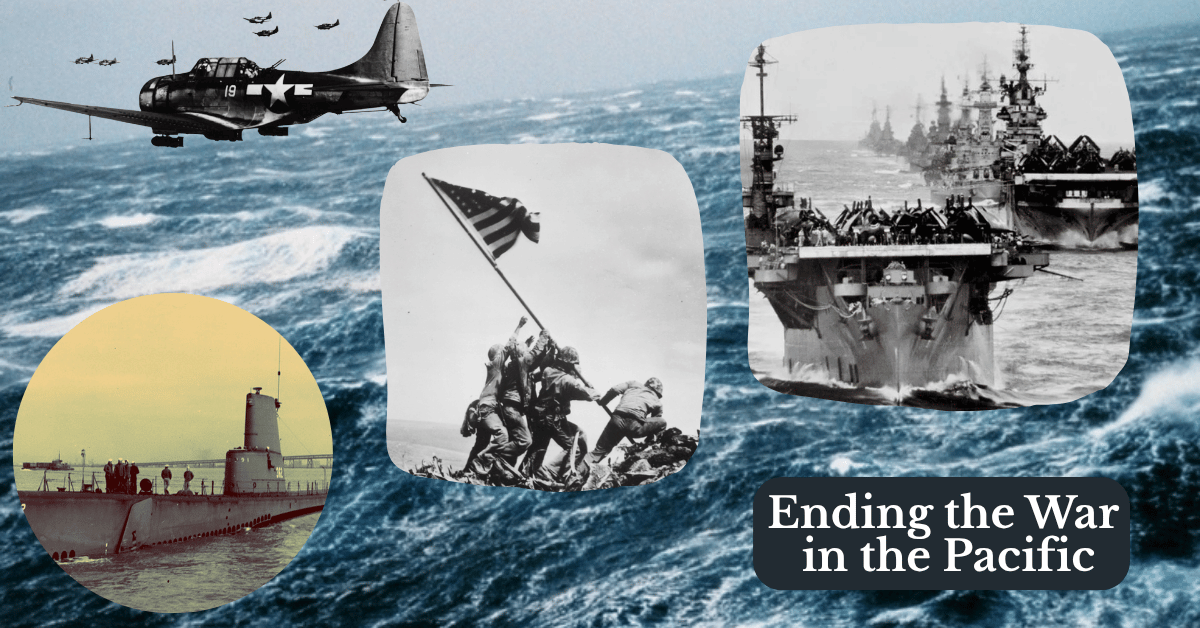
On Feb 23, Mount Suribachi was surrounded and assaulted. Marines raised a small flag at the summit in the morning, followed by a larger flag in the afternoon. Joe Rosenthal’s photograph of the second flag raising became an iconic image of the war. Marines worked to clear the caves, bunkers, and tunnels on Suribachi’s slopes. By the evening of Feb 24 the entire mountain was declared secure, with remaining Japanese resistance destroyed or sealed off.
This was also a precursor of things to come. Marines casualties were high and while they achieved the objectives, Marine veterans noted that you almost never saw the Japanese. Pillboxes, caves and hidden firing points were generally secured with flame throwers and satchel charges. The latter sealed the Japanese, even the survivors (if any) in the caves.
With Suribachi taken, the battle was over… sadly, a common misconception. The flag raising was not a signal of the battle’s end. The battle of Iwo Jima continued for another 32 days before “mop up” and garrison duties began. The Battle of Iwo Jima had just begun.
The Northern Drive
The battle shifted north toward the heavily fortified Japanese strongholds across a forbidding terrain of ridges, ravines, and fortified caves. Spots on the island took on names that are part of Marine Corps lore: Turkey Knob, Hill 382, Amphitheater, the Rock Quarry, Cushman’s Pocket. Marines advanced yard by yard under withering fire, often using flamethrowers, grenades, and demolition charges.
By Mar 11 Japanese defenses were reduced to isolated pockets in the northern tip of the island, but the battle continued for another 15 days. On the night of Mar 26, a large Japanese night infiltration of ~300 men reached the rear echelon area (command posts, medical aid stations, supply depots, field kitchens, etc.). More than 200 US Marine and Army soldiers were killed before the Japanese were killed to the last man. A number of Japanese swords were found among the dead, indicating that the attack included a large number of officers. It was the last gasp.
Aftermath
The 36-day battle was one of the bloodiest of the Pacific War, remembered both for its human cost and its strategic importance. Marine combat veterans from Guadalcanal, Tarawa and Peliliu had seen the carnage of war, but each one noted that they had never seen such carnage before. Robert Sherrod (Time & Life war correspondent), who had already covered “bloody” Tarawa, wrote after going ashore at Iwo Jima: “Iwo was a nightmare in hell… I never expected to survive. I never expected to see anyone else come out alive. The beaches were a slaughter pen. Men lay dead and dying everywhere.” His reporting was echoed by Richard Tregaskis (author of Guadalcanal Diary) who wrote about the seemingly endless destruction: “The whole island was a charnel house. Every yard was fought for with grenades, bayonets, and flame throwers. It was war stripped to its rawest savagery.”
U.S. casualties were ~26,000 total with 6,821 killed, 19,217 wounded, and some 2,000 soldiers that had to be pulled from combat with “battle fatigue,” in today’s parlance known as PTSD.
Japanese Casualties: ~21,000 defenders killed and 200 captured alive. It is estimated that there are some 10,000 Japanese soldiers still entombed in caves and battlements on Iwo Jima.
Major General Graves Erskin, USMC, the leader of the 3rd Marine Division, dedicated the Division Cemetery of Iwo Jima. In part, his words were:
“There is nothing I can say which is wholly adequate to this occasion. Only the accumulated praise of time will pay proper tribute to our valiant dead. Long after those who lament their immediate loss are themselves dead, these men will be mourned by the Nation. They are the Nation’s loss. There is talk of great history, of the greatest fight in our history, of unheard sacrifice and unheard of courage. These phrases are correct, but they are prematurely employed. The evidence has not sufficiently been examined. Even the words and phrases used by historians to describe the fight for Iwo Jima, when the piecemeal story of our dead comes to light, will still be inadequate.”
“Victory was never in doubt. Its cost was.”
“The enemy could have displaced every cubic inch of volcanic ash on this fortress with concrete pillboxes and blockhouses, which he nearly did, and still victory would not have been in doubt.”
“What was in doubt, in all our minds, was whether there would be any of us left to dedicate our cemetery at the end, or whether the last Marine would die knocking out the last Japanese gun and gunner.”
It was Fleet Admiral Chester Nimitz whose words adorn the Iwo Jima Memorial: “Among the men who fought on Iwo Jima, uncommon valor was a common virtue.” (16 March 1945.) Twenty-seven Medals of Honor were awarded (22 to US Marines and 5 to Navy corpsmen) as well as 210 Navy Crosses, the second highest decoration for valor for Navy and Marine personnel.
Iwo Jima was the only battle in the Pacific where Allied casualties exceeded those of the Japanese.
General Kuribayashi has fulfilled his mission and duty to the Emperor. He had delayed the Allied forces, extracted a high price, gave allied home island invasion planners “second thoughts”, and provided more time for defense preparations on Kyushu and Honshu islands.
Image credit: various photographs from Naval Aviation Museum, National World War II Museum, and US Navy Archives.
Discover more from friarmusings
Subscribe to get the latest posts sent to your email.
 friarmusings
I remember watching this historical movie. War doesn’t make men great.