
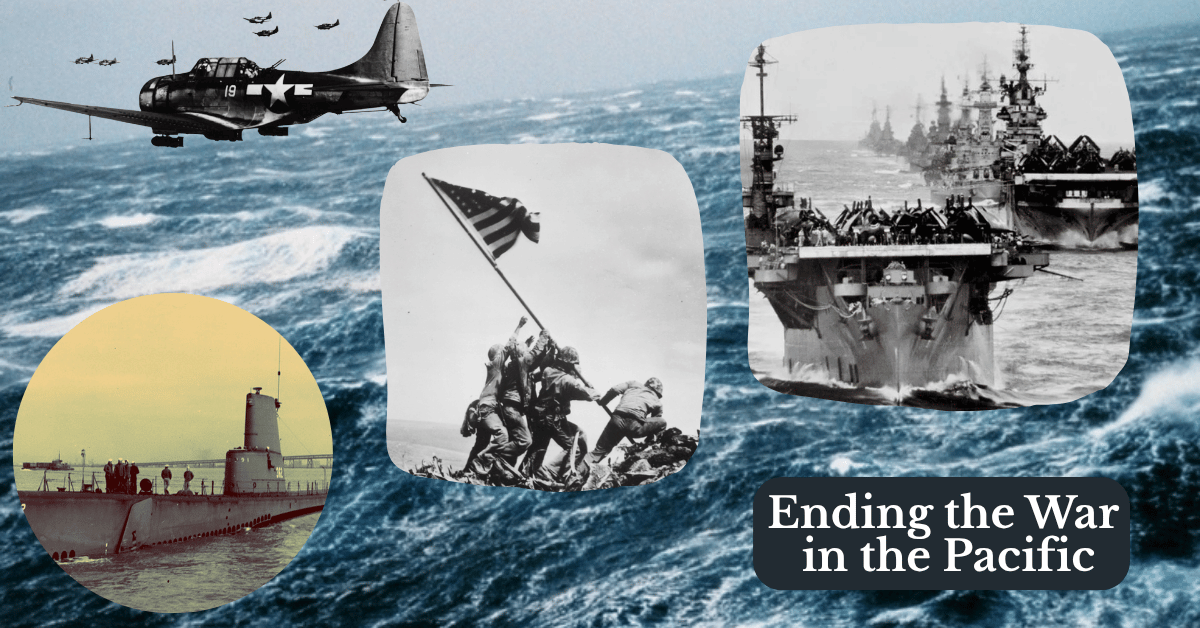
The vast number of islands that were invaded/recaptured by the Allied forces were not highly occupied by civilian populations. Iwo Jima had virtually no inhabitants. Very different experiences were encountered on Saipan, in the Philippines, and on especially on Okinawa whose pre-invasion civilian population was estimated at 300,000 people. Okinawans were Japanese citizens, at least in law.
After the 1879 annexation of the Ryukyu Kingdom, Okinawa was made a prefecture of Japan. By the time of the Allied landings, Okinawans were Japanese citizens in law: subject to conscription, taxation, and wartime mobilization like all other Japanese. Their cultural and social status was something different. The longer and deeper roots of Okinawa were Chinese in custom and perspective and as a result, Okinawans were often regarded by mainland Japanese as a peripheral or inferior people, with distinct language, customs, and history. The Okinawan (Ryukyuan) language was suppressed in schools in favor of standard Japanese. Children caught speaking Okinawan dialects were sometimes punished. Mainland Japanese officials and soldiers stationed in Okinawa frequently treated locals as less disciplined, less loyal, or “not quite Japanese.”
Prior to 1944, Okinawans could join the Japanese military but were rarely assigned to combat ranks, most often serving in labor units, auxiliary roles, or support services. After the fall of Saipan in July 1944, Japan recognized that Okinawa was likely to be the next U.S. target. At that point the 32nd Japanese Army was stationed on Okinawa, and the Japanese authorities began mass mobilization of the Okinawan population. The mobilization had three primary elements:
- Student soldiers (the Tekketsu Kinnotai “Blood and Iron Corps”) — boys as young as 14 conscripted into combat and suicide missions.
- Himeyuri Student Corps — female students (middle and high school aged) mobilized into nursing units that served throughout the battle
- Adult men were drafted into Boeitai (Home Guard) units for construction, supply, and in some cases combat support. Some adult women were also conscripted into labor battalions.
By some estimates, most Okinawan families had at least one family member who had emigrated to the United States (principally Hawaii). The movement began after the 1879 annexation and the onset of economic hard times. Many families received remittances of money from their relatives. This history led Japanese military authorities to distrust Okinawans’ loyalty, fearing ties to Americans because of Okinawa’s prewar emigrant communities in Hawaii, California, and elsewhere. They were, however, treated as Japanese in the sense that the Okinawan civilians were ordered to support the war effort to the last breath in loyalty to the Emperor.
Propaganda before the invasion
One of the most heart wrenching account of the civilian involvement on Okinawa was written by Kaneshiro Kikuko, who documented her experiences in the Himeyuri Student Corps in the book Himeyuri no Shojo: Ju Roku-Sai no Senjo (Himeyuri Girl: 16 Year Old’s Battlefield). Her stories of the middle and high-school aged girls pulled into the war as nurse aides, their struggles for the 82 days of combat, and being abandoned at the height of the end-conflict is the primary focus of her account. But the account is also testimony to the effectiveness of pre-invasion and pre-war propaganda. For years before there was even a hint of war the Okinawa students were told that if the American invaders (“devils”) were arrived on the island they would rape, pilage and descrate young girls, cutting them in half and then running their tanks over the remains so as to deny burial. Kaneshiro’s post-battle experience was completely different. Had she known she said she would have surrendered very early because it was clear that the Japanese soldiers would in no way protect the civilians.
This propaganda was widespread among the entire civilian population and was a significant factor in the horrific level of civilian deaths on Okinawa.
The Battle
There were preliminary landings on the Kerama Islands and Tokashiki. On March 28, 394 civilians on Tokashiki island were forced by Japanese soldiers to kill themselves after the landing of US troops. It was the first indication of what might be facing the soldiers and sailors in the 82-day battle for Okinawa. It is hard to know what to make of the forced suicides, but the discovery of their deaths was a psychological blow to the US forces seeing slaughtered women and children.
The amphibious landings on the main island of Okinawa were barely contested and the civilians that lived and remained in the area soon discovered that the Japanese propaganda about potential atrocities were false. What they discovered was that by the second day, food items were being specifically brought ashore for the local civilian population. While remaining wary and cautious, the first experience of soldiers and marines was a positive one. That would soon change as the battle progressed.
Within days, the bulk of the northern located Japanese forces were cornered on the Motobu Peninsula to the north. The terrain was mountainous and wooded, with the Japanese defenses concentrated on Mount Yaedake, a twisted mass of rocky ridges and ravines on the center of the peninsula. Unlike Iwo Jima where the tunnels had to be constructed and carved into the island, the defenders at Okinawa made extensive use of natural limestone caves, expanded and fortified with concrete and steel doors, creating almost impregnable defensive networks.
As the battle moved towards the south and the larger part of the island, terrain similar to the worst features of Peliliu and Iwo Jima were encountered as the allies advanced. Battles on hills and ridges (Cactus Ridge, the Pinnacle, Kakazu, and Hacksaw Ridge to name a few) were deadly with Army and Marine companies being reduced by casualties of up to 80%. Replacements were available, but these were largely men who were straight out of boot camp who were being asked to replace the combat veterans killed and wounded. The hills and ridges were not the main line of defense. These were just the outposts. The Shuri Line was the main Japanese defensive belt across southern Okinawa, built around Shuri Castle. It included fortified ridges (Shuri, Sugar Loaf, Conical, Half Moon, Horseshoe, etc.), interconnected caves with artillery hidden behind steel shutters, and positions designed so that U.S. advances on one ridge came under flanking fire from the next.
It was the nature of combat on Okinawa that was “next level” compared to other operations: close quarters combat against concealed positions with increasing numbers of night infiltrations. There was little time for identification of the opponent, other than “enemy shooting at me.” It was action-reaction. It was in this milieu that allied forces began to encounter child and teen civilian combatants, especially in the last weeks of the battle. With the arrival of monsoon season in May, the battlefield of Okinawa began to take on an aspect of trench warfare as in World War I.
Okinawa was the costliest battle in terms of deaths. As horrific as the fighting was on Tarawa, Saipan and Peliliu, the number of deaths on Okinawa exceeded the total deaths combined on the three aforementioned battles – each one known for high rates of casualties. This post was not meant to recount the heroism, horror, and harrowing conditions faced on that island – all of which were plentiful – but to begin to paint a picture of the physical and psychic toll that was beginning to mount. Marine Eugene Sledge, a veteran of Guadalcanal, Peleliu and now Okinawa wrote an account: “…everywhere lay Japanese corpses killed in the heavy fighting. For several feet around every corpse maggots crawled in the mud and then were washed away by the runoff of the [monsoon] rains… the smell of death was everywhere. It was the most ghastly corner of hell I had ever witnessed. As far as I could see in the area that had been a low grassy valley with a picturesque stream meandering through it was now a muddy repulsive open sore on the land, choked with death, decay and destruction.” This was a war on the ground faced by US soldiers and marines that led to the highest rate of battle fatigue (now called PTSD) in any allied engagement.
Civilian Deaths
Behind the their lines, the Japanese military committed atrocities against Okinawan civilians: forcing mass suicides, executing suspected spies or “disloyal” villagers, seizing food, using civilians as shields, and deploying coerced students and children into combat roles. These actions reflected both desperation and deep mistrust of Okinawans’ loyalty, and they contributed to the staggering civilian death toll.
Japanese soldiers and officials encouraged or ordered civilians to commit suicide rather than be captured by the Americans. Civilians were given grenades or told to use farming tools to kill themselves and their families rather than be captured by the American who would mass rape and slaughter, thus making suicide seem “honorable.” U.S. Marines and Army soldiers were deeply shaken by encounters with armed children or civilian families coerced into fighting. There are many accounts of soldiers horrified to see children charging with bamboo spears or running with grenades. Troops faced agonizing decisions — whether to fire on child combatants to protect themselves. Others recalled children emerging from caves starving, wounded, or traumatized — needing care even in the middle of combat. The troops came to realize that many Okinawan women and children had been forced into caves and bunkers with retreating Japanese troops. These became death traps as the caves were targeted with flamethrowers, explosives, or blocked entrances. Death by starvation was also widespread.
It was Gotterdamerung.
The Impact
Pulitzer Prize–winning reporter Ernie Pyle described a moment shortly before his death that indirectly reveals how civilians—including children—reacted when they realized U.S. troops were not their enemy and realized who the enemy was: “After a few days the grapevine carried the word to them that we were treating them well so they began to come out in droves and give themselves up. I heard one story about a hundred Okinawan civilians who had a [Japanese] soldier among them, and when they realized the atrocity stories he had told them about the Americans were untrue, our MPs had to step in to keep them from beating him.”
The battle for Okinawa was the costliest battle for allied casualties and had the highest percentage of war fighters removed for battle fatigue (PTSD) than any other Pacific battle. According to the account of the battle presented in Marine Corps Gazette: “More mental health issues arose from the Battle of Okinawa than any other battle in the Pacific during World War II. The constant bombardment from artillery and mortars coupled with the high casualty rates led to a great deal of personnel coming down with combat fatigue. Additionally, the rains caused mud that prevented tanks from moving and tracks from pulling out the dead, forcing Marines (who pride themselves on burying their dead in a proper and honorable manner) to leave their comrades where they lay. This, coupled with thousands of bodies both friend and foe littering the entire island, created a scent you could nearly taste. Morale was dangerously low by May. The Japanese tactic of using the Okinawan people as human shields brought about a new aspect of terror and torment to the psychological capacity of the Americans.”
The Cost of War
The island was devastated: cities and villages flattened, farmland ruined, and infrastructure destroyed. Out of ~300,000 civilians, as many as 100,000–150,000 were dead. Survivors were often homeless, malnourished, and traumatized. Disease and hunger were widespread, as crops and food stores had been burned or shelled. A Military Government (Okinawa Advisory Civil Affairs Unit) under Army and Navy command was established. One of the first acts was to gather the remaining civilians into internment camps for security and for practical humanitarian reasons: housing, shelter, food, medical aid, and the faint beginnings of reestablishing civil society. 13 major camps were established with relief supplies including rice, canned goods, clothing, and medicines, much of it brought in by military logistics. The relief program prevented mass starvation and epidemics but also created dependency on U.S. supplies.
It was only the beginning of rebuilding lives.
Okinawa as Precursor
The Battle of Okinawa lasted 2 months and 3 days and took the lives of some 12,500 Americans killed in action or missing; some 37,000 wounded; along the way some 26,000 “battle fatigue” cases removed soldiers from the front line. These cases included combat exhaustion, anxiety, depression, and psychosomatic breakdowns. A previous post, “The Naval Battle off Okinawa”, outlined the extensive damage to naval vessels: 36 ships sunk and the 218 more seriously damaged. Accompanying this was the death of 4,907 U.S. Navy personnel killed and nearly 4,800 wounded..
The battle ended June 22, 1945.
The Battles Ahead
The series of posts this week have focused on the increasingly grim consequences of the Pacific campaign as it draws closer to the Japanese home islands and the prospect of invasion. Not only is the death toll and casualties increasing, so too are the cases of battle fatigue in land based and sea based personnel.
While operational planning is on-going for “Downfall”, the invasion of Japan, so too are the worries of what will it be like on the home islands if it is this bad here. One problem that will arise is the home island invasion casualty estimates never truly engage the question of “if it was this bad here…” and too much planning was being done in Washington DC.
Meanwhile the war in Europe has been over for almost two months. Soldiers and sailors are returning home while others are in garrison duty in Germany and Austria, while others are being told of their transfer to the Pacific War. Because of the points system used to decide which European war vets would go home, the units were being stripped of their experienced officers and non-commissioned leaders. There were the kinds of units in the later stages of Okinawa that took such high casualties.
On the home front, the public was well aware that Okinawa was the bloodiest Pacific battle. Reports of the ferocity of Japanese resistance (kamikazes, mass civilian suicides, cave fighting) convinced the public and policymakers that invading Japan’s home islands could result in even higher losses. Truman was under mounting pressure to find a way to end the war quickly and avoid a repeat of Okinawa on the Japanese mainland. Demobilization sentiment was already building — Americans wanted their boys home as quickly as possible once the war ended.
The Joint Chiefs were pressing forward with Operation Downfall planning, but casualty estimates varied wildly. Admirals King and Nimitz were opposed to Downfall. MacArthur wanted to lead the largest invasion/amphibious landing in history. Truman thus faced the political dilemma: either proceed with a costly invasion, extend the war through blockade and bombing, or consider other options (note in history that meant the atomic bomb which had not even been tested; but in this series, the atomic bomb is not an option).
Truman needed Soviet entry into the war against Japan to help shorten the conflict. At the same time, Truman was weighing how much he could count on Soviet intervention, while also beginning to see the USSR as a looming postwar rival in Asia and Europe.
Congress and the public wanted a swift victory but were increasingly anxious about the mounting cost in lives. The dynamic leadership of Franklin Roosevelt (d. April 12, 1945), was replaced by an untested president who was under scrutiny from all sectors.
Image credit: various photographs from Naval Aviation Museum, National World War II Museum, and US Navy Archives.
Discover more from friarmusings
Subscribe to get the latest posts sent to your email.
 friarmusings