
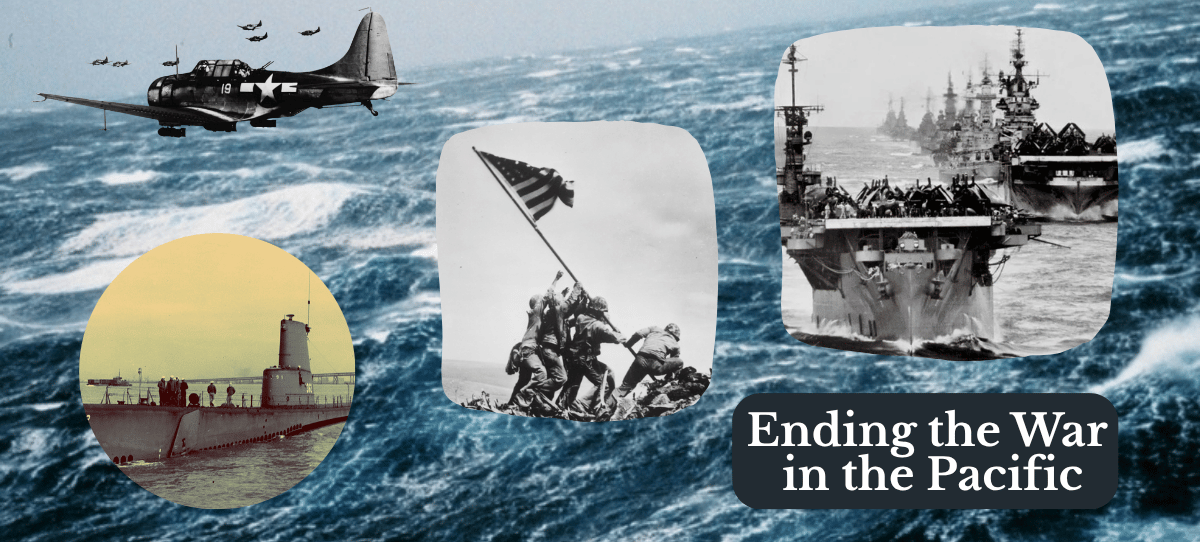
During the early 1945 the war in the Pacific was inexorably drawing closer to the Japanese home islands. There were two major campaigns that were initiated in the Winter and early Spring:
- Iwo Jima (Feb 19 – Mar 26, 1945)
- Okinawa (Apr – Jun 1945)
Each of these campaigns were within range of Japanese aviation forces based on Kyushu and Honshu. A critical element of the above campaigns was the suppression of those aviation forces. That work fell to the U.S. Navy.
The Navy, freed from most major fleet engagements after the Philippine Sea and Leyte Gulf, shifted to directly attacking the Japanese homeland with multiple purposes in mind: suppression of aviation support for Okinawa and Iwo Jima; damage to industrial facilities, disruption of coastal shipping; elimination of the remnants of Japan’s Combined Fleet; disruption of rail-ferry links between Hokkaido and Honshu; cutting a key source of food shipments; disruption of the rail supply system leading from the Tokyo industrial area southward toward Kyushu and; presenting to the Japanese people that the Allied Forces could strike at will.
In February 1945 the first major aircraft raids were conducted in the Tokyo area. The objective was to neutralize Japanese air power prior to the Iwo Jima landings. Carrier aircraft from Task Force 58 struck Tokyo, Yokosuka, and nearby airfields, shipyards, and factories. Over 500 Japanese aircraft were destroyed (majority on the ground), some naval units damaged, including the carrier Amagi.
In the months following, US carriers pre-emptively struck Japan in preparation for the Okinawa landings. From April through June the US carriers supported the ongoing Okinawa operations by striking airfields in nearby Japan when necessary. Finally, by July 1945 Okinawa was secure and the full attention of the US and British fleets (carriers, battleships, cruisers and destroyers) could turn their attention to shore bombardment of Japan from Kyushu in the south to Hokkaido in the north with Honshu in between. While their reach was limited their accuracy was deadly. In late July the industrial and electronics-producing city of Hitachi was subject to shore bombardment. A key factory that had avoided destruction by air assault was level with four hits from the 16-inch guns of a US battleship.
While the July 1945 naval bombardment received little coverage, there are several key elements revealed regarding the state of the war in the Pacific:
- Naval ships (carriers, battleships, cruisers, etc.) could approach the coast with impunity. By way of analogy, Japan was a medieval castle under siege. Outside the “walls” the Allied forces were free to operate; inside there was nothing to do except endure
- At the same time, the Naval aviators and US Army Air Force bombers also operated without restriction.
- The Allied fleet was free to aggressively sweep Home Island waters searching for Japanese warships and merchantmen.
The primary focus of this undeterred bombardment from sea and air was focused on Operation Olympic, the invasion of Kyushu. Targets included:
- Pre-invasion bombardment of potential Kyushu landing beaches and the inland areas immediately adjacent to the beaches to begin the “softening” on the in-depth defense and on-going construction of the same.
- Japanese airfields and aircraft production sites in order to minimize the operational capacity and ability to mount kamikaze attacks during
- Transportation lines and hubs that would be used to supply/re-supply Kyushu (Japan was particularly dependent on coast shipping and railways as they had little to no developed roadways)
- Coastal shipping and merchants attempting to import supplies – including food – to Japan
At this point, by any effective measure, Japan was under an almost complete blockade. Only the Korea-Japan shipping channels were available and only under the cover of weather which limited the ability of the allies to find and track the merchants.
Image credit: various photographs from Naval Aviation Museum, National World War II Museum, and US Navy Archives.
Discover more from friarmusings
Subscribe to get the latest posts sent to your email.
 friarmusings