
Across military histories of the War in the Pacific the phrase “strategic bombing” is used and refers to B-29 Superfortresses flying out of the Mariana Islands (Saipan, Tinian, and Guam) and bombing the Japanese home islands of Honshu and Kyushu. Strategic bombing was an idea that grew out of the experience of air power in the First World War. Military theorists such as airpower advocates like the Italian Giulio Douhet, Britain’s Hugh Trenchard, and General William “Billy” Mitchell became influential in shaping the concept during the 1920s and 1930s. Douhet’s The Command of the Air (1921) and Mitchell’s Winged Defense (1925) became the starting point of thought and planning about the future of air warfare, strategic bombing in particular.
In Winged Defense Mitchell predicted that Japan would one day be America’s principal Pacific rival and that Tokyo itself could be struck by long-range strategic bombers launched from Pacific islands. His ideas were considered to be influential in a general way in the development of War Plan Orange but he was not personally involved in such planning. Nonetheless, the idea of strategic bombing had been planted.
Douhet’s and Mitchell’s books were essential to the course work and de facto “think tank” that was the Air Corps Tactical School (ACTS, Maxwell, AL). ACTS was notable as the birthplace of the Army Air Forces doctrine of daylight precision bombing. This doctrine held that a campaign of daylight air attacks against critical targets of a potential enemy’s industrial infrastructure, using long-range bombers heavily armed for self-defense, could defeat an enemy nation even though its army and navy remained intact.
Going beyond Mitchell’s ideas, ACTS developed a doctrine that heavily armed bombers could fight their way to industrial targets in daylight, unescorted by fighters, and with precision bombing defeat an enemy by destroying key war production targets, rather than engaging in costly and prolonged ground campaigns aimed at destroying enemy armies. While the theory was based on tenets of strategic airpower developed by Mitchell, Trenchard, and Douhet, it rejected the concept of terror-bombing of civil populations as a means of destroying the morale and coercing the will of an enemy state. Yet some of the theorizing about precision bombing of industry included incendiary attacks. It remained a “what if” of ACTS, with Tokyo in mind, but this was not incorporated into War Plan Orange itself. Orange assumed Japan would be defeated by blockade, naval attrition, and eventual fleet action—not by burning cities.
Nonetheless, several ACTS lectures and student papers identified Japan as especially susceptible to urban firebombing, because Japanese cities were densely populated with housing and factories largely built of wood and paper. In addition, because of the damage in the 1923 Kanto Earthquake-induced firestorm, Tokyo’s fire-fighting capabilities were thought to be limited. A 1938 lecture by Muir Fairchild (later USAF Vice Chief of Staff) emphasized that Japanese urban areas could be devastated by incendiary attacks and that civilian morale might collapse in the face of mass fires.
Haywood Hansell, in his ACTS work, also noted that incendiaries would be effective against Japanese targets. General Hansell (who later commanded the first phase of the strategic bombing of the home Japanese islands – Nov 44 to Jan 45) explicitly studied Japan’s urban vulnerability while still at ACTS. In that same period some ACTS documents created fire-damage models, predicting that a minimum of 20–30% of Tokyo could be destroyed in a single raid if incendiaries were used. Hanell was profoundly against the use of firebombing. During WW2, Hanell was replaced by Gen. Curtis LeMay who had no such qualms.
In 1941 the Air War Plans Division (AWPD) was formed whose task was to create plans for incorporating strategic bombing into war plans. The plans AWPD-1 thru 4 were increasingly detailed plans for bombing the German wartime economy. The AWPD plans were “field tested” in the European theater during World War II using the B-17 Flying Fortress bomber. Until the development of the B-29 Superfortress, strategic bombing of Japan was “theory only.” However, once deployed, strategic bombing of Japan’s home islands began in November 1944.
To give some context of the importance of the B-29 program, it was the most expensive military project of the war, costing more than twice the cost of the Manhattan Project that developed the atomic bomb. Planners saw the B-29s and strategic bombing of Japan as an absolutely critical element to the defeat of Imperial Japan.
The Advent of Incendiary Bombing
The U.S. firebombing of Japan in 1945 did not happen in a vacuum — it was influenced by both prewar theorizing and wartime experience in Europe. During the First World War, both allied and German forces had dropped small numbers of incendiary devices (e.g., German zeppelins carried firebombs over London), but with limited effect. During the 1930s, European airpower advocates Douhet and Trenchard argued that future wars would involve massive bombing of enemy cities to break military and civilian morale. Their influence led to testing of incendiaries by Germany, Italy, and Britain during the 1930s. During the Spanish Civil War, the German Luftwaffe’s Condor Legion and Italian Aviazione Legionaria bombed Guernica and Barcelona with high explosives and incendiaries, foreshadowing WWII tactics.
During WW2, Germany initiated air attacks against Britain, known as the Blitz with heavy use of incendiary bombs. On December 29, 1940 (“Second Great Fire of London”), thousands of incendiary devices set central London ablaze, nearly overwhelming firefighters. Tactically, the Luftwaffe used a mix: high explosives to break roofs and water mains, then incendiaries to ignite fires.
The British RAF retaliated in kind. Incendiary bombs became standard in night raids over Germany starting in 1940. By 1941, the British increasingly leaned toward area bombing, not precision.
Air Marshal Arthur “Bomber” Harris, who became British air commander in 1942, strongly supported incendiary bombing as a means to devastate German morale and industry. Incendiaries were central to massive bomber raids (e.g., Cologne, May 1942). In July 1943 Operation Gomorrah was directed against Hamburg. The combined RAF and USAAF raid ignited a massive firestorm, killing ~37,000 and destroying much of the city. This proved how devastating firebombing could be in dense, dry cities. While the US did not deploy incendiaries, their high explosive bombing contributed to the firestorm in the same way that deadwood and debris contribute to forest fires.
Perhaps the most controversial bombing was the Feb 1945 raid on Dresden. The firestorm created by RAF night incendiary raids followed by USAAF daylight non-incendiary bombing led to an estimated 25,000 to 35,000 deaths. Other cities badly hit by incendiaries included Kassel, Darmstadt, Würzburg, and Nuremberg.
U.S. planners studied the European results carefully. By 1943–44, tests at Dugway Proving Ground (Utah) using mock German and Japanese villages incorporated lessons from Hamburg and London.
Even before December 1941, the National Defense Research Committee (NDRC) was experimenting with incendiary devices, anticipating their possible wartime use. Research focused on two main types: magnesium-based thermite (burning at extremely high temperature) and jellied gasoline (napalm), developed in July 1942 at Harvard University. Initial U.S. designs were the M47 and M69 incendiary bombs, tested at proving grounds in the U.S. and at the RAF’s facilities in Britain. The M69, the most famous, was a small bomblet filled with napalm gel that ignited on impact and was designed to penetrate Japanese-style housing before igniting.
In 1943–1944 there was large-scale testing at Dugway where the Army built full-scale Japanese-style village mockups to test firebomb effectiveness. These tests confirmed that Japanese urban areas would burn catastrophically once hit with napalm clusters. By late 1944, stockpiles of incendiary munitions were being shipped to the Marianas to be used by the new B-29 Superfortresses.
The March 9-10 Tokyo firebombing (Operation Meetinghouse) marked the first full-scale deployment of napalm cluster bombs. The results were ~100,000 killed in one night with 16 square miles of Tokyo destroyed.
Strategic Bombing: Japan
As described in the previous post, Allied Bombing – The First Phase, the B-29s were designed to operate at and above 30,000 feet, well above the ability of effective anti-aircraft range and enemy fighter intercepts. However, high-altitude precision bombing was not possible due to Japanese weather (cloud cover) and the newly encountered jet stream above Japan. Pilots and bombardiers could not see targets and when they did, the jet stream winds scattered them – sometimes blowing them “backwards” into the ocean. The ineffectiveness of the high-level bombing with traditional high explosive (HE) weapons led directly to the firebombing campaign of 1945 described in the post Allied Firebombing.
Consider the historical context:
- It was only 25 years after the first world war and the advent of air power;
- In a short time the world had moved from strategic bombing as a theory in the inter-war period to the field test of the Spanish Civil War, into the increasingly wide-spread use of incendiary devices in WW2;
- In March of 1945 the end of the war in Europe was in view while the war in the Pacific seemed endless;
- The U.S. had a new weapon (napalm) that was seen as increasingly necessary in the island fights (e.g. Peliliu, Philippines, and Iwo Jima); and
- The Dugway Proving Grounds tests had shown napalm could be weaponized as a bomb.
Along the way, strategic bombing in Japan was no longer high altitude, inaccurate bombing with HE weapons. It became, over the night of March 9-10, low altitude, quite accurate bombing with incendiary M-69 bombs. The goal “destroying key war production targets” remained but demoralizing the civilian population became part of the objectives. “Demoralizing” included Douhet’s ideas of civilian deaths (not targeted but inevitable), destruction of homes and civil services, elimination of work places, etc. leading to civil disturbance.
What the allies did not anticipate, nor could the tests at Dugway predict because of their limited scale, was that firebombing would not be the simple burning of buildings in an area, but that the intensity of the bombing would lead to the conflagration known as a firestorm.
A firestorm is not just a big fire — it is a self-sustaining, hurricane-like fire system that develops when many simultaneous fires merge over a large area. Fires release so much heat that hot air rises rapidly, creating a huge vertical convection column. The rising column pulls in cooler air from all directions at hurricane speeds. The inflowing winds fan the flames, feeding them oxygen, while sparks and burning debris are carried ahead, igniting new areas. Once established, a firestorm can maintain or expand itself until all available fuel is consumed.
Temperatures can reach 1,400–1,800°F (760–980°C) — hot enough to melt glass, fuse asphalt, and incinerate human bodies. Survivors of the Tokyo firestorm reported being blown off their feet or sucked toward the inferno by high velocity winds. The winds also propelled fire across canals and open spaces that normally would have served as firebreaks.
A firestorm multiplies human casualties beyond the basic causes of a building fire. A firestorm also kills by asphyxiation as the inferno consumes oxygen so rapidly that people in basements and shelters suffocate. At the same time carbon monoxide levels rise, poisoning those trapped underground. The intensity of the fire leads to temperatures that are sufficiently high to cause instantaneous ignition of clothing and hair – and in extreme cases, the human body.
Tens of thousands fled into Tokyo’s canals and Sumida River seeking refuge. But water boiled in places, and superheated air suffocated those who tried to breathe near the surface.
A firestorm simply overwhelms fire fighting systems and infrastructure as pumps, water mains, and brigades are destroyed or choked off by collapsing neighborhoods. Civil defense shelters become death traps. Already built “fire breaks” become useless.
Planners always knew that Tokyo was highly susceptible to incendiary bombing given that over 80% of Tokyo’s housing was flammable wood-and-paper construction and the capital was densely populated. Planners did not understand the resulting firestorm’s devastation.
LeMay’s plan to bomb at 5,000 – 9,000 feet and at night was primarily based on achieving surprise and accuracy. The night time raid confused coastal watchers effectively eliminating advanced warnings, limited anti-aircraft effectiveness, and caught the Japanese fighter aircraft unprepared – the allies were thought to be daytime bombers only. The nighttime raid also found most people were at home asleep when the attack began. Air raid sirens sounded after the first wave of bombers had passed and the fires started. The scale of the fire was beyond comprehension — mass panic set in. Even seemingly rational choices: find an open field, get in the rivers, or find a civil defense shelter, made no difference. Most choices were fatal.
Tokyo was the first of the 62 Japanese cities that were firebombed.
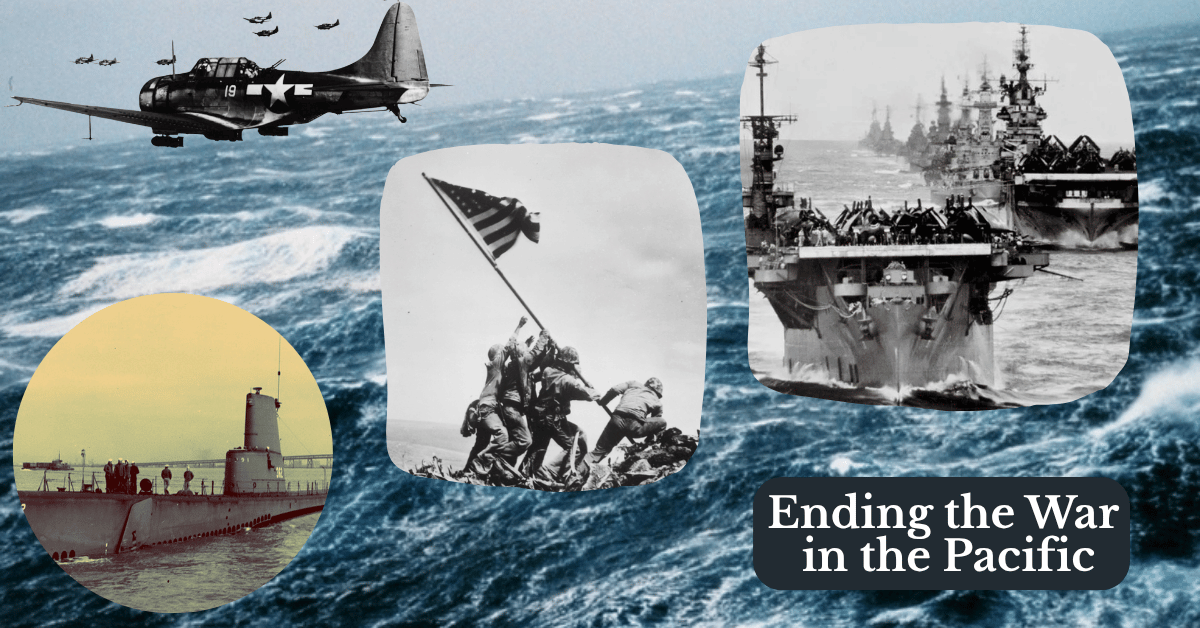
Image credit: various photographs from Naval Aviation Museum, National World War II Museum, and US Navy Archives.
Discover more from friarmusings
Subscribe to get the latest posts sent to your email.
 friarmusings