Two of the legendary warships of the modern Navy were commissioned on this day, 17 years apart. In 1937 the USS Enterprise (CV-6) – the “Big E” was commissioned at Newport News, VA. Enterprise was the only aircraft carrier to start and finish WWII – with a lot of bumps along the way.
The Big E participated in the Battle of Midway, the Battle of the Eastern Solomons, the Battle of the Santa Cruz Islands, various other air-sea engagements during the Guadalcanal campaign, the Battle of the Philippine Sea, and the Battle of Leyte Gulf. Enterprise earned 20 battle stars, the most for any U.S. warship in World War II, and was the most decorated U.S. ship of World War II.
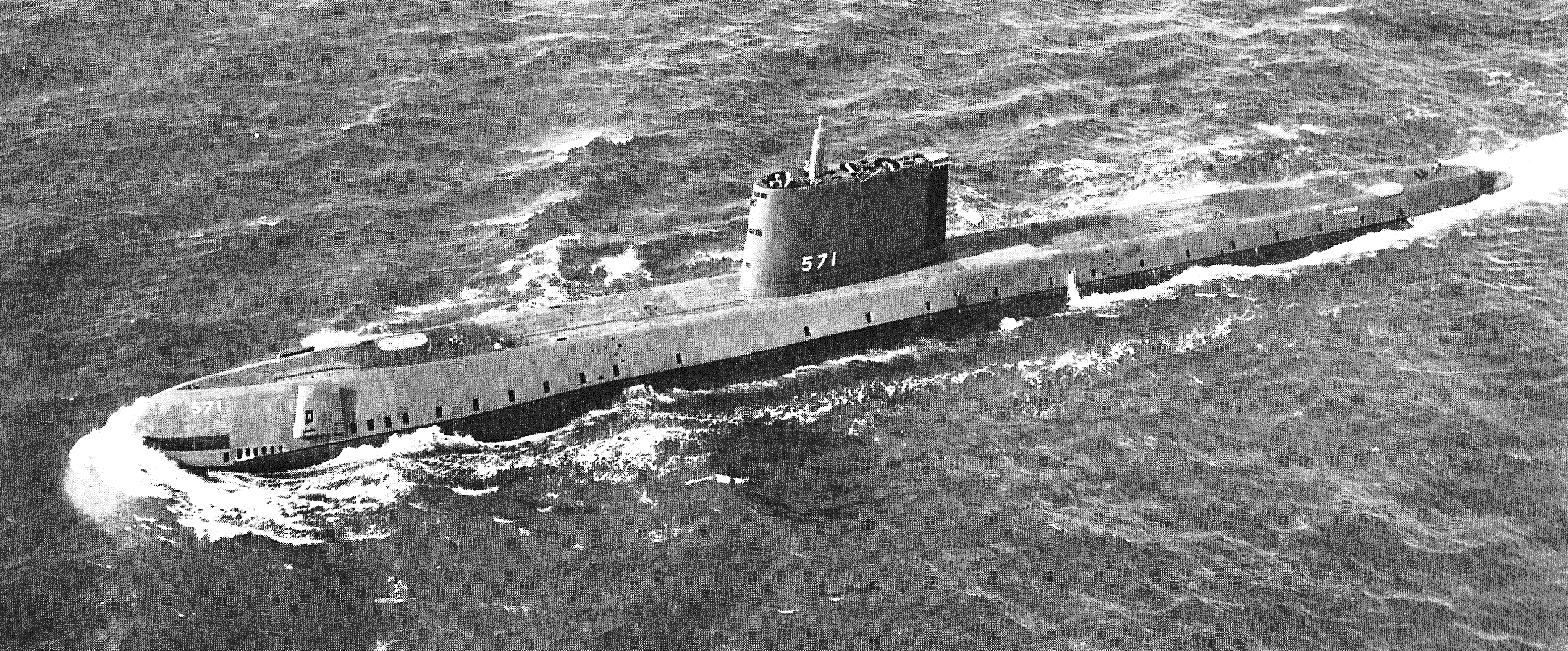
17 years later, the USS Nautilus (SSN-571) was commissioned as the first nuclear powered submarine. Constructed and commissioned at Electric Boat, Groton CN. Nautilus shares the name of the fictional submarine in Jules Verne’s classic 1870 science fiction novel “Twenty Thousand Leagues Under the Sea” and the USS Nautilus (SS-168) that served with distinction in World War II.
Nautilus was decommissioned in 1980 and designated a National Historic Landmark in 1982. She has been preserved as a museum ship at the Submarine Force Library and Museum in Groton, Connecticut, where she receives around 250,000 visitors per year. Sadly the “Big E” was sold for scrap metal.
When it became clear that the Mariana Islands (Saipan, Tinian and Guam) had been taken over by the Allies, the Imperial Japanese Army (IJA) Journal recorded: “We can no longer direct the war with any hope of success. The only course left is for Japan’s one hundred million people to sacrifice their lives by charging the enemy to make them lose the will to fight.” The Japanese military would implement that plan in the Special Attack Forces and would promote their sacrifice to the general population as a means of propaganda and to animate and reinforce the resolve of the Japanese people to be willing to sacrifice their lives for the Emperor.
The air battles at Philippine Sea in June 1944 decimated the Japanese Navy’s (IJN) aviation capability for aircraft carrier based operations. The IJN and IJA aviation units (planes and pilots) were further reduced by the air battles over Formosa (Taiwan) in October 1944. Between the two engagements, Japanese losses were approximately 800 planes and 900 airmen. The critical loss was skilled and experienced pilots. Japan’s aircraft production peaked at about 2,572 planes per month in September 1944, then began to decline from late 1944 into 1945 as strategic bombing increasingly disrupted output, though production hovered above 1,000 combat aircraft per month until mid‑1945. They could replace the planes more easily than the aviators.
At the start of WWII, Japan had 2,600 airplanes of all types. The average pilot had 500-700 flight hours. They reached a peak in January 1944 – approximately 5,600 planes and despite the 1944 losses, they began 1945 with some 4,100 planes. But by 1945 the average Army pilot had only 130 hours of flight time; a Japanese naval aviator had 275 hours on average. The net effect was an enfeebled air combat capability.
By late 1943 Japanese officers began to see the slow devolution of capability and began to advocate for organized suicide attacks. There was no consensus on the idea. On May 27, 1944 an Army pilot intentionally crashed into an allied ship (IJN Journal). Within a month, as Saipan was about to fall, Fleet Admiral Prince Hiroyasu (former chief of the Naval General Staff) openly spoke: “Both Army and Navy must think up some special weapons and conduct the war with them.” “Special weapons” was the Japanese euphemism for suicide weapons. Only a year before the idea had been rejected.
The first organized air kamikaze attack occurred on October 25, 1944 at the Battle of Leyte Gulf (Sommar) in the Philippines against Task Force Taffy 1 which consisted of escort carriers and destroyers. The Japanese force was led by Lt. Seki Yukio and Hiroshi Nishizawa, two of Japan’s premier naval aviators; each of the ace aviators. Eighteen kamikaze took off; six returned having failed to find a target – a common feature on such missions. The remaining dozen scored damaging hits on the escort carriers Santee and Kitkun Bay, killing 17, but sank the St. Lo leaving 114 dead.
Nishizawa’s role was observer. He returns to base and reports the great success of the mission. What was to that point an idea, now became a tactic. The experience at the Battle of Philippine Sea revealed two major advantages held by the US Fleet: aviation and anti-aircraft defense. By the summer of 1944, the US Navy had superior aircraft, better pilots, and superior numbers – all being controlled by the first Combat Information Center (CIC) that coordinated sorties, targets, and missions by integrating radar and message traffic. In 1942 “first detect” range was ~30 miles. By 1944 that range was extended to 100 miles making the first intercept miles away from the aircraft carriers. If they got past that gauntlet, the enemy pilots faced the next advantage.
By 1944 the carriers were protected by defense-in-depth from destroyers to light cruisers that were intentionally outfitted, not for ship-to-ship engagement, but for anti-aircraft (AA) defense. These ships were “armed to the teeth.” In addition, the VT fused shells (proximity weapons) increased the lethality 5-7 times. In 1942 the fleet was capable of firing 32,000 lb/minute in AA weapons fire. In 1944, with the advent of the VT-fused shells, the fleet was capable of effectively firing 575,000 lbs/min.
In a sad calculus of thinking, all the above made clear that a Japanese battle plan to mount a torpedo or dive bomb attack against the US Fleet was not likely to succeed and had an almost zero chance of the pilot returning. The conventional mission gave way to the reality of the one-way mission, now almost a given – and from this was born the battle plan of the divine wind, kamikaze.
What are we seeing?
For the survivors of Taffy 1’s ships they had to wonder what they had just seen. Were the pilots intentionally crashing into ships? Word spread rapidly through the 3rd Fleet. From Admiral to sailor all began to wonder how could these aviators were suddenly suicide bombers? What could possibly drive them? The answer to that question lay deep inside the military culture of Japan.
Kusunoki Masashige was a 14th-century samurai and retainer of Emperor Go-Daigo. He was known for his absolute loyalty to Emperor Go-Daigo during the struggle to overthrow the Kamakura shogunate. He was admired for his strategic brilliance, his defensive stand at Chihaya Castle, and—most famously—his willingness to obey the emperor’s command to fight a hopeless battle at Minatogawa (1336). Knowing he would die, Kusunoki went into battle anyway, sacrificing himself for imperial loyalty. He died in combat along with his brother and many of his men. Because of this, he came to be revered as the archetype of the loyal retainer who sacrifices himself for duty and country.
In the early 20th century, especially during the rise of State Shintō and Japanese militarism, Kusunoki was lionized as a national hero and portrayed as the embodiment of bushidō: selfless loyalty, obedience, and honor in death. A massive bronze statue of him, erected in 1900, stands in front of the Imperial Palace in Tokyo, symbolizing martial devotion to the emperor. By the 1930s and 40s, Kusunoki was the center piece and model of what it meant to be, not just in the Japanese military, but as a citizen of Japan. His story and his devotion to the Emperor was part of school textbooks and state propaganda. He was the personification of a Japanese person: a warrior who placed loyalty above life itself. His famous dying words lamenting “Would that I had seven lives to give for my country” (“Shichishō Hōkoku”). School children memorized his words and were repeatedly taught his story with his statue becoming a pilgrimage site.
Kusunoki gave a historical precedent that made the kamikaze sacrifice seem like part of a long Japanese tradition, not an aberration. By portraying suicide attacks as the modern version of Kusunoki’s doomed battle, leaders could frame the kamikaze not as desperate measures but as honorable continuity. “Seven lives for the emperor” became a rallying cry for the kamikaze pilots.
This was the ethos of the WW II Japanese military and citizenry. Now the aviators were urged to live and die in the same spirit. One need only search for internet images of kamikaze unit flyers. Most of them show young men in their aviator kits with samurai swords.
What the US sailors were seeing was the spirit of Kusunoki Masashige, not on horseback, but piloting lethal, ship-killing missiles.
Okinawa
On April 6, 1945, the first wave of ten coordinated kamikaze attacks began to hit the U.S. Navy’s Fifth Fleet off the coast of Okinawa. Ships in the Fifth Fleet had experienced suicide attacks before — but never on such a scale. The terrifying sight of Japanese pilots diving their planes into ships would become common over the next two and a half months. Aircraft carriers and battleships were supposed to be the main targets, but the ships that suffered the most damage were the destroyers and smaller vessels assigned to protect the fleet from incoming attacks. And as the war continued, troop ships, tankers, and supply ships were increasingly targeted.
From October 1944 until the end of the war, there were some 3,000 sorties flown. This resulted in the loss of 3,389 naval personnel. In total, by the end of July 1945 kamikaze attacks damaged 350 ships (including 30 aircraft carriers) and sank 47.
Invasion Planning and Threat of Kamikaze
According to the postwar Strategic Bombing Survey, Japanese airpower at the end of the was: 5,350 aircraft (combat, advanced trainers and primary trainers) assigned to Special Attack units with an additional 5,300 not yet assigned. In addition, there were another 7,200 aircraft in need of repair. Operationally there were as many as 10,000 available aircraft and some 18,000 pilots with at least 70 hours of flight experience. The survey also noted that there were 1 million barrels of aviation fuel on hand. The planned kamikaze missions were only expected to require 50,000 barrels.
Advanced planning for the coming allied invasion of Kyushu included suicide sorties in waves of 300 to 400 planes every hour with the primary targets being troop transports. This would be more kamikazes in three hours than sent against the Okinawa campaign in three months.
There would be a major difference between Okinawa and Kyushu. The Okinawa attacks required long flights over open water through rings of scouting places, radar picket ships, and combat air patrols. The waves of attacks were always seen in advance, weather/cloud cover permitting. The experience in the Philippines was different: shorter flights, ground clutter affecting radar, and other topographic factors lead to more stealth and thus surprise attacks. At Kyushu the troop transports would lay in conventional disposition close to the coast allowing the kamikaze to burst upon the scene with little warning.
That being said, ULTRA identified most of the kamikaze bases and these would be subject to advanced air attack. This was something that the Japanese realized and initiated new efforts of dispersal and concealment away from the base. They estimated that no more than 20% of aircraft would be destroyed on the ground prior to missions. In addition new production of suicide planes were wood construction: easy to move, shorter runways needed, not easily detected by radar, and far less vulnerable to the proximity fused antiaircraft shell.
Clearly, the airborne kamikaze attacks were a significant threat to lives and shipping. But these were not the only Special Attack units. Other units/means included:
Shinyo – Suicide Motorboats. Small, fast, one-man boats packed with 250–300 kg of explosives in the bow. Around 6,000 were built.
Kaiten – Manned Suicide Torpedoes. These were modified Type 93 “Long Lance” torpedoes with a cockpit for a pilot. The unit was launched from submarines with the pilot guiding the weapon to its target. They had limited success but were responsible for sinking the USS Mississinewa (AO-59) in November 1944.
Ohka (“Cherry Blossom”) – Rocket-Powered Manned Bomb. Small, rocket-propelled glide bomb carried under a bomber, piloted by a kamikaze. The Ohka was to be released near the target to glide/rocket into a ship at high speed.Used mainly in 1945, especially against US ships off Okinawa.
Fukuryu and Maru Dai – both were “frogmen” with either explosive packages or mines to attach to ships.
This all indicates the extent of the June 1944 decision to develop “special weapons.”
That is the mindset and future facing Kyushu invasion planners. What follows is the experience of those who survived kamikaze attacks.
Shipboard perspective (Source: PBS – American Experience: Victory in the Pacific, “Kamikaze”)
One such destroyer was the U.S.S. Newcomb. The Newcomb had seen combat before, at the Mariana Islands, Peleliu, Palau and in the Philippines. But it was at Okinawa that she would fight her fiercest battle. On board the destroyer was 21-year-old John Chapman, a First Class Boatswains Mate, and gun captain of a five-inch gun. Facing enemy pilots willing to give their lives to sink his ship struck him as almost incomprehensible.
“It didn’t make you feel good. I don’t know whether that’s ‘terrified’ or not, but it didn’t make you feel too well because of it, knowing that people would do a thing like that. You know, people we had always known weren’t like that. They were brave people and so forth, and they fight, but weren’t someone to just deliberately take their lives to take yours.”
Watching Kamikazes Attack. More than 300 kamikazes departed Southern Kyushu on April 6. Their target was the U.S. Fifth Fleet stationed in support of the battle being waged on Okinawa. As the Japanese pilots approached, they broke off into smaller attack groups. John Chapman was at his gun post at the stern of the U.S.S. Newcomb.
“There was probably 45 planes in the air. Well, it was a scary situation, because you knew that they were going to dive on you. You could be firing on the aircraft, and they’d come right on, just keep coming right on through that. And you’d see pieces flying over the planes and everything else, and they’d just keep right on a-coming.”
A Roaring Inferno. The Newcomb shot down four enemy planes. Five others hit the ship. Those on board who were not killed or injured fought desperately not only to put out the raging fires and repair damaged engines, but also to keep firing at an enemy dead set on sinking them. The scene aboard the Newcomb was repeated on many vessels of the fleet that day.
“It was hot. The fires were just raging totally out of control. Between the bridge and the afterdeck house, that’s a big percent of the ship. It was nothing but a roaring inferno. The flames were shooting. They said [it] was high as 1,000 feet in the air off the Newcomb.”
Overboard. Firefighters battling the raging fires forced John Chapman and an injured friend to jump overboard. There was no space left for them on the stern to remain. Chapman handed his life belt to the injured friend and, once in the water, towed him to the safety of a lifeboat. They were later rescued along with many others in the waters off Okinawa.
Aftermath. Ninety-one sailors were killed or wounded on the U.S.S. Newcomb. Many of those who were injured suffered devastating burns. But despite suffering at the hands of the five kamikazes, the crew of the Newcomb kept their vessel afloat and earned the Navy Unit Commendation and eight battle stars for World War II service. John Chapman would earn a bronze star for his service; years later, his view of his heroism is clear-eyed:
“People try to glorify wars and so forth. There’s people that do outstanding things, but there’s nothing really glorious about a war. You do wars to protect your country if you have to, and that’s the only time you should ever do it.”
Terrible Naval Losses. Nine more waves of kamikaze attacks hit the fleet off of Okinawa before the battle came to an end. Almost 2,000 Japanese pilots would willingly lose their lives in these attacks.
By late June 1945, close to 5,000 U.S. sailors had been killed and 5,000 more wounded by the Japanese suicide pilots. Thirty ships had been sunk and almost 400 others were damaged. The attack on the Fifth Fleet off Okinawa would mark the worst losses of World War II for the U.S. Navy.
1 He said to his disciples, “Things that cause sin will inevitably occur, but woe to the person through whom they occur. 2 It would be better for him if a millstone were put around his neck and he be thrown into the sea than for him to cause one of these little ones to sin. (Luke 17)
These two sayings are connected by the words skandala (v. 1) and skandalizo (v. 2). The original meaning of this word group skandal- was “trap;” or, more specifically a trap’s tripping mechanism. The word group is used to translate the Hebrew próskomma, meaningboth “trap”, “stumbling block” or, “cause of ruin.” In the latter sense, this transferred to the religious setting to mean “cause of sin.” But is “cause of sin” the best translation here? Paul says that “Christ crucified is a stumbling block (skándalon)to the Jews” (1 Cor 1:23) and also describes the cross as a stumbling block (skándalon) (Galatians 5:11). Consider three other modern gospel translations, all noted for faithful adherence to translation.



 friarmusings