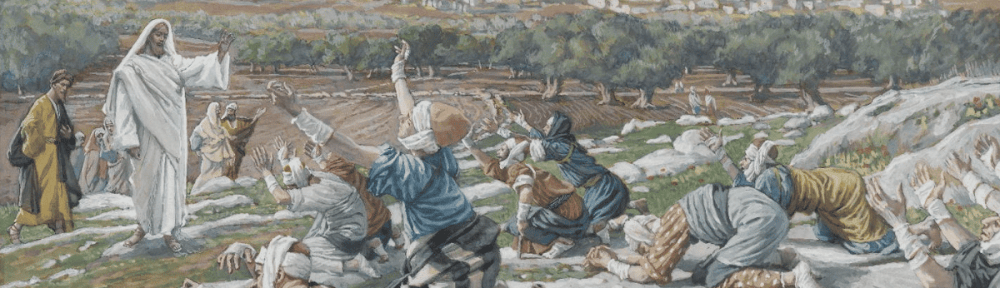
This coming Sunday is the 28th Sunday in Year C with the gospel taken from Luke 17. The narrative of the Journey to Jerusalem (begun in Luke 9:51) returns; new characters are introduced – ten lepers – the disciples play no role in this story. For a brief moment the on-going theme of forming discipleship seemingly takes a backseat, as the accent is upon God’s mercy and salvation. Several commentators hold that this account marks a new turn in Luke’s telling of the gospel moving from an accent on discipleship to the larger theme of “Responding to the Kingdom” as the cleansing of lepers is taken as a sign of the in-breaking of the Kingdom.
This story is only in Luke. (While at first glance Mark 1:40-45 may appear parallel to our passage, it is considered parallel to Luke 5:12-16.) Culpepper notes that there are two instances of seeing that serve a lynchpins to the narrative:
- And when he [Jesus] saw them (v.14)
- And one of them, realizing he had been healed (v.15) – the word translated as “realizing” is idōn whose primary meaning is to literally “see” in a way that leads to insight and perception.
“Seeing” has already played a role in the Gospel according to Luke. Jesus blesses those who see and hear (especially 10:24). Strictly speaking, both references to seeing in this story are, strictly speaking, unnecessary to its telling – yet Luke uses the words. What is clear is that when Jesus sees their need, he responds to it. While the center of attention of the story is the miraculous healing, it is not the central event of the story. I would suggest the central event is when the one leper sees that he has been healed and recognizes that the healing was the work of God through Jesus. Both acts of seeing lead to “doing” or perhaps better said, to a response – a response of faith and of gratitude.
In returning to the journey narrative, the placement of the periscope is most appropriate since one would only expect to encounter lepers on the road. According to the Law, persons with a leprous disease were required to live “outside the camp” (Num 5:2-3) and cry out “Unclean, unclean” whenever anyone approached (Lev 13:45-56). The other details are realistic. Lepers tended to live in groups (2 Kings 7:3), they avoided contact with non-lepers (Luke 17:12; Num. 5:2), but they stayed near populated areas to beg for alms. Such was their life until a priest could certify healings (Lev. 14:2-32). Yet there are no OT occurrences of an Israelite being healed of leprosy.
The story of the grateful Samaritan leper evokes the OT story of the healing of Naaman, a foreigner who had suffered from leprosy (2 Kings 5:1–19). The reference seems clear given several common elements: the characterization of Naaman and the Samaritan as lepers and as foreigners, the Samaritan location, the communication from a distance, the delayed cleansing (after leaving the healer), the return of the healed leper, praise from the healed leper, and thanksgiving. The point of the periscope is both Christological and theological: the story underscores again the connection between Jesus and God’s prophets in the Scriptures, and it emphasizes that not only do Israelites receive the benefits of salvation, but foreigners do as well. In this way the reader is prepared for the next section of Luke when the references to the Kingdom of God are clear and direct.
Yet the account is more than a simple healing miracle. In the immediate context, the lesson of gratitude complements the parable of the unworthy servant (16:1-13) and reemphasizes the disciple’s duty to compassion and mercy as seen in the parable of the Good Samaritan: “ ‘Which of these three, in your opinion, was neighbor to the robbers’ victim?’ He answered, ‘The one who treated him with mercy.’ Jesus said to him, ‘Go and do likewise.’” (10:36-37). As in that parable, so too here, part of the lesson is that one can never repay God’s mercy, but one can respond to God’s mercy.
Image credit: Jesus Healing Ten Lepers | James Tissot, 1886 | Brooklyn Museum | PD-US
Discover more from friarmusings
Subscribe to get the latest posts sent to your email.
 friarmusings